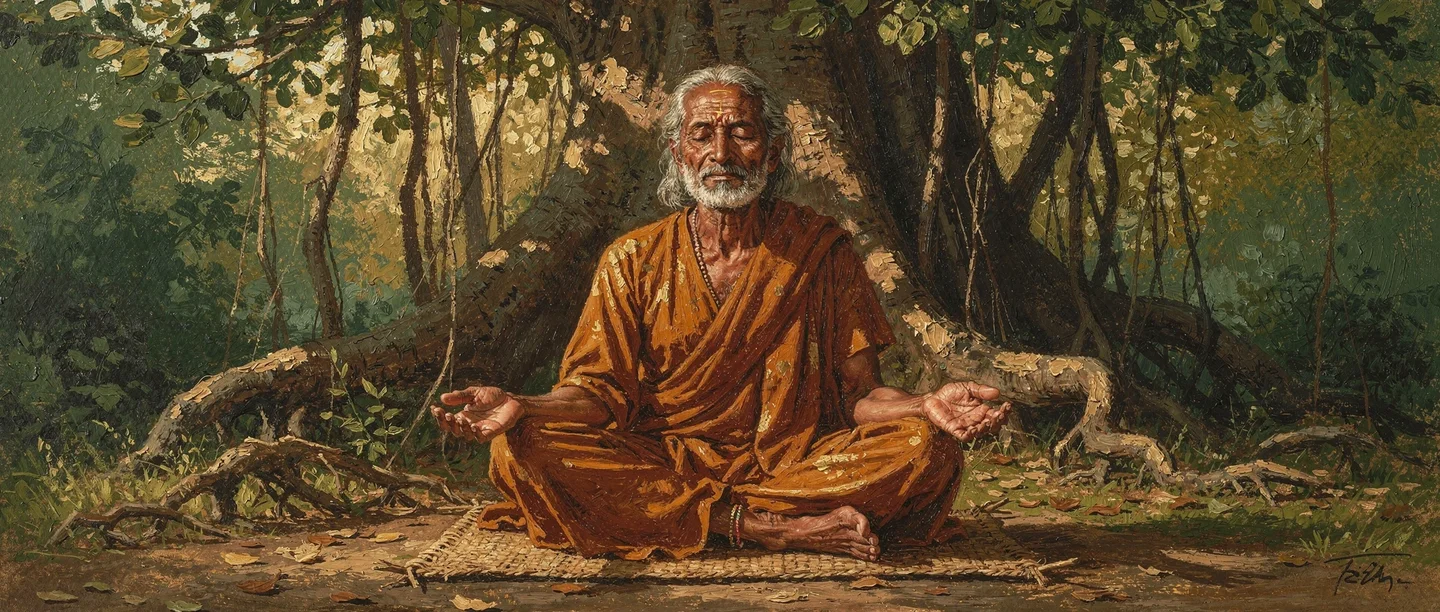
The foundations: Vedas and Upanishads
Hindu philosophy begins with the Vedas, a collection of sacred texts composed in Sanskrit between roughly 1500 and 500 BCE. These texts contain hymns, rituals, and early reflections on the nature of reality. However, it is the Upanishads, composed later as philosophical commentaries, that form the true foundation of Hindu philosophical thought.
The Upanishads ask fundamental questions. What is the nature of the self? What is ultimate reality? How should a person live? As a result, two concepts introduced in these texts became central to all later Hindu philosophy: Brahman and Atman.
Brahman refers to the ultimate, unchanging reality underlying the entire universe. In contrast, Atman refers to the individual self or soul. The Upanishads explore the relationship between these two, with some passages declaring them identical: "Tat tvam asi" ("You are that"). Consequently, this idea became one of the most influential claims in the history of philosophy.
Alongside these metaphysical ideas, the Upanishads introduced other concepts that remain central to Hindu thought. For instance, karma describes the moral law of cause and effect: actions produce consequences that extend across lifetimes. Similarly, samsara is the cycle of birth, death, and rebirth. And moksha is liberation from this cycle, the highest goal of human existence.
The six orthodox schools of Hindu philosophy
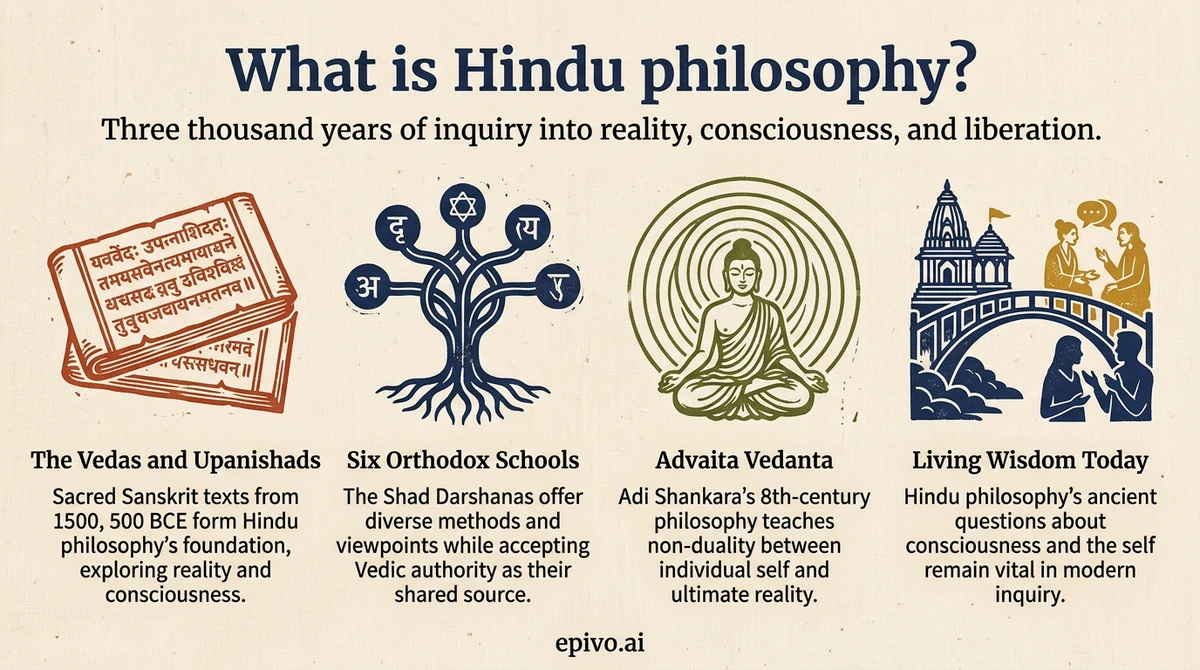
Classical Hindu philosophy is traditionally organised into six orthodox schools, called the Shad Darshanas. Although each accepts the authority of the Vedas, they differ significantly in method and focus. Together, they cover logic, metaphysics, ethics, cosmology, and spiritual practice.
Nyaya and Vaisheshika
First, Nyaya focuses on logic and epistemology, developing rigorous methods for valid reasoning. Meanwhile, Vaisheshika complements it with an atomic theory of matter, arguing that the physical world is composed of indivisible particles. These two schools are often studied together because they share a realist worldview.
Samkhya and Yoga
Second, Samkhya offers a dualist metaphysics, distinguishing between consciousness (purusha) and matter (prakriti). It maps out the evolution of the material world from a single source. Furthermore, Yoga, closely linked to Samkhya, provides the practical discipline for achieving liberation. The Yoga Sutras of Patanjali outline an eightfold path of ethical conduct, meditation, and self-knowledge.
Mimamsa and Vedanta
Finally, Mimamsa examines Vedic ritual and duty, emphasising correct action (dharma) as the path to a good life. Vedanta, by contrast, focuses on the philosophical content of the Upanishads. As a result, Vedanta became the most influential school, splitting into several sub-schools with competing interpretations of Brahman and Atman.
Image: Generated with AI (Epivo)
Advaita Vedanta and later developments
Among the Vedanta sub-schools, Advaita Vedanta is the most widely known. Developed by the philosopher Adi Shankara in the 8th century CE, Advaita teaches non-dualism: Brahman alone is real, the world as we perceive it is an appearance (maya), and the individual self is identical with Brahman.
In essence, Shankara argued that ignorance (avidya) causes us to mistake the world of change for ultimate reality. Through philosophical inquiry and meditation, a person can overcome this ignorance. As a result, they realise their true nature, which constitutes moksha.
However, not all Vedanta philosophers agreed with Shankara. For example, Ramanuja in the 11th century developed Vishishtadvaita (qualified non-dualism), arguing that individual souls and the world are real, though dependent on Brahman. Similarly, Madhva developed Dvaita (dualism), insisting that God, souls, and the world are fundamentally distinct.
Moreover, these debates were not merely academic. They shaped religious practice across India for centuries. In particular, the Bhakti movement, which flourished from the 7th century onwards, emphasised personal devotion to God as a path to liberation. Bhakti poets like Mirabai, Kabir, and Tukaram challenged caste boundaries. Consequently, they made philosophical ideas accessible to ordinary people through song and poetry.
Image: Generated with AI (Epivo)
Did you know?
-
The Rigveda, the oldest of the four Vedas, is among the oldest religious texts still in use today, with portions dating to approximately 1500 BCE.
Encyclopaedia Britannica — Rigveda -
The Yoga Sutras of Patanjali, composed around the 2nd century CE, contain 196 aphorisms that remain the foundational text for yoga philosophy and practice worldwide.
Internet Encyclopedia of Philosophy — Yoga -
Adi Shankara is believed to have established four monasteries (mathas) across India before the age of 32, which continue to function as centres of Vedanta learning today.
Stanford Encyclopedia of Philosophy — Shankara
Why Hindu philosophy matters today
Hindu philosophy is not a museum piece. Indeed, its questions about consciousness, the nature of the self, and the relationship between the individual and the cosmos remain active in both Eastern and Western thought.
For instance, concepts like dharma (righteous duty), ahimsa (non-violence), and karma have entered global vocabulary. Mahatma Gandhi drew heavily on Hindu philosophical ideas when developing his philosophy of non-violent resistance. As a result, his work influenced civil rights movements around the world. Likewise, contemporary discussions about mindfulness and meditation owe a significant debt to Hindu traditions, particularly Yoga and Vedanta.
For students, engaging with Hindu philosophy offers several benefits. First, it develops critical thinking: the tradition's internal debates demonstrate that genuine intellectual diversity has ancient roots. Second, it builds cultural understanding: over a billion people today draw on these ideas in their daily lives and spiritual practices.
Finally, Hindu philosophy challenges the assumption that serious philosophical thought originated exclusively in ancient Greece. The Indian tradition developed sophisticated theories of logic, language, and epistemology independently. In some areas, notably the philosophy of consciousness, its contributions remain unmatched.
Image: Generated with AI (Epivo)
Frequently asked questions
- Is Hindu philosophy the same as Hinduism?
- Not exactly. Hinduism is a broad religious and cultural tradition. Hindu philosophy refers specifically to the systematic schools of thought that emerged within this tradition. Some Hindu philosophical schools focus on logic or metaphysics rather than worship or ritual.
- What is the difference between Brahman and Atman?
- Brahman is the ultimate reality underlying the universe. Atman is the individual self or soul. Different schools disagree about their relationship. Advaita Vedanta says they are identical. Dvaita Vedanta says they are permanently distinct.
- What does karma mean in Hindu philosophy?
- Karma is the principle that every action produces consequences, both in this life and in future lives. Good actions lead to positive outcomes. Harmful actions lead to suffering. Karma is closely tied to the cycle of rebirth (samsara).
- What is moksha?
- Moksha is liberation from the cycle of birth, death, and rebirth. It is considered the highest goal in Hindu philosophy. Different schools describe it differently: as unity with Brahman, as the soul's eternal freedom, or as dwelling with God.
- How many schools of Hindu philosophy are there?
- There are six orthodox schools (astika), which accept Vedic authority: Nyaya, Vaisheshika, Samkhya, Yoga, Mimamsa, and Vedanta. Several heterodox schools (nastika), including Buddhism and Jainism, also emerged from the same intellectual tradition.
- Who was Adi Shankara?
- Adi Shankara was an 8th-century Indian philosopher who systematised Advaita Vedanta, the most influential school of Hindu philosophy. He argued that only Brahman is ultimately real and that the individual self is identical with Brahman.