
The Origins of Stoic Philosophy
Stoicism was founded by Zeno of Citium around 300 BCE in Athens. Zeno began teaching on a painted porch — the Stoa Poikile — which gave the philosophy its name.
Zeno was a merchant from Cyprus who lost his fortune in a shipwreck. According to the ancient biographer Diogenes Laertius, he arrived in Athens with nothing and wandered into a bookshop, where he read about Socrates. Inspired, he began studying philosophy and eventually developed his own system of thought.
Stoicism grew out of the rich tradition of ancient Greek inquiry. It built on ideas from Socrates and the Cynics, but developed a comprehensive framework covering logic, physics, and ethics. Zeno's successors — Cleanthes and Chrysippus — refined and expanded the system. Chrysippus alone reportedly wrote over 700 works, making him one of the most prolific philosophers of the ancient world.
The Stoics divided philosophy into three connected parts. Logic taught clear thinking and valid argument. Physics explored the natural world and humanity's place within it. Ethics — the most well-known branch — addressed how to live a good life. For the Stoics, these three disciplines were inseparable: you could not live well without understanding reality, and you could not understand reality without thinking clearly.
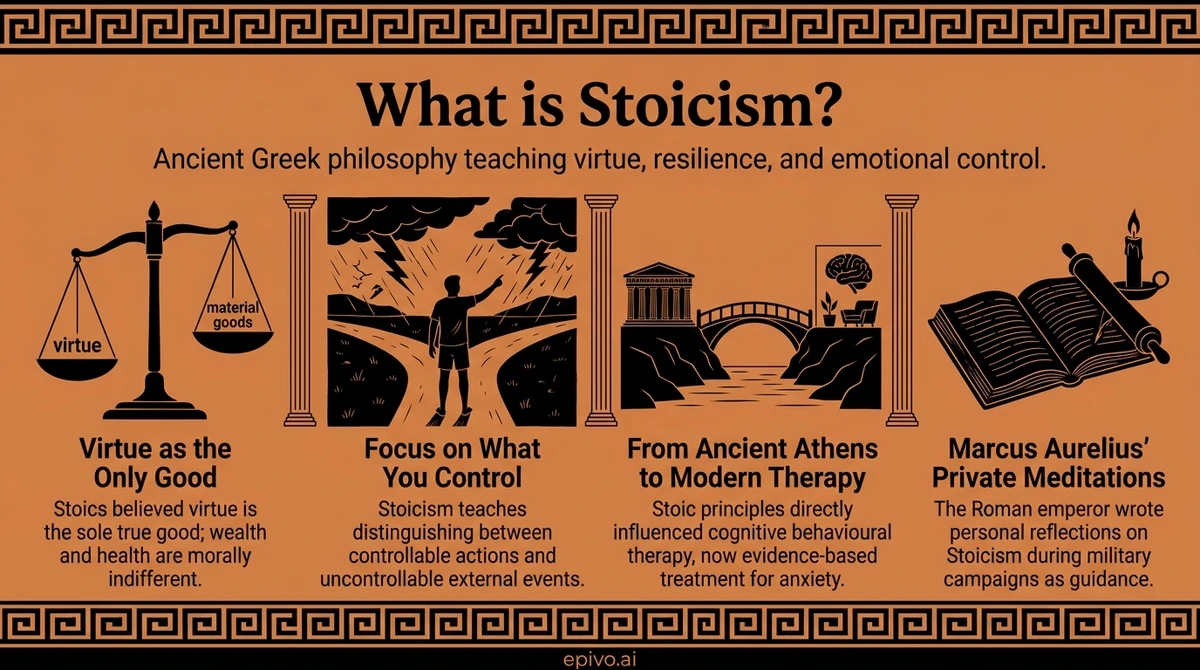
What did the Stoics believe?
The Stoics believed that virtue is the only true good, and that everything else — wealth, health, reputation — is ultimately indifferent. This does not mean Stoics rejected comfort. It means they refused to let external circumstances determine their happiness.
The dichotomy of control
The most famous Stoic idea is the dichotomy of control. Epictetus, a former slave who became one of the greatest Stoic teachers, put it plainly: 'Some things are within our power, while others are not.' Our judgements, intentions, and actions are within our control. Other people's behaviour, natural disasters, and illness are not.
This principle is deceptively simple but remarkably powerful. By focusing energy on what they can influence and accepting what they cannot, Stoics aimed to achieve a state of inner tranquillity the Greeks called ataraxia.
Living according to nature
The Stoics taught that humans should live 'according to nature.' By this they meant living in accordance with reason — our distinctive capacity as human beings. Since reason connects us to other people, Stoic ethics emphasised duty to the community, justice, and treating others fairly. Marcus Aurelius, the Roman emperor and Stoic philosopher, wrote that human beings exist for one another: 'to teach or to tolerate.'

Image: Generated with AI (Epivo)
Key Stoic Thinkers
Stoicism produced remarkable thinkers across six centuries and two civilisations. Four figures stand out for their lasting influence.
Seneca (c. 4 BCE – 65 CE)
Seneca was a Roman statesman, playwright, and tutor to the emperor Nero. His letters and essays offer practical advice on anger, grief, and the shortness of life. His writing is accessible and vivid. 'We suffer more in imagination than in reality,' he observed — a principle that modern psychology has confirmed.
Epictetus (c. 50 – 135 CE)
Born into slavery, Epictetus gained his freedom and founded a school in Greece. His Discourses and the Enchiridion (Handbook) focus on what we can and cannot control. His teachings influenced military resilience training and cognitive therapy.
Marcus Aurelius (121 – 180 CE)
Marcus Aurelius was Roman emperor from 161 to 180 CE. His private journal, known as the Meditations, was never intended for publication. It records his attempts to apply Stoic principles while managing an empire, fighting wars, and enduring personal loss. The Meditations is one of the most widely read works of philosophy in history.
Together, these thinkers show that Stoicism was practised across every level of society — from enslaved people to emperors.

Image: Generated with AI (Epivo)
Why Stoicism Still Matters Today
Stoicism has experienced a significant revival in the 21st century. Its practical approach to emotional resilience resonates with people navigating uncertainty, stress, and information overload.
Cognitive behavioural therapy
Aaron Beck and Albert Ellis, the founders of cognitive behavioural therapy (CBT), acknowledged that their approach drew directly from Stoic philosophy. CBT's core idea — that our emotional distress comes not from events themselves but from our judgements about them — is a restatement of Epictetus. According to the Beck Institute, this Stoic insight remains foundational to modern therapeutic practice.
Modern self-help and leadership
Stoic ideas have entered mainstream culture through bestselling books by Ryan Holiday, Massimo Pigliucci, and others. Military organisations, athletic programmes, and business leaders use Stoic principles to build mental toughness and ethical decision-making.
The Enlightenment philosophers Descartes and Spinoza were also influenced by Stoic ideas about reason, self-mastery, and natural law. In this way, Stoicism helped shape the intellectual foundations of the modern world.
For students, Stoicism offers a framework for managing exam stress, dealing with setbacks, and building self-discipline. Its emphasis on personal responsibility and clear thinking is relevant across every stage of education.

Image: Generated with AI (Epivo)
Did you know?
-
Stoicism was founded by Zeno of Citium around 300 BCE in Athens. The name comes from the Stoa Poikile (Painted Porch), where Zeno taught his students.
Stanford Encyclopedia of Philosophy — Stoicism -
Marcus Aurelius' Meditations was written in Greek as a private journal during military campaigns. It was never intended for publication and has been in continuous print since the 16th century.
Internet Encyclopedia of Philosophy — Marcus Aurelius -
Cognitive behavioural therapy (CBT), one of the most evidence-based treatments for anxiety and depression, was directly inspired by Stoic philosophy — particularly the teachings of Epictetus.
Beck Institute — History of CBT
Frequently asked questions
- What is Stoicism in simple terms?
- Stoicism is a philosophy that teaches people to focus on what they can control, practise virtue, and remain calm during difficulties. It was founded in ancient Greece and later adopted by Romans including Seneca, Epictetus, and the emperor Marcus Aurelius.
- Does Stoicism mean suppressing emotions?
- No. Stoics do not aim to eliminate emotions. They distinguish between harmful emotional reactions based on false judgements and healthy responses grounded in reason. The goal is emotional clarity, not emotional numbness.
- Who were the most famous Stoics?
- The most influential Stoics were Zeno of Citium (the founder), Seneca (Roman statesman and writer), Epictetus (a formerly enslaved teacher), and Marcus Aurelius (Roman emperor and author of the Meditations).
- How is Stoicism connected to CBT?
- Cognitive behavioural therapy draws on the Stoic principle that our distress comes from our interpretations of events rather than the events themselves. Both the founders of CBT, Aaron Beck and Albert Ellis, cited Epictetus as a direct influence.
- Is Stoicism a religion?
- Stoicism is a philosophy, not a religion. It does not require belief in any particular god. Ancient Stoics believed in a rational order to the universe, but modern practitioners often adopt Stoic ethics without any specific theological commitment.