What is Sufism and where did it come from?
Sufism emerged in the early centuries of Islam as a spiritual response to the growing worldliness of Muslim societies. While Islamic law (sharia) governed outward behaviour, Sufis sought to cultivate the inner life — the purification of the heart and a direct, personal relationship with God.
Origins and early development
The roots of Sufism lie in the Quran and the example of the Prophet Muhammad, whose contemplative practices inspired early Muslim ascetics. In the 8th century, figures like Hasan al-Basri (642–728) emphasised renunciation and constant awareness of God. The word 'Sufi' likely derives from suf (wool), referring to the simple garments worn by early ascetics.
Rabia al-Adawiyya (c. 717–801), a formerly enslaved woman from Basra, transformed early Sufism by introducing the concept of pure, selfless love for God — love that seeks neither reward in paradise nor escape from hell.
From asceticism to philosophy
Over time, Sufism developed from individual asceticism into a sophisticated philosophical tradition with its own vocabulary and institutions. By the 10th century, Sufi thinkers had mapped the spiritual journey — stages (maqamat) and states (ahwal) through which the seeker progresses toward God.
Key concepts in Sufism
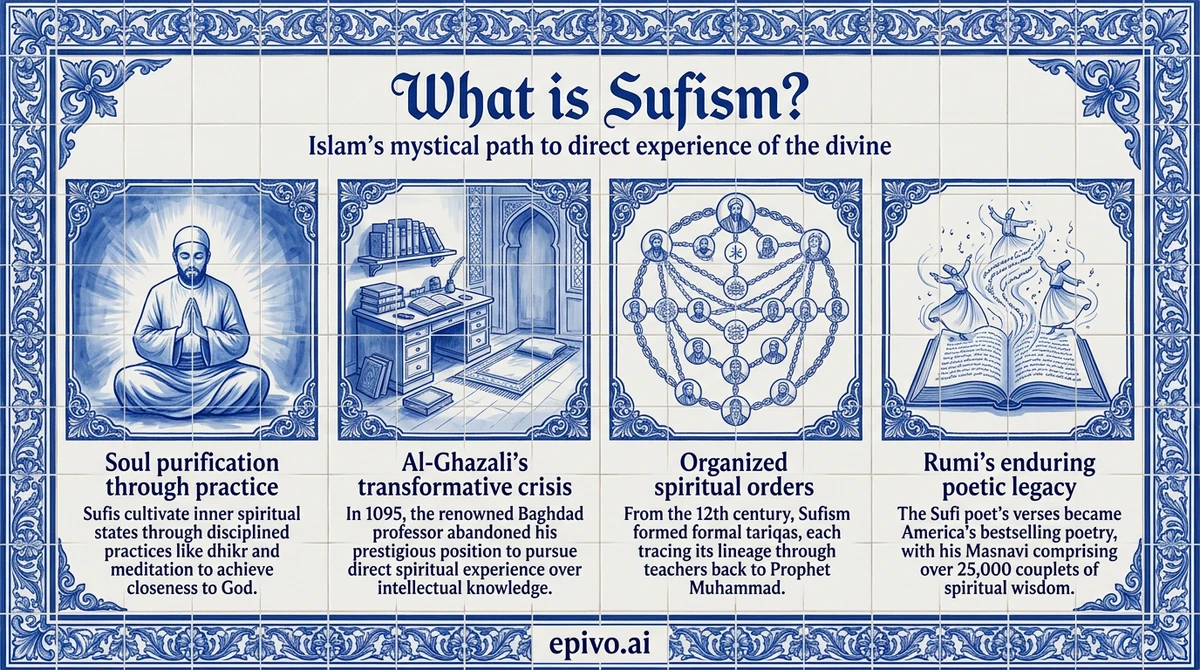
Sufism developed a rich vocabulary of spiritual concepts that describe the seeker's journey toward God. These ideas remain central to Sufi practice and thought today.
The tariqa: the spiritual path
The word tariqa means 'path' or 'way.' In Sufism, it refers to the spiritual method a seeker follows under the guidance of a teacher (shaykh or murshid). The relationship between teacher and student is considered essential — the path cannot be walked alone.
Dhikr: remembrance of God
The most characteristic Sufi practice is dhikr — the repetitive remembrance or invocation of God's names. This may be performed silently or aloud, individually or in groups, sometimes accompanied by rhythmic breathing, movement, or music. Dhikr is both a meditation technique and an act of worship. Its purpose is to quiet the ego and open the heart to divine presence.
Fana and baqa: annihilation and subsistence
Fana describes the annihilation or dissolution of the individual ego in the experience of God. It is not the destruction of the self but the transcendence of selfish desires and attachments. Baqa — subsistence — is the state that follows, in which the seeker returns to the world transformed, acting with wisdom and compassion while remaining inwardly connected to God.
According to the Encyclopædia Britannica, these stages of spiritual development remain central to Sufi practice worldwide. They also connect Sufism to broader questions explored across Islamic philosophy, particularly debates about the nature of the self, knowledge, and reality.
Image: Generated with AI (Epivo)
Great Sufi thinkers and poets
Sufism produced some of the most influential philosophers, theologians, and poets in world history.
Al-Ghazali (1058–1111)
Abu Hamid al-Ghazali was one of the most important Muslim intellectuals of any era. A brilliant scholar of law and theology, he experienced a spiritual crisis in 1095 that led him to abandon his prestigious teaching position in Baghdad. After years of Sufi practice and wandering, he wrote The Revival of the Religious Sciences, which integrated Sufi spirituality with mainstream Islamic scholarship. Al-Ghazali made Sufism respectable within orthodox Islam — a synthesis that shaped the tradition for centuries.
Ibn Arabi (1165–1240)
Muhyiddin Ibn Arabi, born in Moorish Spain, developed the most philosophically complex expression of Sufi thought. His concept of wahdat al-wujud (the unity of being) proposed that all existence is a manifestation of a single divine reality. His influence extends across Islamic philosophy, and scholars compare his system to the work of Enlightenment-era metaphysicians in Europe.
Rumi (1207–1273)
Jalal al-Din Rumi is the most widely read poet in the world today. Born in present-day Afghanistan, he settled in Konya (modern Turkey), where a transformative friendship with the wandering mystic Shams-i-Tabrizi inspired his greatest poetry. His Masnavi, over 25,000 verses long, has been called 'the Quran in Persian' for its spiritual depth. According to the BBC, Rumi remains one of the bestselling poets in the United States and Europe.
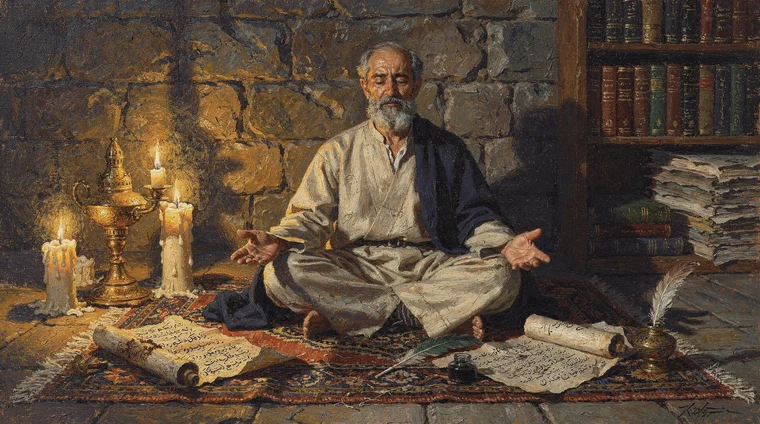
Image: Generated with AI (Epivo)
Did you know?
-
The word 'Sufi' likely derives from the Arabic suf (wool), referring to the simple woollen garments worn by early Muslim ascetics as a sign of their rejection of worldly luxury.
Encyclopædia Britannica — Sufism -
Rumi's poetry has made him the bestselling poet in the United States. His Masnavi comprises over 25,000 verses and is considered one of the greatest works of mystical literature ever written.
Wikipedia — Rumi -
Al-Ghazali's spiritual crisis in 1095 led him to abandon a prestigious professorship in Baghdad. His subsequent writings reconciled Sufi mysticism with mainstream Islamic theology, transforming the religion permanently.
Stanford Encyclopedia of Philosophy — Al-Ghazali
Sufi orders and their global influence
From the 12th century onwards, Sufism organised itself into formal orders (tariqas), each tracing its spiritual lineage back through a chain of teachers to the Prophet Muhammad. These orders became one of the most important vehicles for the spread of Islam worldwide.
Major Sufi orders
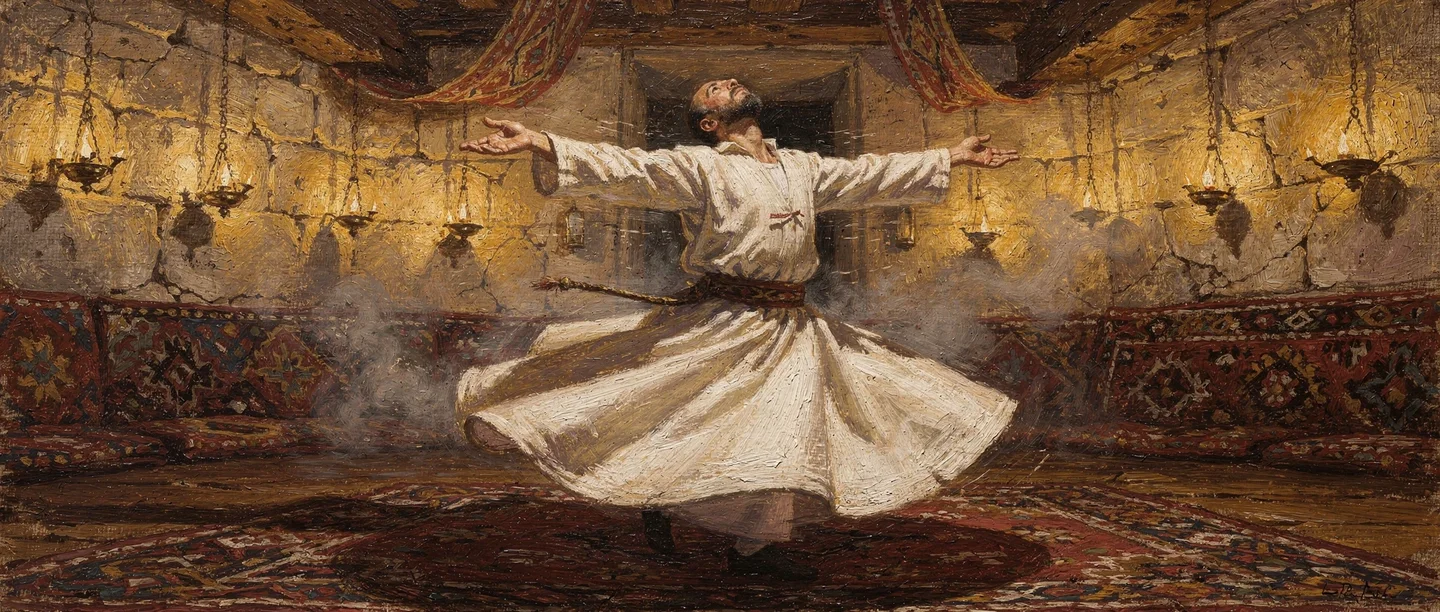
The Qadiriyya, founded by Abdul Qadir Gilani (1077–1166) in Baghdad, became one of the most widespread orders, with followers across the Middle East, Africa, and South Asia. The Naqshbandiyya, originating in Central Asia, emphasised silent dhikr and engagement with political life. The Mevlevi order, founded by Rumi's followers in Turkey, is famous for the sema — the meditative whirling dance of the 'whirling dervishes.'
Sufism and the spread of Islam
Sufi teachers carried Islam into sub-Saharan Africa, India, Indonesia, and China — often more effectively than military conquest. By emphasising personal experience and spiritual community rather than rigid legalism, Sufi preachers found common ground with local cultures.
Sufism today
Sufism remains a living tradition with millions of practitioners worldwide. Sufi music — from Pakistani qawwali to Turkish ney flute — has reached global audiences. However, Sufism has also faced opposition from literalist movements within Islam. Despite this tension, Sufi orders continue to thrive from Senegal and Morocco to Turkey, Pakistan, and Indonesia.
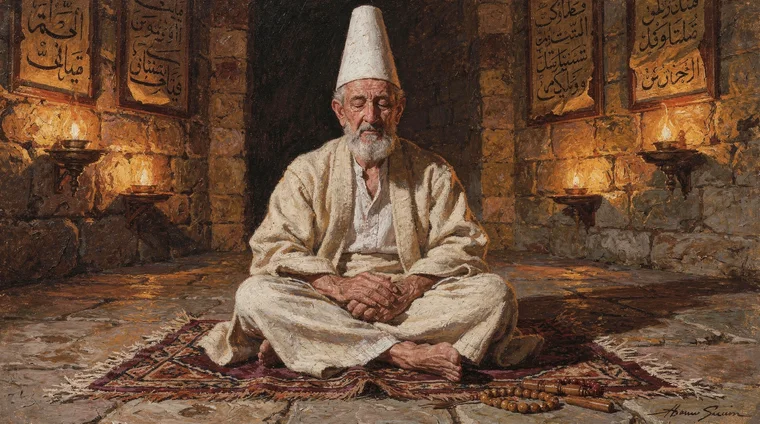
Image: Generated with AI (Epivo)
Frequently asked questions
- What is Sufism in simple terms?
- Sufism is the mystical and spiritual dimension of Islam. It focuses on inner purification, love for God, and direct spiritual experience rather than only outward religious observance. Sufis practise meditation, chanting (dhikr), and follow a spiritual path under the guidance of a teacher.
- Is Sufism part of Islam?
- Yes. Sufism is not a separate religion — it is a tradition within Islam that emphasises the inner, spiritual aspects of the faith. Most Sufis are practising Muslims who also follow Islamic law. However, some literalist movements within Islam have criticised Sufi practices as unnecessary additions to the faith.
- Who are the whirling dervishes?
- The whirling dervishes belong to the Mevlevi order, founded by followers of the poet Rumi in 13th-century Turkey. Their spinning dance, called the sema, is a form of moving meditation intended to bring the practitioner closer to God. The right hand faces upward to receive divine grace, while the left hand faces downward to share it with the world.
- Why is Rumi so popular today?
- Rumi's poetry speaks to universal human experiences — love, longing, loss, and the search for meaning. His imagery is vivid and emotionally direct, transcending cultural and religious boundaries. Translations by Coleman Barks and others have introduced his work to millions of English-language readers.
- What is the difference between Sufism and mainstream Islam?
- Sufism is not separate from Islam but represents its inward, mystical dimension. Where Islamic law (sharia) focuses on outward behaviour, Sufism emphasises the inner state of the heart and personal experience of God. Most Sufi masters teach that both dimensions are necessary — outward practice and inward devotion together form a complete spiritual life.