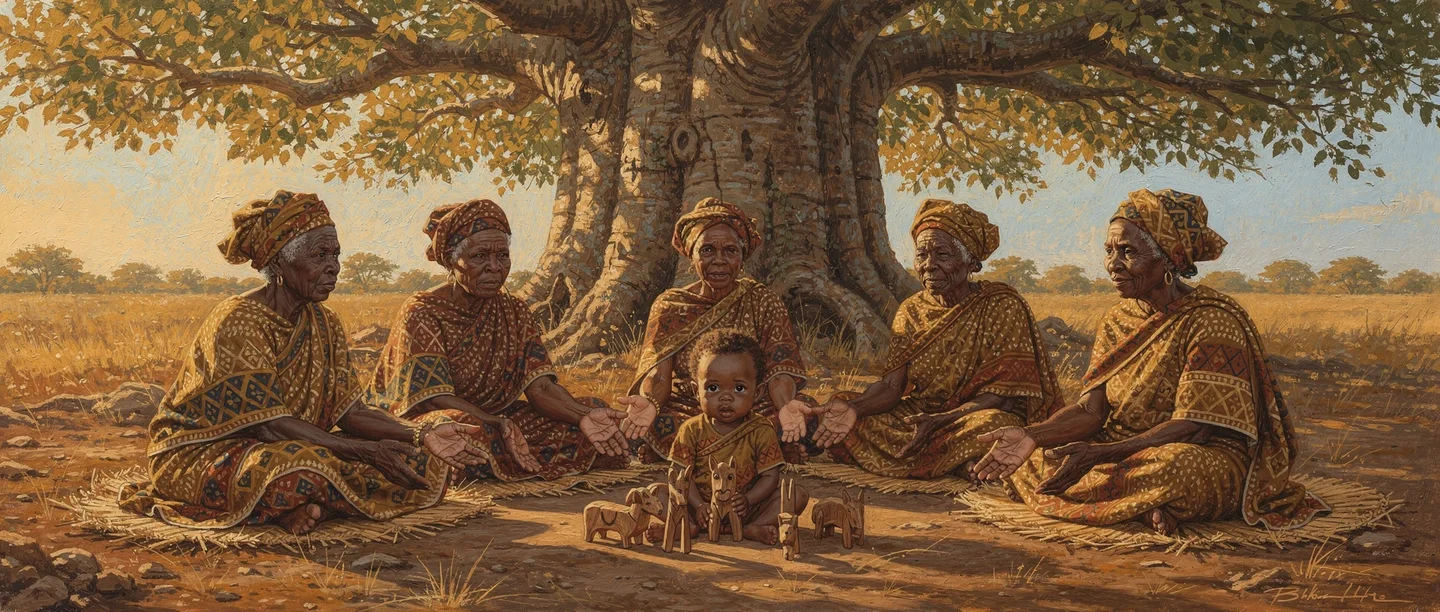
The meaning of Ubuntu: 'I am because we are'
Ubuntu is a Nguni Bantu term found across southern and eastern African languages. It translates roughly as 'humanness' or 'humanity towards others.' At its core, Ubuntu philosophy teaches that individual identity is inseparable from the community. A person is not defined by what they own or achieve alone but by how they relate to others.
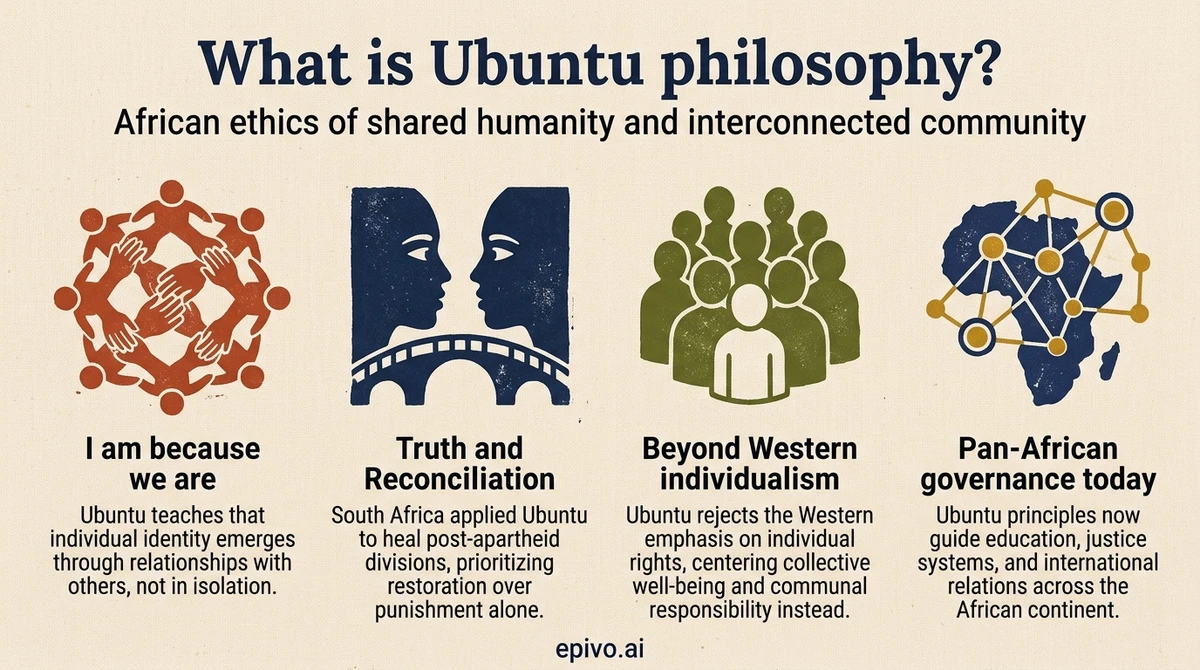
This idea stands in contrast to much of Western philosophy, which has historically emphasised individual rights, autonomy, and self-interest. In the Ubuntu worldview, the self is fundamentally relational. As the Kenyan philosopher John Mbiti summarised: 'I am because we are, and since we are, therefore I am.'
Ubuntu does not reject individuality. Instead, it holds that a person's unique qualities develop and gain meaning through participation in a community. Generosity, compassion, and respect for others are not optional virtues — they are what make someone truly human. A person who accumulates wealth while their neighbours go hungry has, in the Ubuntu framework, diminished their own humanity.
This understanding of personhood has deep roots. Long before European contact, many African societies organised themselves around communal decision-making, shared responsibility, and reciprocal obligations. Ubuntu philosophy gives a name to the ethical principles that sustained those communities.
Ubuntu and the Truth and Reconciliation Commission
The most famous application of Ubuntu philosophy in modern politics came in South Africa after the end of apartheid. When the country transitioned to democracy in 1994, it faced a question with no easy answer: how should a new society deal with decades of systematic racial violence and oppression?
Archbishop Desmond Tutu, who chaired the Truth and Reconciliation Commission (TRC), argued that Ubuntu offered a path forward. Rather than pursuing purely punitive justice, the TRC emphasised restorative justice — a process in which perpetrators acknowledged their crimes, victims told their stories, and the goal was healing rather than revenge.
Tutu explained the connection directly: 'Ubuntu speaks of the very essence of being human... My humanity is caught up, is inextricably bound up, in yours.' In this view, punishing wrongdoers without seeking to restore the community would only deepen division. Consequently, the TRC granted amnesty to some perpetrators in exchange for full public disclosure of their actions.
The TRC was not without criticism. Many victims felt that justice was sacrificed for political stability. However, the commission demonstrated that Ubuntu philosophy could operate as a practical framework for governance — not just an abstract ideal. It influenced approaches to transitional justice in Rwanda, Sierra Leone, and other post-conflict societies.

Ubuntu versus Western individualism
To fully grasp what is Ubuntu philosophy, it helps to compare it with dominant Western ethical traditions.
Western liberal thought, shaped by thinkers such as John Locke and John Stuart Mill, places the individual at the centre of moral and political life. Rights belong to individuals. Freedom means freedom from interference. Society is a collection of autonomous individuals who agree to cooperate for mutual benefit.
Ubuntu philosophy starts from the opposite premise. The community is not a contract between self-interested individuals — it is the foundation from which individuals emerge. Rights and responsibilities are not separable; they are two sides of the same relationship. Freedom, in the Ubuntu sense, is not the absence of obligation but the presence of meaningful connection.
This difference has practical consequences. In Western legal systems, justice typically focuses on individual guilt and punishment. Ubuntu-informed justice asks how the community can be restored. In Western economics, success is often measured by individual accumulation. Ubuntu ethics would measure success by the wellbeing of the group.
Neither framework is wholly right or wrong. However, Ubuntu philosophy challenges assumptions that many students encounter as universal truths. Understanding this alternative perspective develops the kind of critical thinking that underpins genuine human rights awareness — the ability to question one's own cultural defaults.
Did you know?
-
The word 'ubuntu' appears in more than 30 African languages across the continent, with related terms including 'utu' in Swahili, 'botho' in Sesotho, and 'hunhu' in Shona.
Stanford Encyclopedia of Philosophy — Ubuntu -
Archbishop Desmond Tutu was awarded the Nobel Peace Prize in 1984 for his nonviolent campaign against apartheid. He later chaired the Truth and Reconciliation Commission, explicitly grounding its restorative approach in Ubuntu philosophy.
Nobel Prize — Desmond Tutu -
The South African interim constitution of 1993 directly invoked Ubuntu, stating that amnesty should promote 'understanding but not vengeance, reparation but not retaliation, ubuntu but not victimisation.'
Constitution of the Republic of South Africa (1993 Interim)
Ubuntu in modern governance and pan-African thought
Ubuntu philosophy has moved well beyond its original communal context. Today, it influences governance, education, and international relations across Africa and beyond.
In South Africa, Ubuntu is referenced in the national constitution and shapes public discourse about social cohesion and economic justice. Former President Nelson Mandela spoke frequently about Ubuntu, describing it as the principle that 'the world can be a better place only if we work together.'
Beyond South Africa, Ubuntu connects to the broader tradition of pan-African thought. Thinkers such as Kwame Nkrumah of Ghana and Julius Nyerere of Tanzania articulated similar communal philosophies — Nkrumah's 'African personality' and Nyerere's 'Ujamaa' (familyhood) both drew on the same ethical foundations. These ideas shaped independence movements and post-colonial governance across the continent.
In education, Ubuntu-inspired approaches emphasise collaborative learning, community service, and mutual accountability. Several African universities have adopted Ubuntu as a guiding principle for pedagogy. Internationally, Ubuntu has influenced discussions at the United Nations about community-based development and indigenous knowledge systems.
For students exploring what is Ubuntu philosophy, the tradition offers a framework for thinking about citizenship that goes beyond voting and individual rights. It asks: what do we owe each other? How does my wellbeing depend on yours? These questions are as relevant in a classroom as they are in national politics.

Frequently asked questions
- What does Ubuntu mean in simple terms?
- Ubuntu means 'humanity towards others.' Understanding what is Ubuntu philosophy starts with its core claim: a person becomes truly human through their relationships and responsibilities to the community. The phrase 'I am because we are' captures this idea.
- Where does Ubuntu philosophy come from?
- Ubuntu originates from the Bantu-speaking peoples of southern and eastern Africa. The concept has roots stretching back centuries and appears in more than 30 African languages under related terms.
- How is Ubuntu different from Western philosophy?
- Western philosophy typically centres the individual as the basic unit of moral life. Ubuntu centres the community. In Western thought, rights belong to individuals. In Ubuntu, rights and responsibilities are inseparable — personal identity is shaped by relationships.
- How did Desmond Tutu use Ubuntu?
- Tutu applied Ubuntu as the ethical foundation for South Africa's Truth and Reconciliation Commission after apartheid. He argued that restorative justice — focused on healing the community — was more aligned with Ubuntu than punitive justice.
- Is Ubuntu still relevant today?
- Yes. Ubuntu influences governance, education, and justice systems across Africa. It also shapes global discussions about community development, restorative justice, and alternatives to purely individualistic models of society.
- Is Ubuntu the same as the computer operating system?
- The Linux-based operating system Ubuntu was named after the philosophy. Its founder, Mark Shuttleworth, chose the name to reflect the principle of shared humanity and collaborative development. The philosophy predates the software by centuries.