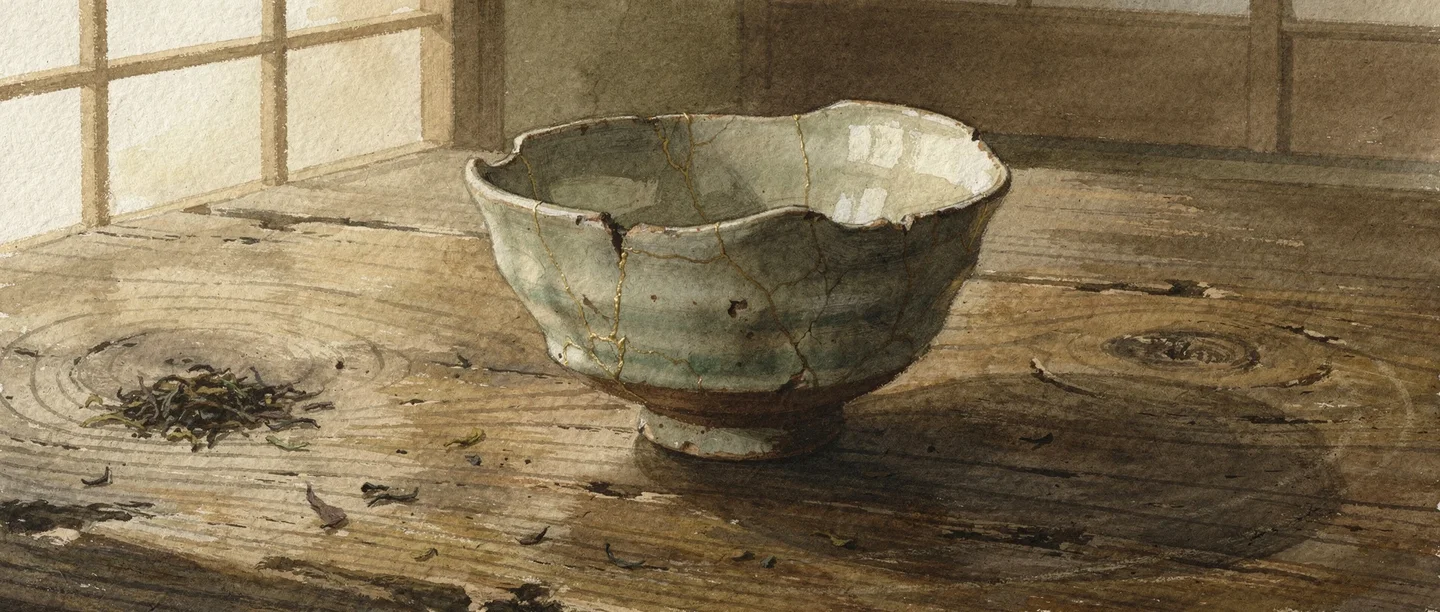
The meaning of wabi and sabi
Wabi-sabi is not a single word but two related concepts that evolved over centuries and gradually merged into one aesthetic philosophy.
Wabi
Originally, wabi meant loneliness, desolation, or the sadness of living alone in nature. Over time, its meaning shifted. By the 15th century, wabi had come to describe a positive quality: rustic simplicity, quiet contentment, and beauty found in modesty. A simple wooden hut, an unglazed tea bowl, a garden path of irregular stepping stones — these express wabi. The word points toward sufficiency rather than luxury, and toward the beauty of things stripped down to their essence.
Sabi
The word sabi originally meant 'chill' or 'withered.' It evolved to describe the beauty that comes with the passage of time — the patina on old bronze, the moss growing over stone, the fading ink on a handwritten scroll. Sabi finds value not despite aging but because of it. A new object may be beautiful, but a weathered one carries the visible evidence of its history.
Together, wabi-sabi describes an aesthetic that values the imperfect, impermanent, and incomplete. It stands in deliberate contrast to Western ideals of symmetry, permanence, and flawlessness.
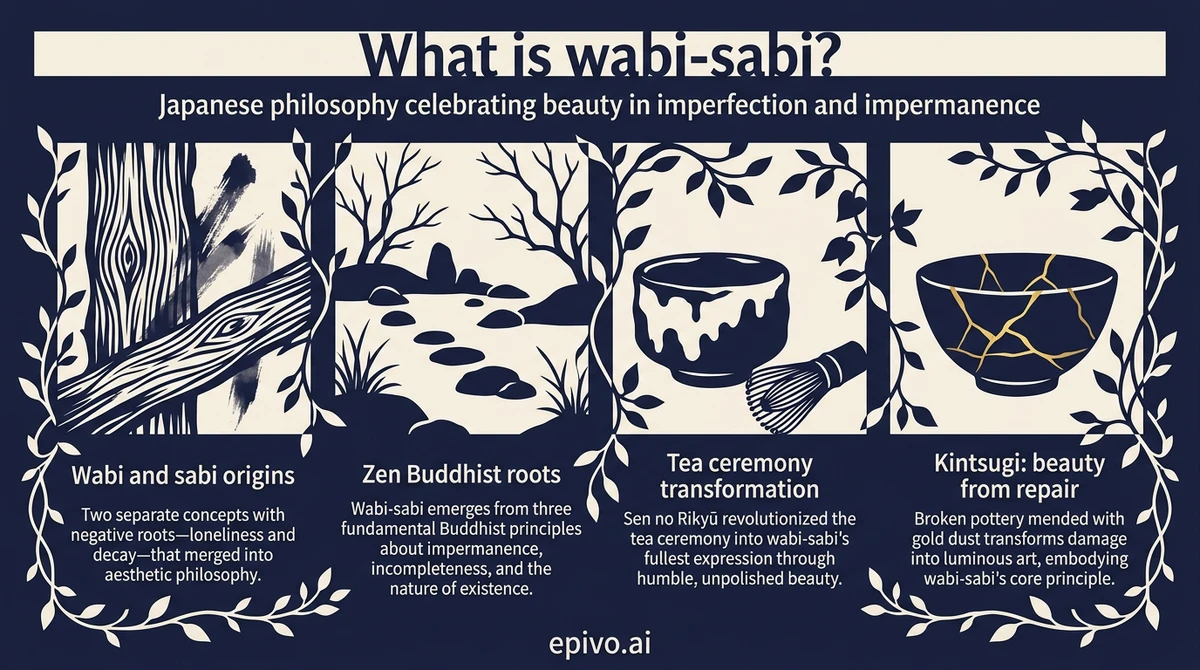
What is wabi-sabi's connection to Zen Buddhism?
Wabi-sabi cannot be understood apart from Zen Buddhism. Its philosophical roots lie in three fundamental Buddhist principles.
The three marks of existence
Buddhism teaches that all things are characterised by three qualities: impermanence (anicca), suffering or dissatisfaction (dukkha), and the absence of a permanent self (anatta). Wabi-sabi takes these ideas — which in Buddhism describe the nature of reality — and transforms them into an aesthetic. If nothing is permanent, then transience is not a flaw to be concealed but a truth to be honoured.
Zen and direct experience
Zen Buddhism emphasises direct, unmediated experience over intellectual analysis. Wabi-sabi reflects this: it asks you to look at a cracked pot, a fading flower, or an asymmetrical room and respond with feeling rather than judgement. The beauty is not explained — it is perceived.
Taoism also shaped the philosophy. The Taoist idea of naturalness (ziran) — acting without artifice, following the grain of the natural world — runs through wabi-sabi's preference for raw textures, muted tones, and organic forms. A wabi-sabi object does not try to look perfect. It simply is what it is.
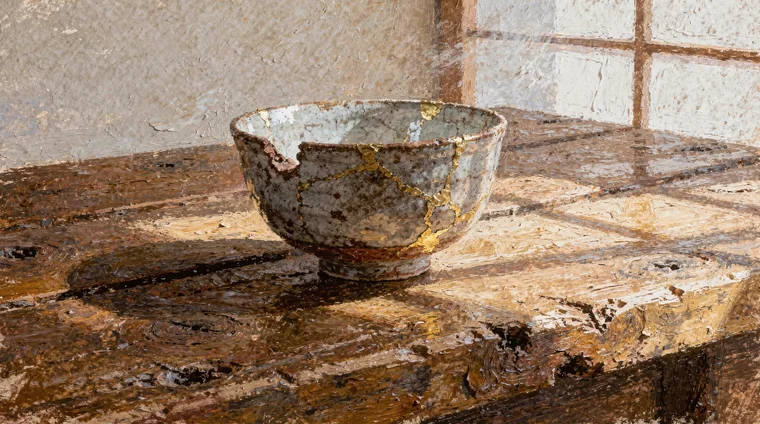
The tea ceremony and the art of imperfection
Wabi-sabi found its fullest expression in the Japanese tea ceremony (chanoyu), particularly through the revolutionary work of the tea master Sen no Rikyū (1522–1591).
Sen no Rikyū
Before Rikyū, the tea ceremony in Japan favoured expensive Chinese ceramics and lavish settings. Rikyū transformed the practice. He served tea in small, humble rooms with low doorways that forced even samurai to bow as they entered. He used rough, irregular tea bowls made by Japanese potters rather than polished Chinese imports. He arranged flowers simply and seasonally, following Bushido-era aesthetics that valued restraint over display.
Rikyū made the tea ceremony an embodiment of wabi: austere, attentive, and stripped of unnecessary ornament. His influence was enormous and permanent. The tea ceremony became Japan's most refined cultural practice — and wabi-sabi became its guiding aesthetic.
Kintsugi: beauty in breakage
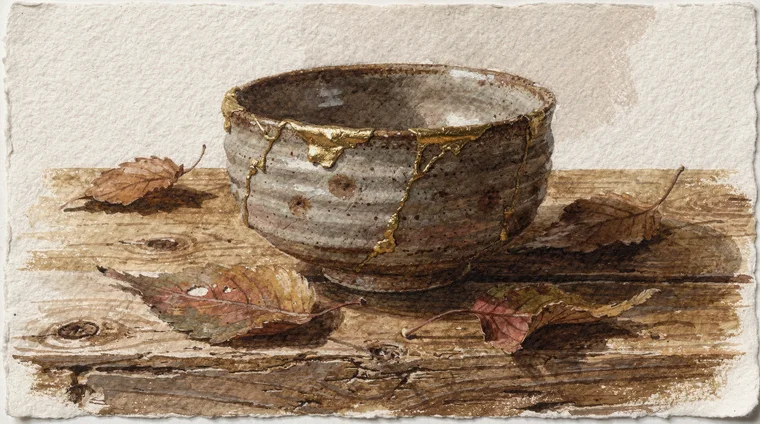
Closely related to wabi-sabi is kintsugi — the practice of repairing broken pottery with gold lacquer. Rather than hiding the damage, kintsugi highlights it. The cracks become part of the object's history, made visible and beautiful. This philosophy resonates beyond art: kintsugi suggests that damage and repair are part of life, not something to be ashamed of.
Mono no aware
Another related concept is mono no aware — 'the pathos of things.' This describes the bittersweet feeling that arises from an awareness of impermanence. Cherry blossoms are beautiful precisely because they fall. A sunset moves us because it ends. Mono no aware and wabi-sabi share a common root: the recognition that transience deepens beauty.
Did you know?
-
Sen no Rikyū (1522–1591) transformed the Japanese tea ceremony into an expression of wabi-sabi by replacing expensive Chinese ceramics with rough, handmade Japanese tea bowls.
Stanford Encyclopedia of Philosophy — Japanese Aesthetics -
Kintsugi ('golden joinery') is a Japanese repair technique that mends broken pottery with gold-dusted lacquer, turning breakage into a visible part of the object's history rather than a flaw to conceal.
Wikipedia — Kintsugi -
The concepts of wabi and sabi were originally separate words with negative connotations — wabi meant loneliness and sabi meant chill or decay — before evolving into positive aesthetic ideals over several centuries.
Encyclopaedia Britannica — Wabi-sabi
What is wabi-sabi in modern life?
Wabi-sabi has travelled far beyond Japan. Its influence is visible in architecture, design, art, and even psychology — though its meaning is often simplified or distorted along the way.
Genuine influence
Architects and designers worldwide have drawn on wabi-sabi to create spaces that embrace natural materials, visible wear, and asymmetry. The Belgian architect Axel Vervoordt is known for interiors that use raw plaster, aged wood, and empty space — principles drawn directly from Japanese aesthetics. In Japanese architecture, concepts like ma (negative space) and fukinsei (asymmetry) are closely related to wabi-sabi.
Contemporary artists working in ceramics, textiles, and photography also engage with wabi-sabi — seeking beauty in the irregular, the accidental, and the unrefined.
The problem of oversimplification
In Western popular culture, wabi-sabi has often been reduced to a decorating trend: distressed furniture, neutral palettes, and rustic accessories. This misses the philosophical depth entirely. Wabi-sabi is not a style to be purchased. It is a way of seeing — a willingness to sit with impermanence and find meaning in it.
As Leonard Koren writes in Wabi-Sabi for Artists, Designers, Poets and Philosophers, the philosophy opposes the modern impulse to make things newer, shinier, and more permanent. It asks a different question: what becomes more beautiful with time?
Frequently asked questions
- What is wabi-sabi in simple terms?
- Wabi-sabi is a Japanese philosophy of beauty that values imperfection, impermanence, and incompleteness. Instead of seeking flawlessness, it finds meaning in things that are worn, weathered, aged, or asymmetrical. It is rooted in Zen Buddhism and the Japanese tea ceremony tradition.
- How is wabi-sabi connected to Zen Buddhism?
- Wabi-sabi draws directly from Buddhist teachings about impermanence (anicca), which holds that nothing lasts forever. Zen Buddhism emphasises direct perception and acceptance of things as they are — qualities central to wabi-sabi. The philosophy became closely linked with Zen through the tea ceremony, which treats the preparation and drinking of tea as a meditative practice.
- What is the difference between wabi-sabi and kintsugi?
- Kintsugi is a specific repair technique that mends broken pottery with gold lacquer, making the cracks visible rather than hiding them. Wabi-sabi is the broader philosophy that underpins this practice — the idea that damage, aging, and imperfection add to an object's beauty rather than diminishing it. Kintsugi is one expression of wabi-sabi thinking.
- Is wabi-sabi just an interior design trend?
- No. While wabi-sabi has influenced modern design, reducing it to a decorating style misses its philosophical depth. Wabi-sabi is a worldview rooted in centuries of Zen Buddhist thought about impermanence and the nature of beauty. It involves a fundamental shift in how you perceive the world — not a set of colours or materials to buy.
- Can wabi-sabi be practised outside Japan?
- Yes. The principles of wabi-sabi — appreciating imperfection, accepting transience, and finding beauty in simplicity — are universal. You can practise wabi-sabi by noticing the beauty in everyday wear and aging, choosing quality over novelty, and becoming more comfortable with things that are incomplete or asymmetrical.