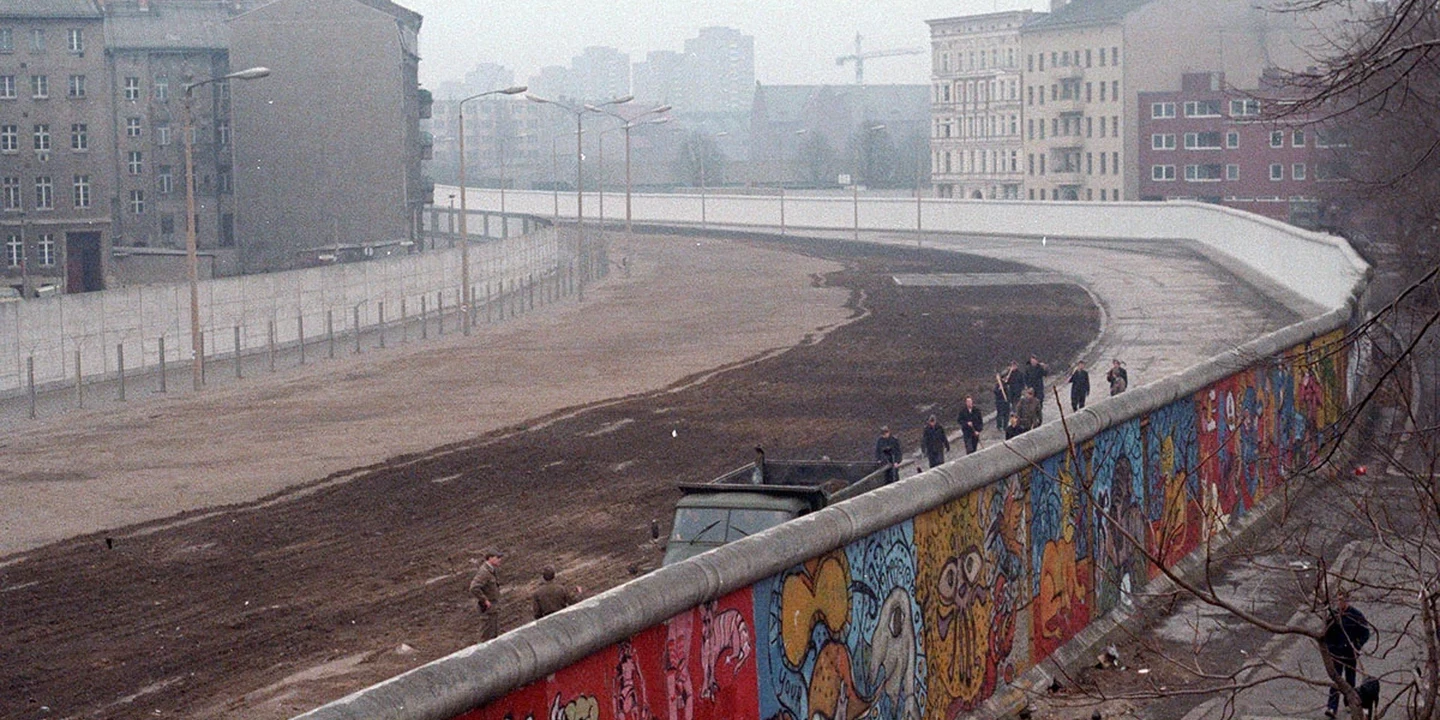
Why Was the Berlin Wall Built?
The Berlin Wall was built on 13 August 1961 to stop East Germans from fleeing to the West. To understand why, we need to look at the division of Germany after World War 2.
After Germany's defeat in 1945, the four Allied powers — the United States, Britain, France, and the Soviet Union — divided the country into occupation zones. Berlin, located deep inside the Soviet zone, was also split into four sectors. By 1949, the Western zones had merged into the Federal Republic of Germany (West Germany), while the Soviet zone became the German Democratic Republic (East Germany).
The brain drain crisis
Between 1949 and 1961, approximately 3.5 million East Germans crossed into the West. Many were young professionals — doctors, engineers, and teachers — seeking better opportunities. According to Encyclopaedia Britannica, this mass exodus threatened to collapse the East German economy. In response, the East German government, backed by the Soviet Union, erected barbed wire barriers overnight. Within days, workers replaced the wire with concrete blocks. The Wall had begun.
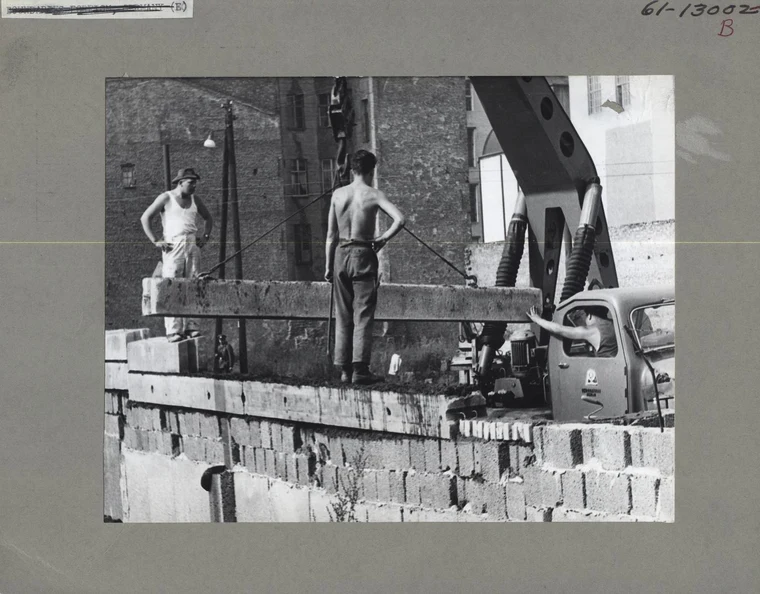
Workers erect barriers to seal the border between East and West Berlin in August 1961. The Wall was built overnight to stop the mass exodus of East Germans to the West.. Image: Central Intelligence Agency, via Wikimedia Commons (Public domain)
Life in Divided Berlin
The Berlin Wall did not just divide a city. It tore apart families, friendships, and communities overnight.
On the morning of 13 August 1961, Berliners woke to find barbed wire cutting through their streets. People who lived on one side and worked on the other were suddenly separated. Some families would not see each other again for 28 years.
The death strip
Over time, the East German government expanded the Wall into a complex system of fortifications. A "death strip" ran between two parallel walls, featuring watchtowers, anti-vehicle trenches, guard dogs, and trip-wire-activated guns. Border guards had orders to shoot anyone attempting to cross. According to BBC Bitesize, at least 140 people died trying to cross the Wall.
Checkpoint Charlie
Checkpoint Charlie became the most famous crossing point between East and West Berlin. It was the only place where Allied personnel and foreign visitors could pass between the two sides. In October 1961, American and Soviet tanks faced each other across the checkpoint — one of the tensest moments of the Cold War. For most ordinary Berliners, however, the crossing points were permanently closed.
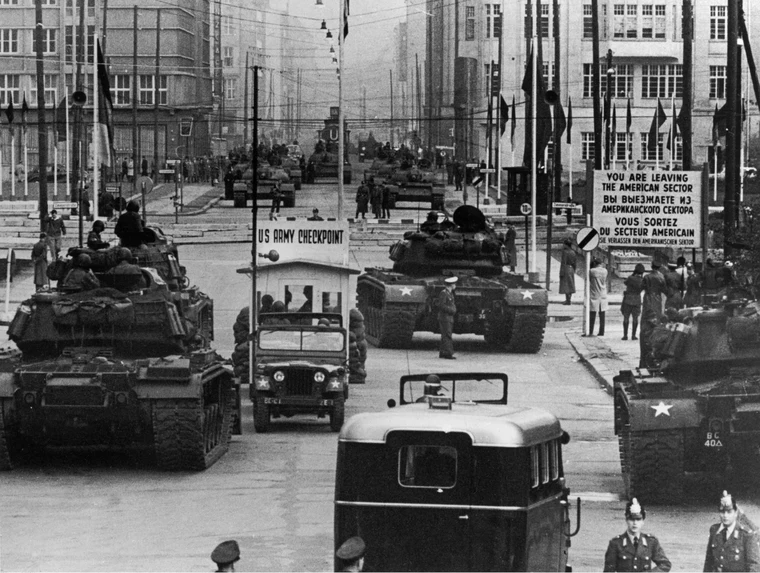
American and Soviet tanks face off at Checkpoint Charlie in October 1961. This standoff was one of the most dangerous moments of the Cold War, with armed forces just metres apart.. Image: Central Intelligence Agency, via Wikimedia Commons (Public domain)
The Berlin Wall as a Cold War Symbol
The Wall became the most powerful symbol of the ideological divide between East and West during the Cold War. On one side stood capitalist democracy; on the other, communist single-party rule.
Western leaders used the Wall to illustrate the failures of communism. In 1963, US President John F. Kennedy visited West Berlin and declared "Ich bin ein Berliner" — a statement of solidarity that became one of the most famous speeches of the Cold War era. In 1987, President Ronald Reagan stood at the Brandenburg Gate and challenged Soviet leader Mikhail Gorbachev: "Mr. Gorbachev, tear down this wall!"
For people in the East, the Wall represented something more personal. It meant restricted travel, limited freedom, and constant surveillance by the Stasi — East Germany's secret police. The Wall was not just a political symbol. It was a daily reality that shaped millions of lives.
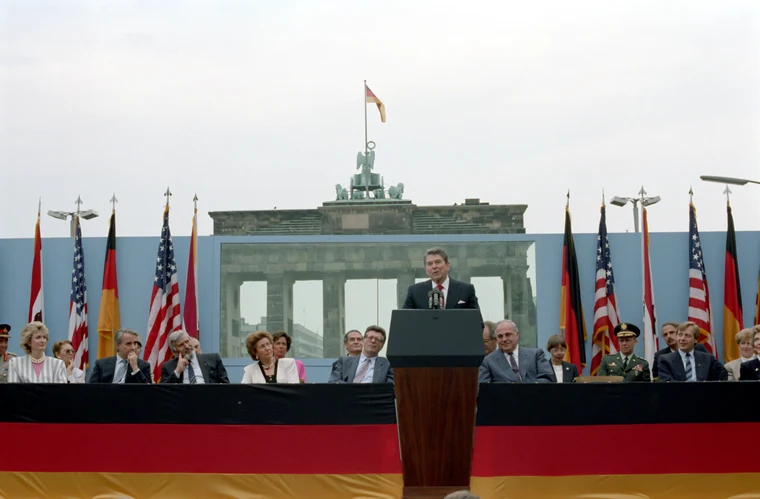
President Ronald Reagan addresses the people of West Berlin at the Brandenburg Gate on 12 June 1987, delivering his famous challenge: 'Mr. Gorbachev, tear down this wall!'. Image: White House Photographic Collection / NARA, via Wikimedia Commons (Public domain)
Did you know?
-
The Berlin Wall stood for 28 years, 2 months, and 27 days — from 13 August 1961 to 9 November 1989. At its peak, it stretched 155 kilometres around West Berlin.
Encyclopaedia Britannica — Berlin Wall -
Between 1949 and 1961, approximately 3.5 million East Germans — roughly 20% of the population — fled to West Germany before the Wall sealed the border.
BBC Bitesize — The Cold War -
On 9 November 1989, an estimated 2 million East Berliners crossed into the West within 24 hours of the border opening — the largest single-day migration in European history.
Berlin Wall Memorial — Chronicle of the Wall
How the Berlin Wall Fell and Germany Reunified
The fall of the Berlin Wall on 9 November 1989 was one of the most dramatic events of the 20th century. It happened not through military force, but through a combination of political miscommunication and popular pressure.
By 1989, the Soviet Union under Gorbachev had loosened its grip on Eastern Europe. Hungary had opened its border with Austria, allowing East Germans to flee westward. Mass protests erupted across East German cities, with hundreds of thousands demanding reform.
On 9 November, East German spokesman Gunter Schabowski announced new travel regulations at a press conference. When asked when the new rules would take effect, he fumbled through his notes and replied: "Immediately, without delay." Thousands of East Berliners rushed to the Wall. Overwhelmed border guards, lacking orders, opened the gates.
Crowds from both sides climbed onto the Wall at the Brandenburg Gate, celebrating and chipping away at the concrete with hammers. Within months, formal demolition began. On 3 October 1990, East and West Germany officially reunified as one nation. The Cold War's most visible barrier had fallen, and within two years, the Soviet Union itself would dissolve. Understanding what democracy means helps explain why so many East Germans demanded the right to choose their own government.
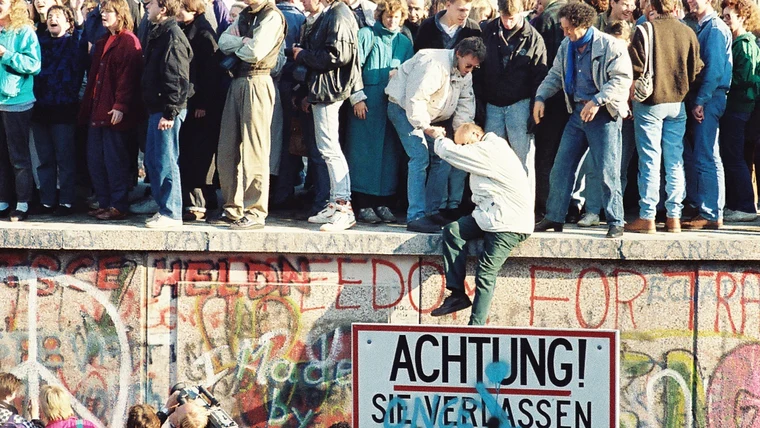
Berliners from East and West celebrate atop the Wall at the Brandenburg Gate on the night of 9 November 1989. Within a year, Germany would be reunified as one nation.. Image: Sue Ream, via Wikimedia Commons (CC BY 3.0)
Frequently asked questions
- How long was the Berlin Wall?
- The Berlin Wall stretched approximately 155 kilometres around the western sectors of Berlin. Its inner-city section between East and West Berlin was about 43 kilometres long. In total, the barrier included two parallel concrete walls, watchtowers, a death strip, and anti-vehicle trenches.
- How many people died trying to cross the Berlin Wall?
- At least 140 people died attempting to cross the Berlin Wall between 1961 and 1989. Some were shot by border guards, while others drowned in canals or rivers, fell from buildings, or were killed by mines. The exact number remains debated by historians.
- Why did the Berlin Wall fall in 1989?
- The Wall fell due to a combination of factors: Soviet leader Gorbachev's reforms reduced Moscow's control over Eastern Europe, Hungary opened its western border, mass protests swept East German cities, and a miscommunicated press conference led crowds to rush the border crossings on 9 November 1989.
- What happened to Germany after the Berlin Wall fell?
- East and West Germany officially reunified on 3 October 1990 — now celebrated as German Unity Day. Reunification brought economic challenges, as the East's infrastructure and economy lagged behind the West. The process cost an estimated 2 trillion euros over three decades.
- Can you still see the Berlin Wall today?
- Yes. Several sections of the Wall have been preserved as memorials. The East Side Gallery — a 1.3-kilometre stretch covered in murals — is the longest remaining section. The Berlin Wall Memorial on Bernauer Strasse shows the full depth of the border fortifications, including the death strip.