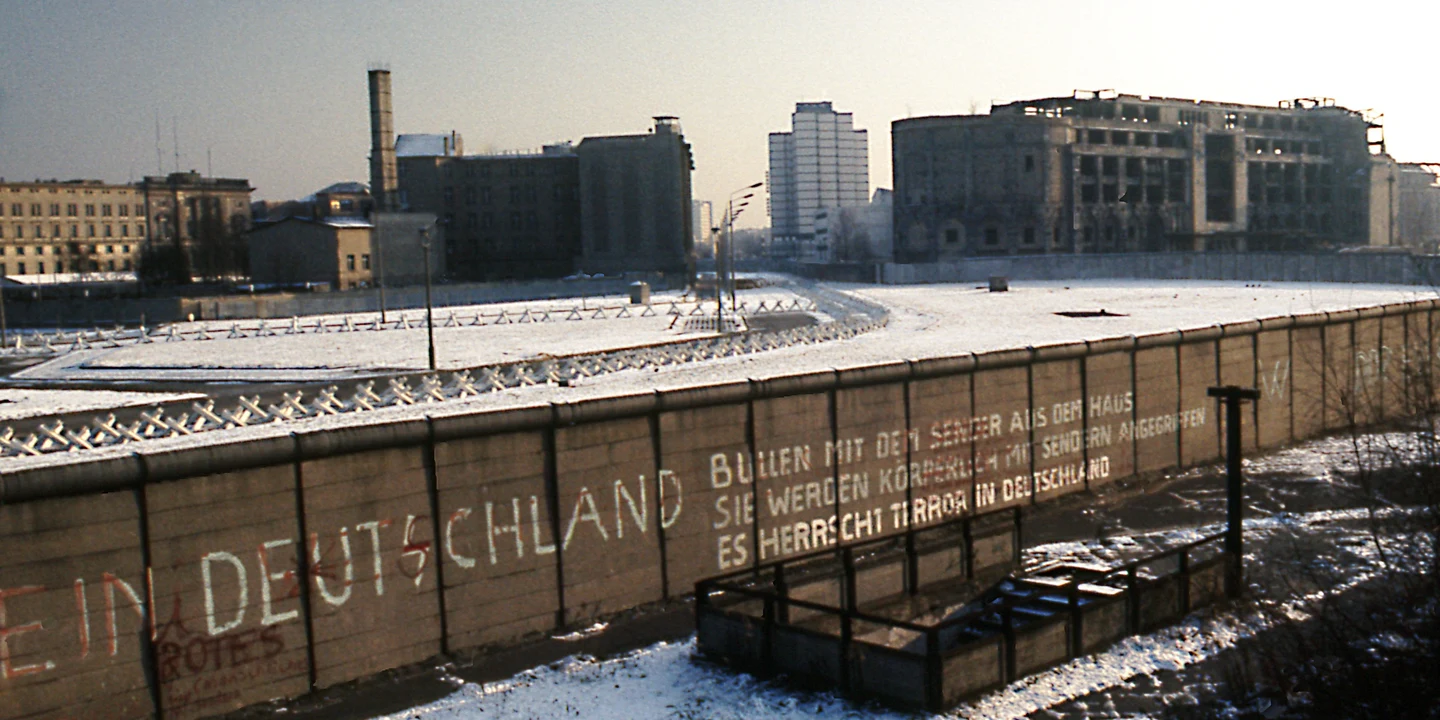
What was the Iron Curtain and where did the term come from?
The Iron Curtain was the invisible border that separated Western democracies from Soviet-controlled communist states across Europe. Although no single physical barrier ran the full length, the term described a real divide enforced by walls, fences, minefields, and armed guards.
British Prime Minister Winston Churchill popularised the phrase on 5 March 1946 in a speech at Westminster College in Fulton, Missouri. He declared: "From Stettin in the Baltic to Trieste in the Adriatic, an iron curtain has descended across the Continent." According to the National Archives, Churchill intended to warn the West that Soviet expansion threatened European freedom.
A line through the heart of Europe
The Iron Curtain ran roughly from the border between Finland and the Soviet Union in the north, down through divided Germany, and south to the borders of Yugoslavia and Greece. On the western side stood nations aligned with the United States and NATO. On the eastern side stood nations under Soviet influence, later formalised as the Warsaw Pact. Germany itself was split in two. The city of Berlin became the most visible flashpoint of this divide, eventually sealed by the Berlin Wall in 1961.
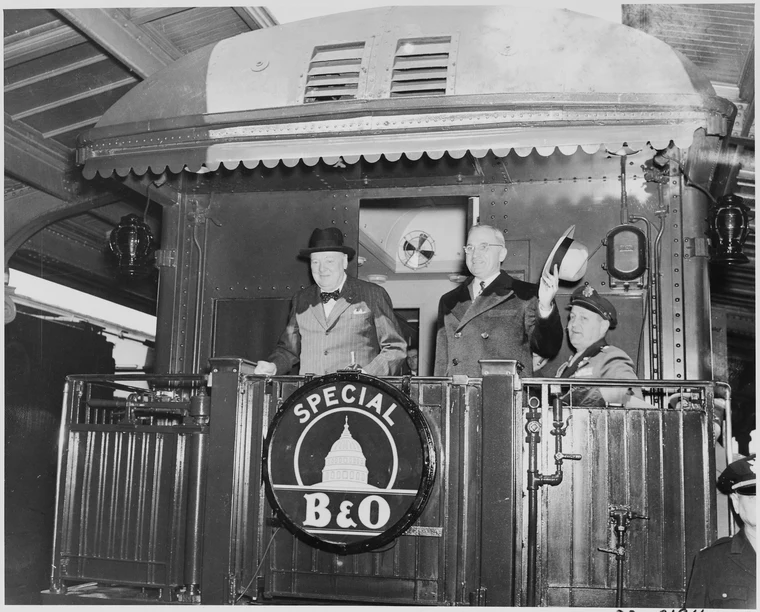
Winston Churchill at Westminster College in Fulton, Missouri, where he delivered his famous Iron Curtain speech on 5 March 1946.. Image: Abbie Rowe, via Wikimedia Commons (Public domain)
How the divide shaped Cold War alliances
The Iron Curtain created the framework for two rival alliance systems that dominated global politics for over four decades. In 1949, the United States and eleven Western nations formed NATO — the North Atlantic Treaty Organisation — as a military alliance against Soviet aggression. In response, the Soviet Union established the Warsaw Pact in 1955, binding Eastern European states into a communist defence bloc.
These alliances turned the divide into more than a line on a map. Both sides stationed troops, nuclear weapons, and surveillance systems along the border. According to Encyclopaedia Britannica, the frontier between East and West Germany alone featured over 1 million land mines by the 1980s. Tens of thousands of soldiers from both blocs stood ready on either side.
Proxy conflicts and global reach
Although NATO and Warsaw Pact forces never fought each other directly in Europe, the rivalry fuelled conflicts elsewhere. The Cold War played out through proxy wars in Korea, Vietnam, and Afghanistan. Events like the Cuban Missile Crisis in 1962 brought the world to the brink of nuclear war. In addition, the arms race accelerated rapidly, with both superpowers stockpiling enough nuclear weapons to destroy the planet several times over. As a result, the confrontation between East and West influenced not only Europe but the entire global order.
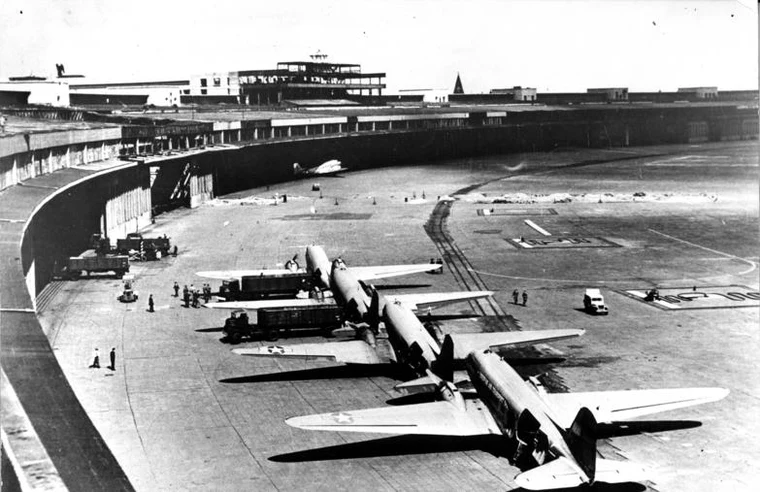
A C-54 Skymaster approaches Berlin Tempelhof airport while Berliners watch during the 1948-49 Berlin Airlift.. Image: Unknown authorUnknown author, via Wikimedia Commons (Public domain)
Life behind the barrier
For hundreds of millions of people in Eastern Europe, life behind the Iron Curtain meant restricted freedoms, state surveillance, and limited contact with the outside world. Governments controlled the press, banned opposition parties, and restricted travel to the West.
Secret police forces monitored citizens in nearly every Warsaw Pact country. East Germany's Stasi employed an estimated 90,000 full-time agents and relied on a vast network of civilian informants. In Czechoslovakia, Romania, and Poland, similar agencies suppressed dissent through arrests, censorship, and intimidation. People could be imprisoned for listening to Western radio broadcasts or distributing banned literature.
Economic and cultural isolation
Eastern bloc economies operated under central planning. The state decided what factories produced, what shops sold, and what prices consumers paid. Consumer goods that were common in the West — fresh fruit, electronics, fashionable clothing — were often scarce or unavailable. Long queues for basic necessities became a defining feature of daily life. Furthermore, cultural exchange was tightly controlled. Western books, films, and music were censored or banned outright. Travel to the West required government permission, which authorities rarely granted to ordinary citizens. Many families separated by the border went decades without seeing each other.
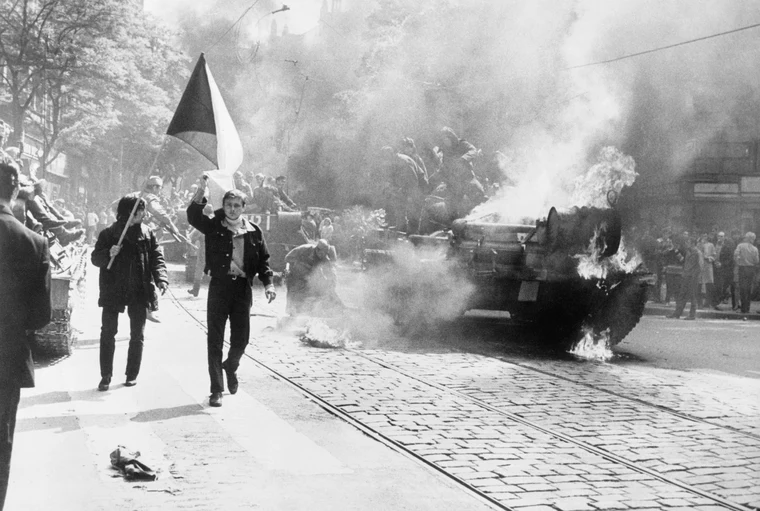
Soviet tanks rolling through the streets of Prague during the Warsaw Pact invasion of Czechoslovakia, August 1968.. Image: Central Intelligence Agency, via Wikimedia Commons (Public domain)
Did you know?
-
Churchill's 1946 'Iron Curtain' speech at Fulton, Missouri, is widely considered the opening declaration of the Cold War, alerting the West to Soviet expansion across Eastern Europe.
National Archives — Iron Curtain Speech -
The inner-German border stretched 1,393 kilometres and was reinforced with over 1 million land mines, making it one of the most heavily fortified frontiers in history.
Encyclopaedia Britannica — Iron Curtain -
Between 1945 and 1990, an estimated 3.8 million people fled Eastern bloc countries despite the dangers, risking arrest, imprisonment, or death to cross the Iron Curtain.
BBC Bitesize — The Cold War
How the Iron Curtain fell
The division of Europe collapsed between 1989 and 1991 through a combination of economic failure, popular protest, and political reform. Soviet leader Mikhail Gorbachev introduced policies of glasnost (openness) and perestroika (restructuring), which loosened Moscow's grip on Eastern Europe.
In 1989, Hungary dismantled its border fence with Austria, creating the first gap in the barrier. Thousands of East Germans fled westward through this opening. Mass protests then swept across Eastern Europe — in Poland, Czechoslovakia, East Germany, and Romania. On 9 November 1989, the Berlin Wall fell after border guards opened the gates to overwhelming crowds.
Within two years, communist governments across Eastern Europe had collapsed. Germany reunified in October 1990. The Warsaw Pact dissolved in July 1991, and the Soviet Union itself ceased to exist on 26 December 1991. The Iron Curtain — the divide that had shaped European life for over four decades — was finally gone. Today, many of the former Eastern bloc nations are members of NATO and the European Union, a transformation that would have seemed impossible during the Cold War.
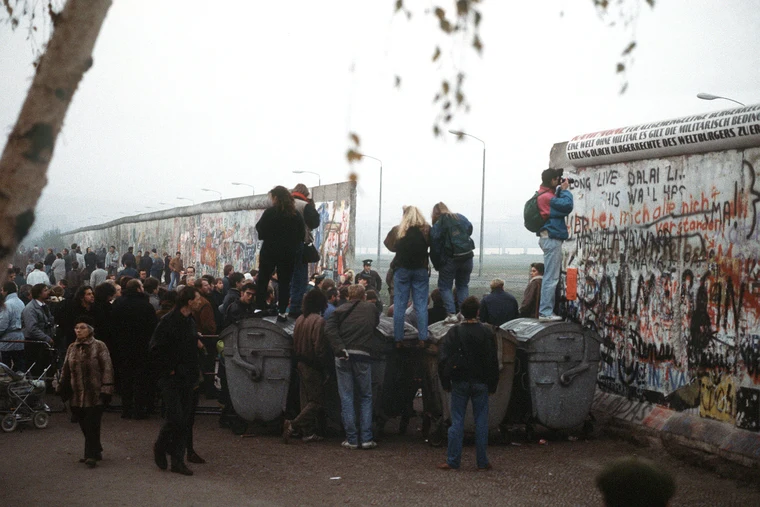
Berliners celebrate on the Wall near the Brandenburg Gate on 9 November 1989, the night the Berlin Wall fell.. Image: Series: Combined Military Service Digital Photographic Files, 1982 - 2007 Record Group 330: Records of the Office of the Secretary of Defense, 1921 - 2008, via Wikimedia Commons (Public domain)
Frequently asked questions
- Was the Iron Curtain a real wall?
- Not a single wall, but a network of physical barriers. The Iron Curtain included barbed wire fences, concrete walls, minefields, and watchtowers along borders from the Baltic Sea to the Adriatic. The Berlin Wall was its most famous physical section.
- Who coined the term Iron Curtain?
- Winston Churchill popularised the term in his 5 March 1946 speech at Westminster College in Fulton, Missouri. However, the phrase had appeared earlier in other contexts. Joseph Goebbels used a similar expression in 1945, and the metaphor dates back to the 19th century.
- Which countries were behind the Iron Curtain?
- The main countries behind the Iron Curtain were the Soviet Union, East Germany, Poland, Czechoslovakia, Hungary, Romania, Bulgaria, and Albania. Yugoslavia maintained a communist government but operated more independently from Moscow after 1948.
- When did the Iron Curtain fall?
- The Iron Curtain fell in stages between 1989 and 1991. Hungary opened its border with Austria in May 1989, the Berlin Wall fell in November 1989, and the Soviet Union dissolved in December 1991, ending the division of Europe.
- How did the Iron Curtain affect ordinary people?
- Citizens behind the Iron Curtain faced restricted travel, censored media, state surveillance, and limited consumer goods. Many families separated by the border went decades without contact. Secret police forces monitored dissent in every Eastern bloc country.