
What was the Islamic Golden Age and how did it begin?
The Islamic Golden Age began with the rise of the Abbasid caliphate in 750 CE. The Abbasids moved the capital of the Islamic empire from Damascus to a newly built city — Baghdad — which quickly became the largest and most cosmopolitan city in the world.
At the heart of this intellectual revolution was the House of Wisdom (Bayt al-Hikma), founded in Baghdad around 830 CE under Caliph al-Ma'mun. This was not simply a library. It was a research institution where Muslim, Christian, Jewish, and Zoroastrian scholars worked side by side, translating and expanding upon the knowledge of ancient Greece, Persia, and India.
The translation movement
The translation movement was the catalyst. Scholars translated the works of Aristotle, Plato, Euclid, Galen, and Ptolemy from Greek and Syriac into Arabic. But they did far more than copy. They corrected errors, filled gaps, and extended ideas in original directions. Arabic became the international language of science and scholarship — much as English functions today.
This movement was possible because the Abbasid caliphs actively funded scholarship. They believed that knowledge — regardless of its origin — was worth pursuing. The result was a culture of inquiry that valued evidence and reason alongside faith.
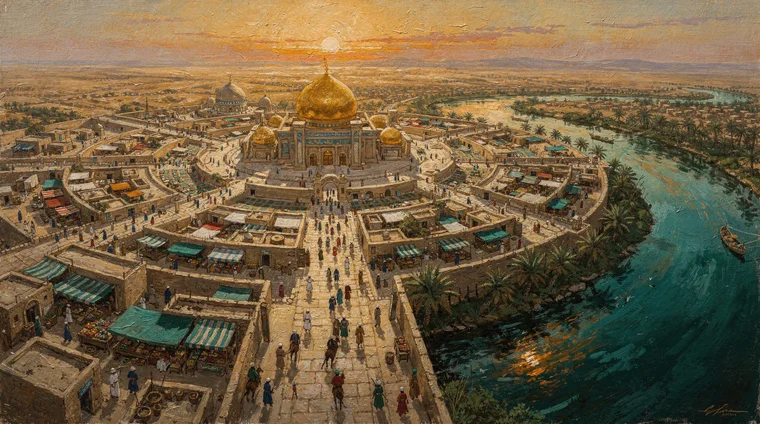
Image: Generated with AI (Epivo)
The great scholars and polymaths
The Islamic Golden Age produced polymaths — scholars who mastered multiple fields — at a rate unmatched in any other period of history.
Al-Khwarizmi (c. 780–850)
Al-Khwarizmi is often called the father of algebra. His treatise Al-Kitab al-Mukhtasar fi Hisab al-Jabr wal-Muqabala gave us the word "algebra" (from al-jabr). His name also gives us the word "algorithm." He introduced Hindu-Arabic numerals to the Islamic world, which eventually replaced Roman numerals in Europe.
Ibn Sina (Avicenna, 980–1037)
Ibn Sina wrote the Canon of Medicine, which remained the standard medical textbook in European universities until the 17th century. He classified diseases systematically, described the contagious nature of tuberculosis, and identified the spread of disease through water and soil. In philosophy, he developed sophisticated arguments about the nature of existence and the soul.
Ibn al-Haytham (Alhazen, 965–1040)
Ibn al-Haytham is considered the father of modern optics. His Book of Optics rejected the Greek theory that eyes emit light rays. Instead, he demonstrated that vision occurs when light enters the eye — a revolutionary insight. He also pioneered the scientific method, insisting on experimental verification rather than relying on authority.
Al-Biruni (973–1048)
Al-Biruni was an astronomer, mathematician, and anthropologist. He calculated the Earth's circumference with remarkable accuracy — within 1% of the modern accepted value. He also wrote one of the first serious comparative studies of world religions and cultures.
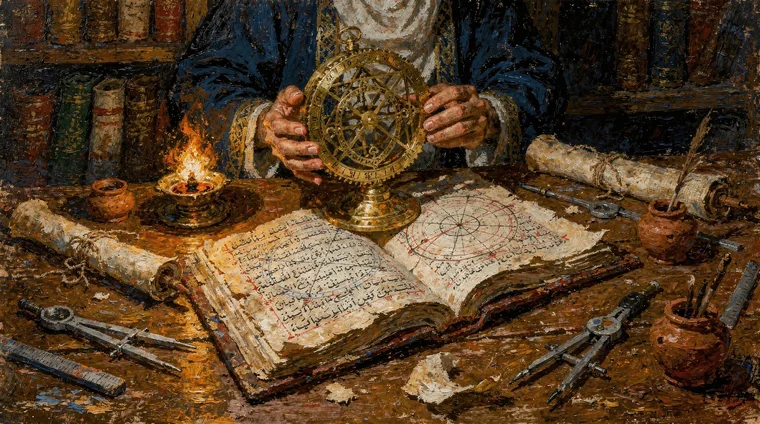
Image: Generated with AI (Epivo)
Breakthroughs in science, medicine, and mathematics
The achievements of the Islamic Golden Age extended far beyond individual scholars. Entire fields of knowledge were transformed.
Mathematics
Islamic mathematicians developed algebra, refined trigonometry, and introduced the decimal point. They adopted the Indian numeral system (including zero) and transmitted it to Europe — where these "Arabic numerals" became the foundation of modern mathematics.
Medicine
Hospitals (bimaristans) in the Islamic world were among the first to separate patients by illness, maintain medical records, and train physicians through structured apprenticeships. Surgeons developed techniques for cataract removal, and pharmacists created the first pharmacopoeias — systematic catalogues of medicines and their effects.
Chemistry
Jabir ibn Hayyan (c. 721–815), often called the father of chemistry, developed experimental techniques including distillation, crystallisation, and filtration. The word "chemistry" itself derives from the Arabic al-kimiya.
Astronomy
Islamic astronomers built sophisticated observatories and refined the astrolabe — a device for measuring the positions of stars. They corrected errors in Ptolemy's astronomical tables and produced star catalogues that remain the basis for many star names used today, such as Aldebaran, Betelgeuse, and Rigel.
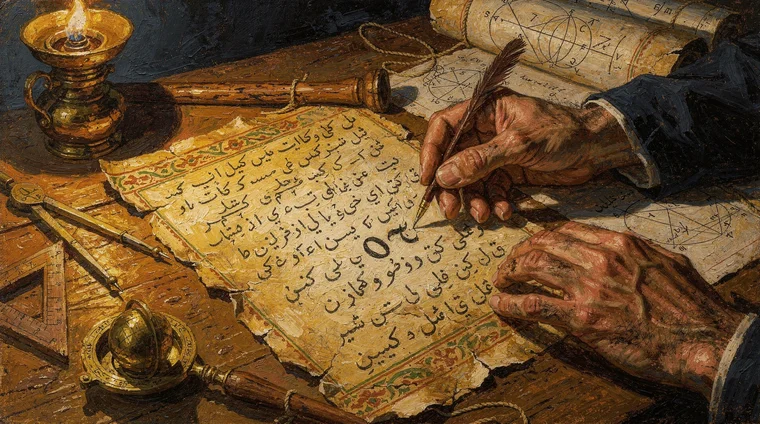
Image: Generated with AI (Epivo)
Did you know?
-
The word 'algebra' comes from the Arabic 'al-jabr,' a term used by Al-Khwarizmi in his 9th-century mathematical treatise — one of the most influential textbooks ever written.
Encyclopaedia Britannica — Islamic Golden Age -
Baghdad's House of Wisdom employed scholars of multiple faiths and languages, making it one of the earliest examples of an international, multi-faith research institution.
Wikipedia — Islamic Golden Age -
Ibn al-Haytham's Book of Optics (c. 1011–1021) is considered one of the most important works in the history of science, laying the foundations for modern optics and the scientific method.
1001 Inventions -
Al-Biruni calculated the Earth's circumference at approximately 6,339.6 km for its radius — remarkably close to the modern accepted value of 6,371 km.
Wikipedia — Islamic Golden Age
The end of the Islamic Golden Age and its legacy
The Islamic Golden Age is traditionally considered to have ended with the Mongol siege of Baghdad in 1258. The Mongol army, led by Hulagu Khan, sacked the city, destroyed the House of Wisdom, and — according to historical accounts — threw so many books into the Tigris that the river ran black with ink.
But the end was not sudden. Political fragmentation, the Crusades, and internal conflicts had already weakened the Abbasid caliphate. Scholarly activity continued in other centres — Cairo, Cordoba, Samarkand — but the unifying conditions that had made Baghdad the world's intellectual capital did not return.
Transmission to Europe
The Islamic Golden Age's greatest legacy may be what it gave to Europe. During the 12th and 13th centuries, scholars in Toledo, Palermo, and other cities translated Arabic scientific and philosophical texts into Latin. This transmission reintroduced Aristotle to Europe and brought entirely new knowledge in mathematics, medicine, and astronomy. Without these translations, the European Renaissance and the Scientific Revolution might have unfolded very differently. As Islamic philosophy scholars have shown, this transmission was one of history's most consequential acts of cultural exchange.
Today, the Islamic Golden Age serves as a powerful reminder that intellectual progress depends on openness — to ideas from other cultures, to collaboration across religious boundaries, and to the belief that knowledge is worth pursuing for its own sake.
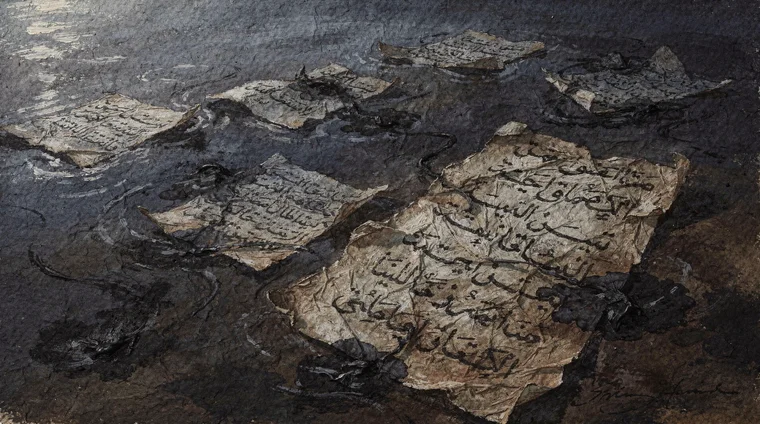
Image: Generated with AI (Epivo)
Frequently asked questions
- When was the Islamic Golden Age?
- The Islamic Golden Age is generally dated from around 750 CE, with the founding of the Abbasid caliphate, to 1258 CE, when the Mongols sacked Baghdad. Some scholars extend the period earlier or later, but this roughly five-century span represents the peak of Islamic scientific and cultural achievement.
- What was the House of Wisdom?
- The House of Wisdom (Bayt al-Hikma) was a major intellectual centre in Baghdad, founded around 830 CE. It served as a library, translation bureau, and research institution where scholars of different faiths translated Greek, Persian, and Indian texts into Arabic and produced original works in science, mathematics, and philosophy.
- How did the Islamic Golden Age influence modern science?
- Islamic scholars developed algebra, refined the scientific method, advanced optics and medicine, and transmitted ancient Greek knowledge to medieval Europe through Latin translations. Many scientific terms — algorithm, algebra, chemistry — derive from Arabic. Modern hospital practices, pharmacology, and astronomical star names all trace back to this period.
- Why did the Islamic Golden Age end?
- The traditional end point is the Mongol sack of Baghdad in 1258, which destroyed much of the city's intellectual infrastructure. However, the decline was gradual, caused by political fragmentation, the Crusades, and shifting trade routes. Scholarship continued in other Islamic centres, but the unique concentration of talent and resources that defined the Golden Age was not replicated.
- What is the difference between the Islamic Golden Age and Islamic philosophy?
- The Islamic Golden Age refers to the broader period of scientific, cultural, and intellectual achievement across the Islamic world. Islamic philosophy (falsafa) is one strand within it — the tradition of rational inquiry influenced by Greek thought. The Golden Age also encompassed medicine, mathematics, astronomy, chemistry, art, and architecture.