Who was Marcus Aurelius, the Roman emperor?
Marcus Aurelius ruled Rome from 161 to 180 CE. He is remembered as the last of the Five Good Emperors — a sequence of rulers who governed Rome during its most stable and prosperous period.
His reign was not easy, however. Marcus Aurelius faced two enormous crises simultaneously. The Antonine Plague swept through the empire from 165 to 180 CE, killing an estimated five million people. At the same time, Germanic tribes repeatedly threatened the Danube frontier, forcing Marcus Aurelius to spend much of his reign commanding military campaigns far from Rome.
Despite these pressures, Marcus Aurelius was known for his restraint and fairness. He consulted the Senate rather than ruling by decree. He freed many slaves in his personal household. Unlike many rulers of his era, he did not persecute those who disagreed with him.
His decision at the end of his life has been criticised by historians: Marcus Aurelius named his biological son Commodus as successor rather than selecting an adopted heir as the previous Good Emperors had done. Commodus proved to be a disastrous ruler — and the tradition of the Five Good Emperors ended with him. To understand the world Marcus Aurelius inhabited, see our article on what is ancient Greece, which explores the Greco-Roman cultural world he was shaped by.
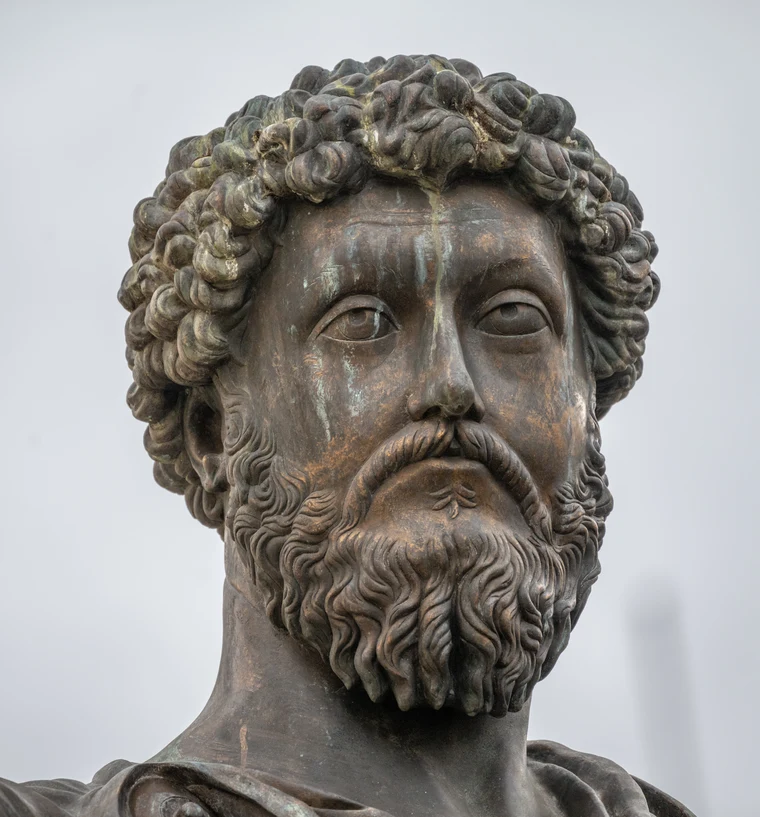
A replica of the equestrian statue of Marcus Aurelius on the Piazza del Campidoglio, Capitoline Hill. The original was moved indoors to the Capitoline Museums in 1981 for preservation.. Image: Alvesgaspar, via Wikimedia Commons (Public domain)
How did Marcus Aurelius become a Stoic philosopher?
Marcus Aurelius was born in 121 CE into a prominent Roman family and was adopted by Emperor Antoninus Pius, which placed him on the path to the throne. From an early age, he showed a deep interest in ideas.
At around age 25, Marcus Aurelius began studying Stoic philosophy seriously under the tutor Junius Rusticus. Rusticus introduced him to the teachings of Epictetus, a former slave who had become one of the greatest Stoic thinkers. This influence was decisive — Marcus Aurelius absorbed the Stoic belief that virtue, not wealth or power, was the only true good.
He also studied with Marcus Cornelius Fronto, one of Rome's leading rhetoricians. However, it was Stoicism that shaped how Marcus Aurelius thought about duty, self-discipline, and the limits of what we can control.
Unusually for a Roman emperor, Marcus Aurelius wrote his deepest thoughts in Greek — the language of Stoic philosophy — rather than Latin. These writings became the Meditations, a work he never intended anyone to read.
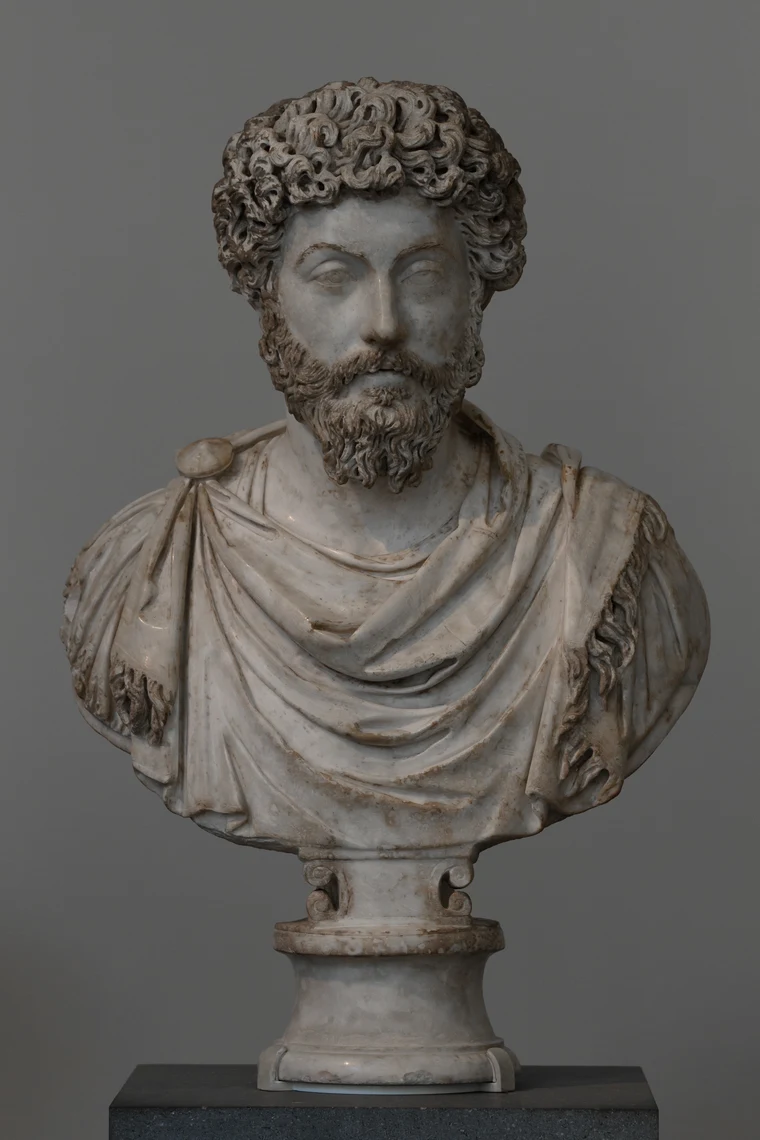
A marble portrait bust of Marcus Aurelius in the Louvre, Paris. Roman portrait sculpture aimed for realistic likenesses, and this bust shows the curly hair and beard characteristic of Marcus Aurelius.. Image: Unknown photographer, via Wikimedia Commons (Public domain)
Did you know?
-
The Meditations was written as a private journal during military campaigns — Marcus Aurelius never gave it a title, and he never intended it for publication. The title was assigned by later editors.
Internet Encyclopedia of Philosophy — Marcus Aurelius -
The Antonine Plague, which struck during the reign of Marcus Aurelius from 165 to 180 CE, may have killed up to five million people — roughly a tenth of the Roman Empire's total population.
Meditations — Marcus Aurelius (MIT Classics) -
Stoicism was founded in Athens around 300 BCE. Its core teaching — that we should focus only on what is within our control — continues to influence psychology, therapy, and leadership thinking today.
Stanford Encyclopedia of Philosophy — Stoicism
What does the Meditations teach us?
The Meditations is divided into 12 books and has been in continuous print since the 16th century. It remains one of the most widely read philosophical works in history — remarkable for a text written as private self-reminders.
Several themes run throughout. Marcus Aurelius returns again and again to the idea of memento mori — the awareness that life is short and that each morning may bring difficult people and difficult circumstances. He opens Book 2 by reminding himself: "Begin the morning by saying to thyself, I shall meet with the busy-body, the ungrateful, arrogant, deceitful, envious, unsocial." Rather than a counsel of despair, this is practical preparation.
On impermanence, Marcus Aurelius wrote: "Time is a river of vanishing moments." On personal responsibility: "You have power over your mind, not outside events. Realise this, and you will find strength." On duty: "What we do now echoes in eternity."
These ideas connect directly to the broader tradition of what is philosophy. Stoicism, as practised by Marcus Aurelius, is not a passive acceptance of fate — it is an active discipline of directing attention toward what is within our control and letting go of what is not.
The modern relevance of Marcus Aurelius is striking. According to the Internet Encyclopedia of Philosophy, his Meditations maps closely onto modern cognitive behavioural therapy (CBT), which teaches people to distinguish between what they can and cannot control. Authors like Ryan Holiday have brought the Meditations to millions of new readers through books such as The Daily Stoic. For students and parents seeking a personal AI tutor to explore these ideas deeply, Epivo's international philosophy curriculum covers Stoicism in full.
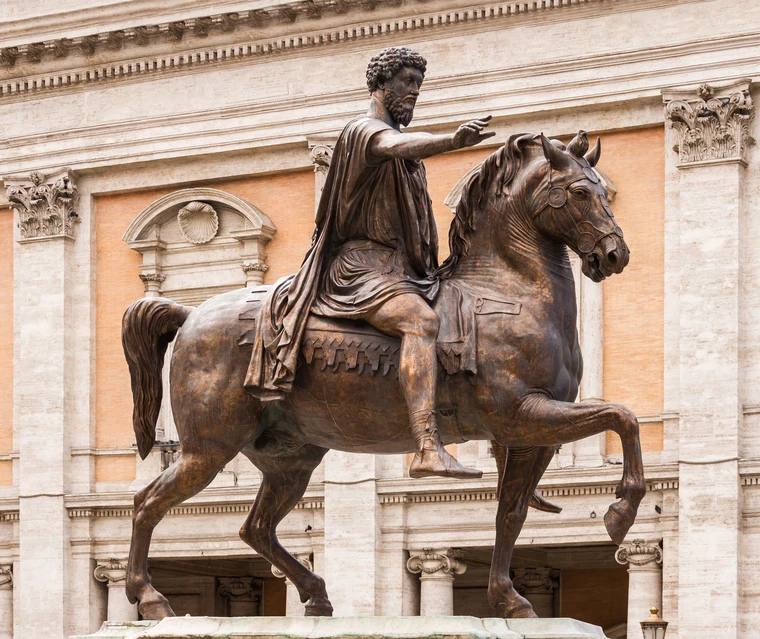
The original gilded bronze equestrian statue of Marcus Aurelius, displayed inside the Capitoline Museums. Its survival through the centuries is attributed to the medieval belief that it depicted the Christian emperor Constantine.. Image: Nicholas Hartmann, via Wikimedia Commons (CC BY-SA 4.0)
Frequently asked questions
- Who was Marcus Aurelius in simple terms?
- Marcus Aurelius was Roman emperor from 161 to 180 CE and a Stoic philosopher. He is best known for writing the Meditations, a private journal of philosophical reflections that has been read continuously for nearly two thousand years.
- Why is Marcus Aurelius called a philosopher-emperor?
- Marcus Aurelius was unusual among rulers because he studied Stoic philosophy seriously and tried to live by its principles. Most ancient philosophers were teachers or writers, not heads of state. His combination of supreme political power and genuine philosophical commitment earned him the description 'philosopher-emperor'.
- What did Marcus Aurelius believe?
- Marcus Aurelius believed in the core Stoic teaching that virtue is the only true good, and that we should focus only on what is within our control — our thoughts, choices, and responses. He also believed in duty to one's community, writing: 'We are all working together toward one end.'
- Why did Marcus Aurelius write the Meditations in Greek?
- Greek was the language of Stoic philosophy. Although Marcus Aurelius was Roman and Latin was the language of imperial administration, the great Stoic thinkers — including Epictetus, whose work influenced him most — wrote in Greek. Writing in Greek placed his reflections within that philosophical tradition.
- What happened after Marcus Aurelius died?
- Marcus Aurelius named his biological son Commodus as emperor rather than selecting a capable adopted heir, as the previous Good Emperors had done. Commodus proved to be a poor ruler — erratic, vain, and ineffective — and the stable period of the Five Good Emperors came to an end.
- Why is Marcus Aurelius still relevant today?
- The ideas in the Meditations map closely onto modern cognitive behavioural therapy (CBT), which teaches people to distinguish between what they can and cannot control. His work also underpins a large body of modern leadership writing. In an age of information overload and anxiety, his practical Stoic advice continues to resonate.