
The Foundations of Geometry
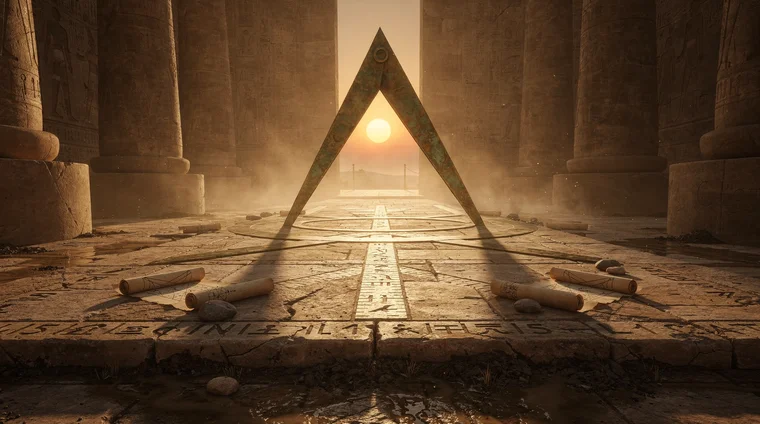
Geometry began with practical problems: measuring land, building temples, navigating seas. Ancient Egyptians used geometry to re-survey fields after the Nile flooded. In ancient Greece, mathematics became more abstract.
Euclid of Alexandria collected and organised geometric knowledge into a systematic framework around 300 BCE. His 13-volume work Elements started from five simple postulates and derived hundreds of theorems. It remained the standard geometry textbook for over 2,000 years.
Points, lines, and planes
Geometry builds from basic elements. A point has no size — just a position. A line extends infinitely in two directions. A plane is a flat surface that extends forever in two dimensions. From these, all shapes can be constructed.
Angles
An angle is formed where two lines or line segments meet. Angles are measured in degrees. A right angle is exactly 90°. An acute angle is less than 90°. An obtuse angle is between 90° and 180°. A straight angle is exactly 180°.
2D and 3D Shapes
Two-dimensional shapes exist in a flat plane. They have length and width but no depth. Common 2D shapes include triangles, quadrilaterals (squares, rectangles, parallelograms), circles, and polygons.
Triangles
Triangles are the simplest polygon — three sides and three angles that always add up to 180°. The Pythagorean theorem describes right-angled triangles: the square of the hypotenuse equals the sum of the squares of the other two sides (a² + b² = c²). This theorem has thousands of applications in engineering and construction.
3D geometry
Three-dimensional shapes have length, width, and height. Cubes, spheres, cylinders, cones, and pyramids are all 3D forms. Geometry tells us how to calculate their surface areas and volumes — essential for architecture, packaging, and engineering.
Coordinate geometry
René Descartes merged geometry and algebra in the 17th century. By placing shapes on a coordinate grid with x and y axes, any point can be described with two numbers. This allows equations to describe curves and shapes — and opened the door to calculus and modern physics.
Where Geometry Appears in the World
Geometry is not just school mathematics — it is everywhere.
Architecture and engineering
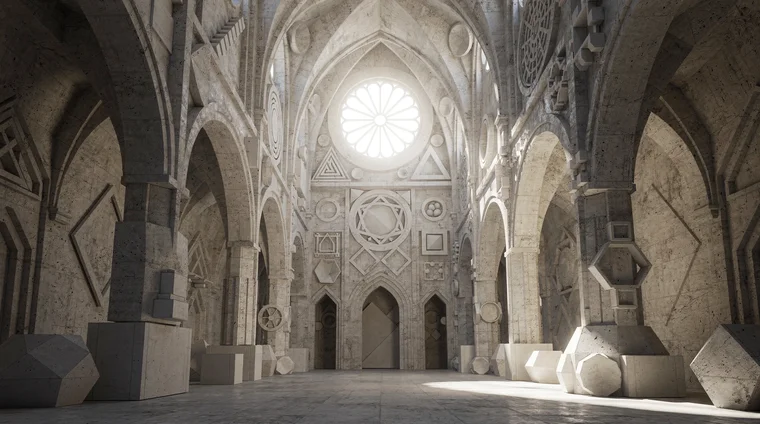
Every building is a geometry problem. Architects calculate loads, angles, and proportions to ensure structures are safe and functional. Bridges, domes, and arches depend on geometric principles. The geodesic dome — popularised by Buckminster Fuller — uses triangles to create maximum strength with minimum materials.
Art and design
Artists from ancient Greece to the Renaissance used geometry to create proportion and balance. The golden ratio — approximately 1:1.618 — appears in the Parthenon, Leonardo da Vinci's paintings, and the spiral of a nautilus shell. Graphic designers and architects still use it today.
Technology
Computer graphics and video games are built entirely on geometry. Every 3D model is a mesh of triangles. Every movement on screen is a geometric transformation — rotation, translation, or scaling. GPS navigation uses geometry to calculate routes and positions. Learn more about the history of geometry.
Frequently asked questions
- What is the difference between 2D and 3D geometry?
- 2D geometry deals with flat shapes that exist in a plane — triangles, circles, squares. They have area but no volume. 3D geometry adds a third dimension — depth — to create solid shapes like spheres, cubes, and pyramids. These have both surface area and volume. Most real-world applications involve 3D geometry.
- Why does the Pythagorean theorem work?
- The theorem states that in any right-angled triangle, the area of the square on the longest side equals the combined area of the squares on the other two sides (a² + b² = c²). It works because of the relationships between areas that arise from the properties of right angles. Over 370 different proofs exist.
- What is perimeter and how is it different from area?
- Perimeter is the total length of the boundary of a shape — the distance around the outside. Area is the amount of flat surface enclosed inside that boundary. A rectangle 4 cm wide and 3 cm tall has a perimeter of 14 cm (4+3+4+3) and an area of 12 cm² (4×3). They measure different things.
- What is geometry used for in real life?
- Geometry is used in architecture, engineering, art, navigation, computer graphics, robotics, and medicine. Surgeons use geometry to plan operations. Engineers use it to design safe structures. Game developers use it to build virtual worlds. Geometry is one of the most directly applicable areas of school mathematics.