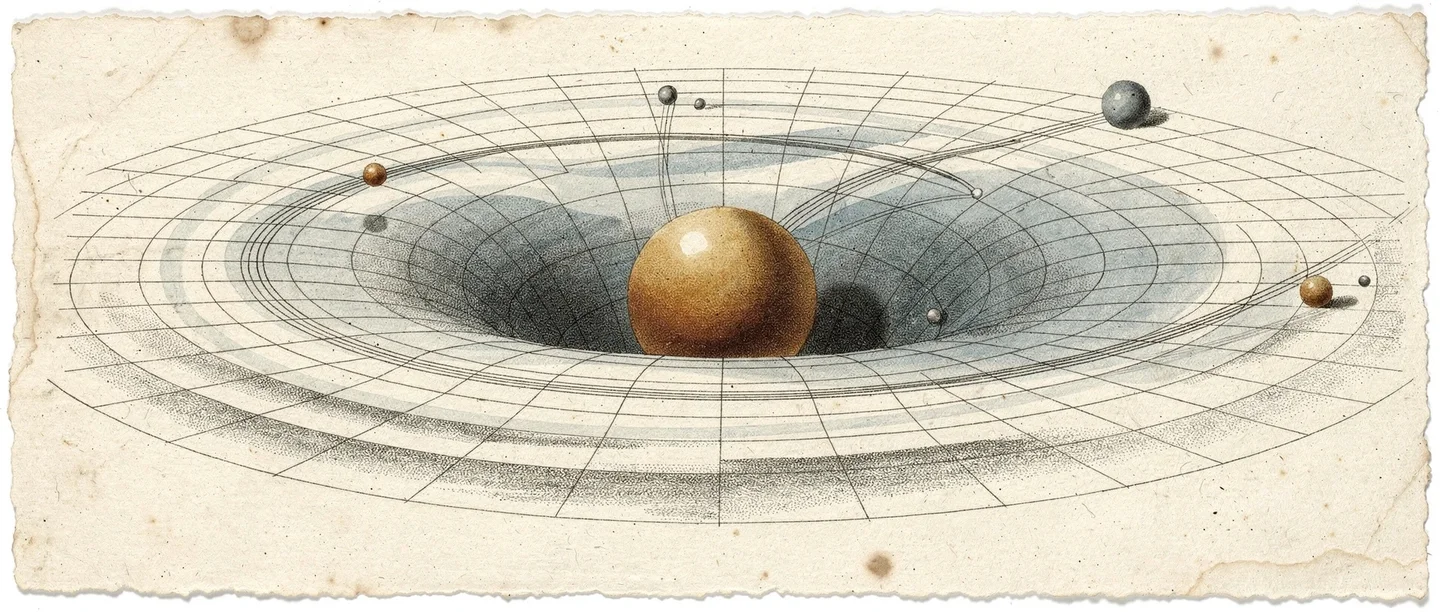
What is special relativity?
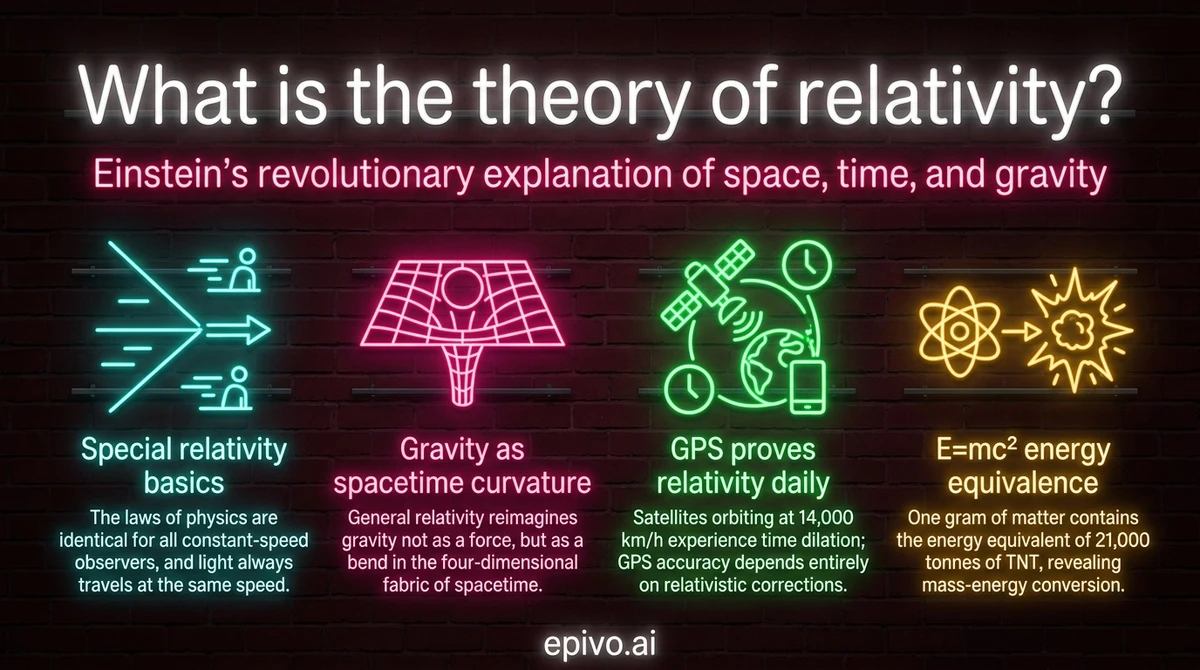
Einstein published special relativity in 1905. It starts with two ideas. First: the laws of physics are the same for everyone moving at a constant speed. Second: the speed of light is always 299,792 kilometres per second — no matter how fast the observer is moving.
These two ideas have a strange consequence: time passes at different rates depending on how fast you move. A clock on a fast-moving spacecraft ticks slightly more slowly than a clock sitting still on Earth. This effect is called time dilation. At everyday speeds the difference is tiny, but it becomes large near the speed of light.
What does E=mc² mean?
Special relativity also produced the most famous equation in science: E=mc². It says that energy (E) and mass (m) are two forms of the same thing. They are connected by the speed of light squared (c²). A tiny amount of mass contains an enormous amount of energy. Nuclear power plants — and the Sun itself — release energy by converting a small fraction of mass through nuclear reactions.
What is general relativity?
In 1915, Einstein extended his ideas to include acceleration and gravity. General relativity describes gravity not as a pulling force, but as a curvature in spacetime — the four-dimensional fabric of space and time.
A massive object like the Sun bends spacetime around it, the way a heavy ball bends a stretched rubber sheet. Other objects — planets, light, even signals — follow those curves. This is why Earth orbits the Sun. It is also why light bends near the Sun — confirmed by Eddington's 1919 solar eclipse observations.
How is gravity related to time?
General relativity also predicts that clocks in stronger gravitational fields tick more slowly. A clock on the ground ticks fractionally slower than a clock high in orbit, where gravity is weaker. This effect — gravitational time dilation — sits alongside the velocity effect from special relativity. Both are real, measurable, and together they affect every GPS satellite in orbit.
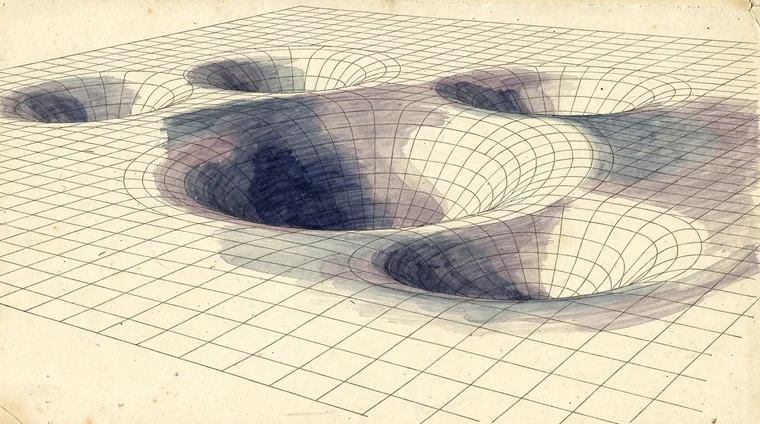
Image: Generated with AI (Epivo)
How GPS proves the theory of relativity
The clearest everyday proof of both theories is the GPS network. GPS satellites orbit Earth at about 14,000 kilometres per hour. That speed causes their clocks to tick roughly 7 microseconds slow per day, as predicted by special relativity. Those satellites sit in weaker gravity than clocks on the ground. General relativity predicts their clocks tick about 45 microseconds fast per day.
The net result is that GPS clocks gain approximately 38 microseconds per day relative to clocks on Earth's surface. That sounds tiny, but at the speed of light, 38 microseconds corresponds to about 10 kilometres of position error — every single day. Engineers understood this before the first GPS satellites launched. They programmed the satellite clocks to run slightly slow before launch so that, once in orbit, they tick at the correct rate.
Without these relativistic corrections, GPS navigation would drift by 10 kilometres per day and become useless within hours. Every time you use turn-by-turn navigation, you are relying on Einstein's theory of relativity. GPS.gov explains this in more detail.
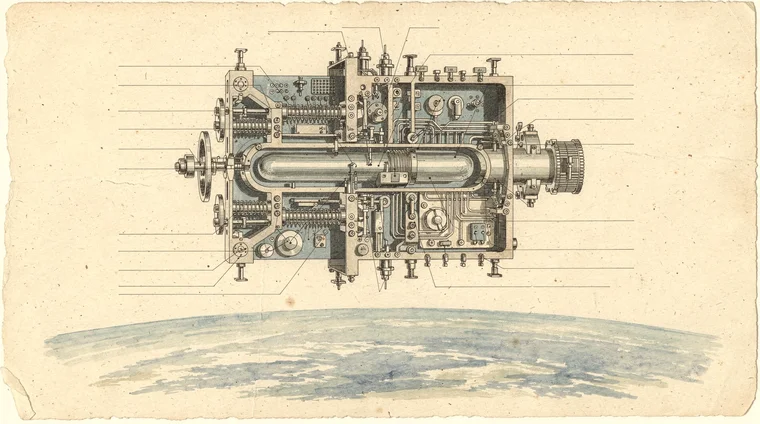
Image: Generated with AI (Epivo)
Did you know?
-
GPS satellites travel at about 14,000 km/h. Special relativity causes their clocks to tick 7 microseconds slow per day due to speed, while general relativity causes them to tick 45 microseconds fast per day due to weaker gravity. The net correction is 38 microseconds — equivalent to 10 km of position drift per day if left uncorrected.
Ashby N. 2003. Relativity in the Global Positioning System. Living Reviews in Relativity 6(1) -
E=mc² means a single gram of matter contains the same energy as about 21,000 tonnes of TNT. The Sun converts roughly 4 million tonnes of mass into energy every second through nuclear fusion, releasing the light and heat that powers life on Earth.
NASA Science. The Science of Relativity -
Einstein published special relativity in 1905, the same year he explained the photoelectric effect (for which he won the Nobel Prize) and Brownian motion. Physicists call 1905 his 'miracle year'. General relativity followed ten years later, in November 1915.
Feynman Lectures on Physics. Vol. I, Ch. 4. California Institute of Technology
What the theory of relativity means for students today
The theory of relativity can seem intimidating, but its core ideas are accessible once you build up the right foundations. Start with speed, distance, and time — the concepts are rooted in everyday experience, even if the conclusions are surprising.
Understanding relativity unlocks the most exciting questions in physics — black holes, gravitational waves, and the nature of time itself. It also connects to practical technology — from nuclear energy to GPS — making it one of the most applicable discoveries in the history of physics.
Epivo's International Curriculum teaches science from Grade 1 to Grade 12. Parents curious about how AI tutoring works can find more information on our page for parents.
For the technical treatment, see Ashby (2003) in Living Reviews in Relativity. The official GPS.gov resource explains the satellite system in accessible terms.
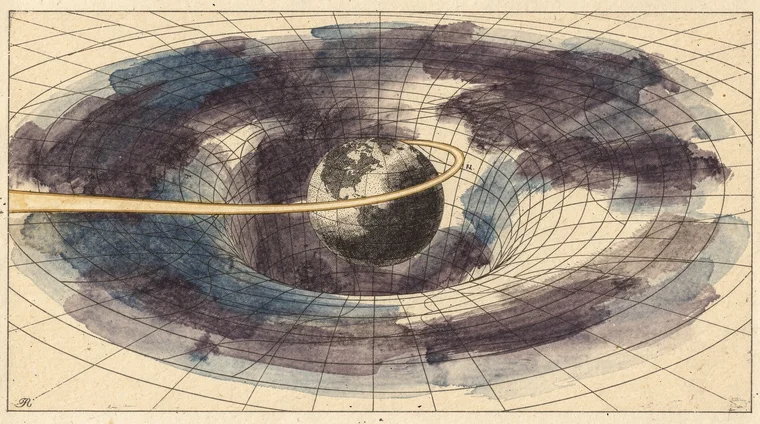
Image: Generated with AI (Epivo)
Frequently asked questions
- What is the theory of relativity in simple terms?
- The theory of relativity is Einstein's explanation of how space, time, and gravity work. Special relativity (1905) shows that the speed of light is constant and that moving clocks tick more slowly. General relativity (1915) shows that massive objects bend spacetime, which is what we experience as gravity. Both theories have been confirmed by experiments and are used in technologies including GPS satellites.
- What is the difference between special and general relativity?
- Special relativity deals with objects moving at constant speeds and has no gravity. It showed that time and space are not fixed — they depend on how fast you move. General relativity extended this to include acceleration and gravity, describing gravity as a curvature of spacetime rather than a force. General relativity contains special relativity as a special case.
- What does E=mc² actually mean?
- E=mc² says that mass and energy are two forms of the same thing. A small amount of mass (m) can be converted into an enormous amount of energy (E) because the conversion factor is c² — the speed of light squared, which is a very large number. Nuclear reactions release energy by converting a tiny fraction of mass. The Sun loses about 4 million tonnes of mass every second as it converts mass to light and heat.
- Has the theory of relativity ever been proven wrong?
- No. The theory of relativity has passed every experimental test it has faced for more than a century. Precise atomic clocks have confirmed time dilation from both velocity and gravity. The 2015 detection of gravitational waves by LIGO was a direct confirmation of general relativity. GPS systems require relativistic corrections to work accurately. No confirmed observation contradicts Einstein's theory, though physicists continue searching for its limits.
- Can anything travel faster than light?
- According to special relativity, no object with mass can reach or exceed the speed of light. As an object accelerates, it gains energy and behaves as if its mass increases, requiring ever more energy to accelerate further. Reaching the speed of light would require infinite energy. Massless particles like photons travel at the speed of light, but objects with mass are always slower.