
How does persuasion work in the brain?
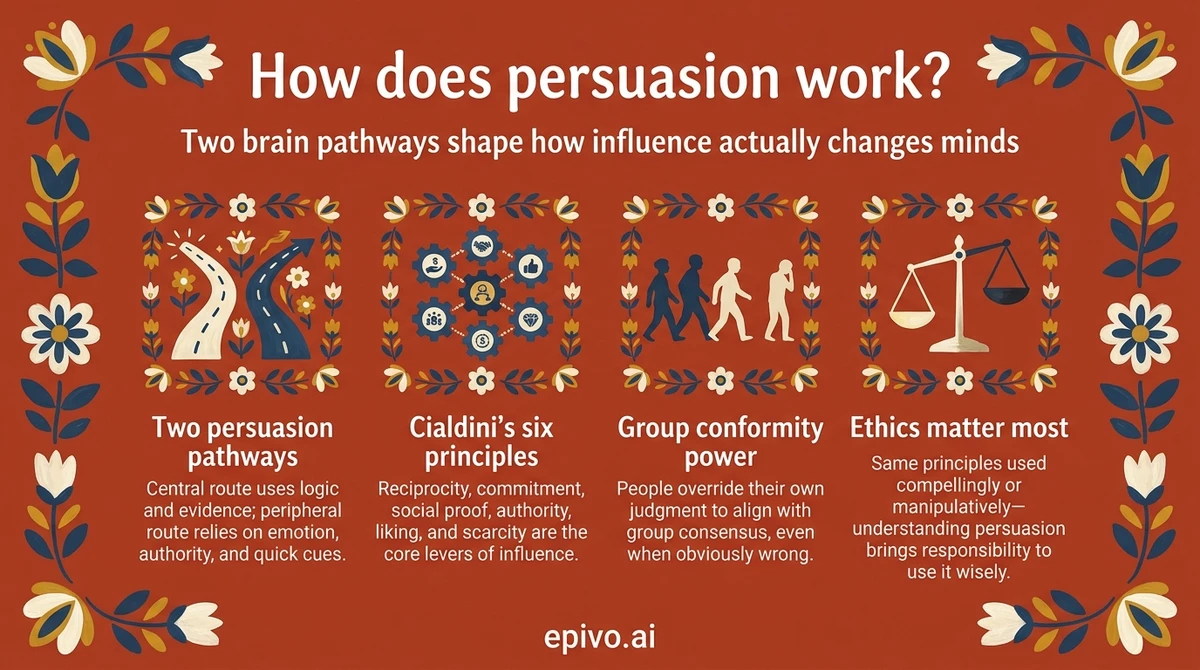
Persuasion is not a single process — it is at least two. Richard Petty and John Cacioppo's Elaboration Likelihood Model (ELM)60214-2) proposed in 1986 that attitude change follows two distinct routes. The key variable is how much you care about the issue at hand.
The central route activates when personal involvement is high. You carefully evaluate arguments, weigh evidence, and form an opinion based on logic and reasoning. Attitudes formed this way are durable and resistant to counter-persuasion.
The peripheral route dominates when motivation or ability to think carefully is low. Instead of scrutinising the argument, your brain reaches for shortcuts: How confident does the speaker sound? How many people agree? Is the source attractive or credible? These cues can shift attitudes without any real engagement with the underlying claims — but the resulting attitude change is shallow and easily reversed.
The practical implication is significant. When you are trying to persuade someone who genuinely cares about the issue — a hiring manager evaluating your pitch, a client weighing a major purchase — only strong arguments will work. Peripheral cues like confidence or social proof may even backfire by signalling that you lack substance. For low-involvement audiences, by contrast, framing, delivery, and source credibility can move the needle even when the argument itself is weak.
Understanding which route your audience is using is the first step to communicating persuasively.
Cialdini's six principles of persuasion
In 1984, psychologist Robert Cialdini published Influence: The Psychology of Persuasion after spending years working undercover inside sales, PR, and fundraising organisations. He identified six universal principles that cause people to say yes — often automatically, before conscious reasoning can intervene.
1. Reciprocity. We feel obligated to return favours. A free sample, an unsolicited gift, or a concession in a negotiation all trigger the urge to give something back.
2. Commitment and consistency. Once we commit to a position — even a small one — we feel internal pressure to act consistently with it. Getting a small 'yes' early makes a larger 'yes' far more likely.
3. Social proof. In uncertain situations, we look to what others are doing. A review count, a testimonial, or the phrase '75% of guests reuse their towels' all tap this mechanism.
4. Authority. We defer to experts, credentials, and symbols of expertise — sometimes regardless of whether the authority is genuinely relevant to the decision.
5. Liking. We are more easily persuaded by people we like, find physically attractive, or perceive as similar to ourselves.
6. Scarcity. Perceived rarity increases desire. 'Only three left in stock' exploits this principle — whether the scarcity is real or fabricated.
Cialdini emphasised that these principles operate automatically, 'often below conscious awareness.' As he wrote, 'The problem is that the weapons of automatic influence can cut both ways: they can be used in our best interests or our worst.' Knowing which principle is being deployed — by you or against you — is a core professional skill. You can explore these dynamics in depth through Epivo's psychology curriculum or read more on our for-parents page about how we develop these skills in young learners.

Persuasion at work: conformity and group influence
Persuasion does not only operate in one-to-one interactions. One of the most powerful forces shaping human decisions is the group itself.
In Solomon Asch's landmark conformity experiments, participants were shown a line of a given length and asked to match it to one of three comparison lines — an objectively easy task. When confederates unanimously gave the wrong answer, 75% of real participants conformed to the incorrect group response at least once. Most knew the group was wrong. They complied anyway.
This finding has direct implications for professional life. Team meetings, performance reviews, and strategy discussions are all social settings where conformity pressure operates beneath the surface. The most senior or confident voice in the room shapes what others say they believe — not because the argument is better, but because social proof and authority are working in tandem.
Digital environments have amplified this dynamic considerably. Dark patterns — design choices that exploit social proof, artificial scarcity, and commitment cues — are now embedded in subscription flows, checkout pages, and notification systems. A pre-ticked consent box exploits commitment. A countdown timer manufactures scarcity. A pop-up showing 'twenty people viewing this right now' deploys social proof. Recognising these as deliberate applications of persuasion principles is the first step to making genuinely free choices online.
For professionals in leadership, design, or sales roles, understanding conformity also raises an ethical question: when does legitimate influence become manipulation?

Did you know?
-
Cialdini's reciprocity principle has been replicated across 15 cultures, demonstrating cross-cultural robustness well beyond the original North American sample.
Cialdini, R. B. (1984). Influence: The Psychology of Persuasion. Harper Business. -
In Petty and Cacioppo's 1983 advertising study, high-involvement consumers were unmoved by the number of celebrity endorsers — only argument quality mattered. Low-involvement consumers showed the opposite pattern.
Petty, R. E., & Cacioppo, J. T. (1986). The elaboration likelihood model of persuasion. Advances in Experimental Social Psychology, 19, 123–205. -
Solomon Asch's conformity experiments found that 75% of participants gave at least one obviously wrong answer when the group unanimously stated the incorrect response.
Asch, S. E. (1955). Opinions and social pressure. Scientific American, 193(5), 31–35.
How to use and resist persuasion ethically
Understanding how persuasion works creates a responsibility. The same principles that help you communicate ideas compellingly can be deployed manipulatively — and the line between the two matters.
Cialdini draws the ethical boundary clearly: a persuasion technique is legitimate when it accurately reflects reality and helps the other person make a better decision. It becomes manipulation when it exploits a psychological shortcut to extract a decision the person would not make with full information. Genuine scarcity is informative. Fabricated scarcity is deceptive. Real social proof — what people in your situation actually do — is useful. Fake reviews are fraud.
Practical strategies for ethical influence
Match your approach to your audience. High-involvement audiences deserve strong arguments and evidence. Leaning on peripheral cues — status, confidence, liking — with someone who is carefully evaluating your case signals that you lack substance.
Name the principle you are using. Transparency about influence attempts paradoxically increases rather than decreases trust. Telling a client 'I want to show you what other companies in your sector are doing' is a more honest application of social proof than manufacturing the impression organically.
Slow down before you comply. Conformity pressure and peripheral cues work fastest when you are moving fast. When you notice urgency, scarcity framing, or heavy social proof, that is the moment to pause and ask: what do I actually think when I evaluate this carefully?
Pre-commit to your criteria. Before entering a negotiation or making a purchase decision, write down your criteria and walk-away conditions. Commitment and consistency principles work on your own stated positions — use this to your advantage by anchoring your decision to a considered position before the persuasion attempt begins.
Persuasion literacy — understanding cognitive bias, emotional intelligence, and influence principles together — is one of the most transferable skills a professional can develop. Epivo's psychology curriculum builds this fluency systematically.

Frequently asked questions
- How does persuasion work psychologically?
- Persuasion works through two main routes. When you are highly motivated and able to think carefully, you evaluate arguments on their merits — this is the central route. When motivation or attention is low, you rely on shortcuts such as source credibility, social proof, or confidence of delivery. Cialdini's six principles — reciprocity, commitment, social proof, authority, liking, and scarcity — describe the specific psychological mechanisms that trigger automatic compliance.
- What are Cialdini's six principles of persuasion?
- Cialdini identified six universal principles: reciprocity (we return favours), commitment and consistency (we act in line with prior statements), social proof (we follow what others do in uncertain situations), authority (we defer to experts), liking (we comply more with people we find attractive or similar), and scarcity (we want things we perceive as rare). These principles operate automatically and are used across sales, marketing, negotiation, and leadership.
- What is the Elaboration Likelihood Model?
- The Elaboration Likelihood Model (ELM), developed by Petty and Cacioppo in 1986, proposes that attitude change occurs via two routes. The central route involves careful evaluation of argument quality and produces durable attitude change. The peripheral route relies on cognitive shortcuts and cues — such as source attractiveness or confidence — and produces shallower, less lasting attitude change. Personal involvement in the issue is the key variable determining which route dominates.
- What did Asch's conformity experiments show about persuasion?
- Solomon Asch's experiments showed that social pressure is a powerful form of persuasion even when the group is clearly wrong. When confederates unanimously gave an incorrect answer to an obvious visual task, 75% of real participants conformed at least once. This demonstrates that social proof and conformity pressure operate even against direct sensory evidence — a finding with significant implications for team decision-making and organisational behaviour.
- How can you resist persuasion and manipulation?
- Effective resistance starts with recognising which principle is being applied. Slow down when you notice urgency, scarcity framing, or heavy social proof — these cues work fastest when you are moving fast. Pre-commit your decision criteria before entering high-stakes situations. For repeated influence contexts, inoculation research suggests that exposure to weakened versions of persuasion tactics, paired with explicit refutations, builds lasting resistance.
- What is the difference between persuasion and manipulation?
- Cialdini draws the line at accuracy and benefit. Persuasion is ethical when it uses genuine information to help someone make a better decision — real scarcity, authentic social proof, legitimate expertise. It becomes manipulation when it exploits a psychological shortcut using false or misleading information to extract a decision the person would reject with full awareness. The intent and accuracy of the influence attempt are what separate the two.