
What is active listening?
Active listening is not simply staying quiet while someone speaks. Psychologist Carl Rogers — whose person-centred therapy established the research foundation for the field — described active listening as being fully present with another person. This means suspending your own agenda, tracking both the words and emotions behind them, and responding to show genuine comprehension.
More than silence
A listener can remain completely silent and still fail to listen actively. Research by Nichols and Stevens — published in the Harvard Business Review in 1957 — showed that people typically retain only about 25% of what they hear, even when motivated to listen well. The gap exists because the brain processes speech roughly four times faster than people speak. This leaves spare cognitive capacity that the mind fills with distraction, rehearsal, or judgement.
The four components
Researchers identify four interdependent components that together constitute active listening. First, full attention: orienting your body and mind toward the speaker without distraction. Second, comprehension: processing both the literal content and the emotional undertone. Third, retention: holding key points in working memory so you can respond accurately. Fourth, response: offering feedback — verbal or nonverbal — that confirms understanding and keeps the speaker engaged.
All four components are necessary. Without visible response, the speaker cannot know whether understanding has occurred.
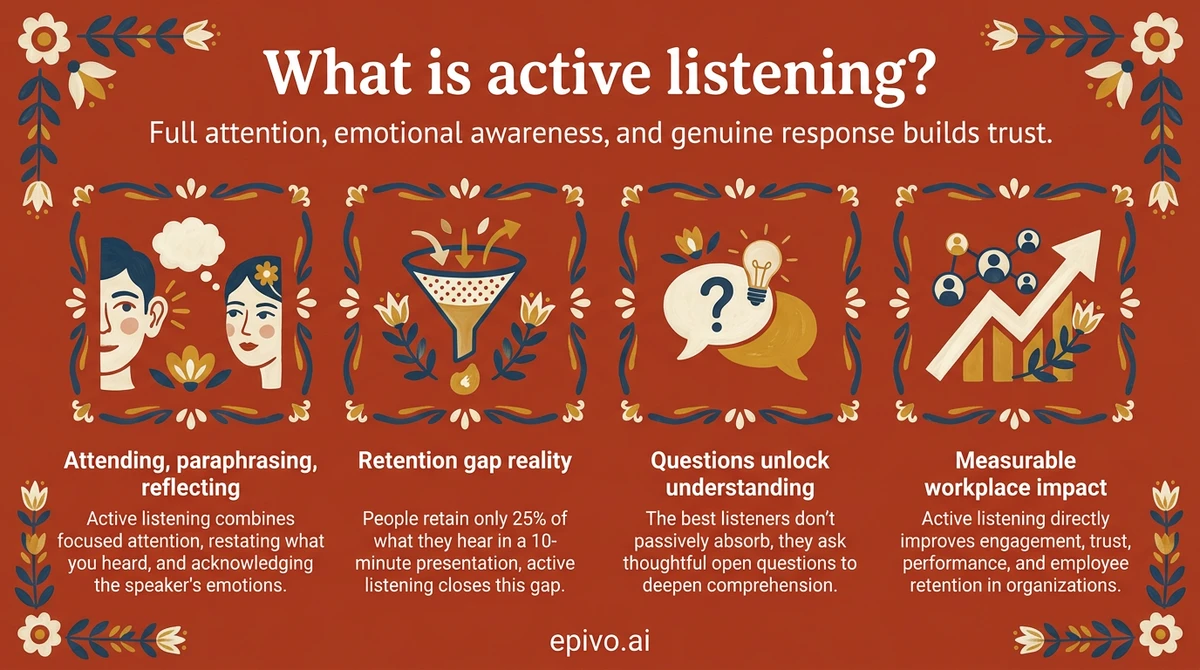
The core skills of active listening
Active listening is a set of learnable techniques, not a fixed personality trait. The skills most consistently supported by research are attending, paraphrasing, reflecting emotions, and asking open questions.
Paraphrasing and reflective listening
Paraphrasing means restating the speaker's message in your own words — not repeating it verbatim, which feels mechanical and signals that you processed sound rather than meaning. Miller and Rollnick, who developed Motivational Interviewing, identify two levels: simple reflection mirrors the literal content; complex reflection adds an inferred emotional tone for the speaker to confirm or adjust. Complex reflection opens richer conversations and builds trust more rapidly.
Asking open questions
A landmark 2016 study by Zenger and Folkman in the Harvard Business Review found that the best listeners are not merely absorbers. They ask questions that promote insight in the speaker — questions that challenge assumptions gently and open new lines of thought. This reframes active listening as a collaborative act, not a passive one.
Avoiding premature judgement
One of the most common listening failures is deciding you understand before the speaker finishes. Premature closure — substituting your internal model of what is being said for the actual incoming message — often masquerades as efficiency. In practice it produces repeated misunderstandings and erodes psychological safety over time. Suspending judgement until the speaker has finished is one of the highest-leverage habits a professional can develop.

Why active listening matters at work
Active listening has measurable effects on the outcomes that matter most to organisations: engagement, trust, performance, and retention.
Engagement and turnover
Research consistently shows that managers who practise active listening lead teams with higher engagement and lower turnover. When employees feel genuinely heard, they are more willing to raise problems early — before they escalate — and more committed to agreed solutions. The Zenger and Folkman HBR study found that being perceived as a good listener was one of the strongest predictors of being rated as a highly effective leader.
Psychological safety
Amy Edmondson's research on psychological safety at Harvard Business School shows that teams perform best when members believe their input will be received without punishment or ridicule. Active listening is one of the primary behaviours through which leaders signal that input is safe and valued. Leaders who interrupt frequently or display premature closure — 'I know what you're going to say' — systematically destroy the conditions that make high performance possible.
Conflict and negotiation
In conflict and negotiation contexts, active listening changes the dynamic entirely. Rather than each party working to win an argument, active listening reorients both sides toward understanding. Paraphrasing the other party's position before responding reduces defensiveness and surfaces misunderstandings that would otherwise harden into permanent disagreement.
For professionals who want to build these skills systematically, Epivo's communication and influence curriculum offers structured, AI-guided practice. You can also explore for parents to see how Epivo supports communication skills across all age groups.

Did you know?
-
Carl Rogers identified active listening as a core therapeutic skill in the 1940s, arguing that feeling genuinely heard is itself transformative — distinct from receiving advice or interpretation.
Rogers, C. R. (1957). The necessary and sufficient conditions of therapeutic personality change. Journal of Consulting Psychology, 21(2), 95–103. -
Ralph Nichols found that people typically retain only 25% of what they hear in a 10-minute presentation, even when motivated to listen well — because spare cognitive capacity drifts into distraction and response-rehearsal.
Nichols, R. G., & Stevens, L. A. (1957). Are you listening? Harvard Business Review, 35(5), 85–92. -
Zenger and Folkman's 2016 HBR study found that the best listeners don't just absorb — they ask questions that promote new insight in the speaker, making listening a collaborative rather than passive act.
Zenger, J., & Folkman, J. (2016). What great listeners actually do. Harvard Business Review.
Common barriers to active listening
Understanding what disrupts active listening is as important as knowing what it requires. Most barriers are internal rather than environmental.
Cognitive load and emotional reactivity
When cognitive load is high — under stress, distraction, or time pressure — working memory cannot fully process incoming speech. Emotional reactivity compounds this: when a speaker's words trigger a strong reaction, attention redirects to managing that emotional response, leaving fragments of speech to be filled in with assumptions. The practical fix is to notice the moment of emotional activation and deliberately pause before responding. Even a few seconds of conscious delay frees working memory enough to re-engage with what is actually being said.
Status and assumed familiarity
Status differences create systematic listening failures. High-status individuals frequently listen less carefully, assuming their own perspective is the more relevant one. In close working relationships, people often stop listening carefully because they assume they already know what the other person means. Both patterns share the same root: the listener substitutes an internal model of what is being said for the actual incoming message.
The speed gap
As Ralph Nichols observed, the mind processes speech roughly four or five times faster than the average person speaks. This spare capacity is not an asset — it is the primary source of listening failure. Listeners fill the gap by rehearsing responses, critiquing the speaker's delivery, or daydreaming. Directing that spare capacity back toward the speaker — attending to tone, hesitation, and nonverbal signals — transforms a structural liability into a listening advantage.

Frequently asked questions
- What is active listening in simple terms?
- Active listening means giving a speaker your full attention — tracking both their words and the emotions behind them — and responding in a way that shows genuine understanding. It is not just staying silent; it requires deliberate effort, visible responsiveness, and suspension of premature judgement.
- What are the key skills of active listening?
- The main skills are: full attention (orienting body and mind toward the speaker), paraphrasing (restating their message in your own words), reflecting emotions (acknowledging the feeling behind the words), asking open questions, and avoiding premature closure. Each skill builds on the others.
- How does active listening improve leadership?
- Managers who practise active listening lead teams with higher engagement and lower turnover. Zenger and Folkman's HBR research found that being perceived as a good listener is one of the strongest predictors of being rated as a highly effective leader. It also builds the psychological safety that underpins team performance.
- What is the difference between active listening and reflective listening?
- Active listening is the broader practice — attending fully, comprehending, retaining, and responding. Reflective listening is one specific technique within it: restating the speaker's message in your own words to make your understanding visible and give the speaker the chance to confirm or correct it.
- What are the most common barriers to active listening at work?
- The most common barriers are cognitive overload (limited working memory under stress), emotional reactivity (strong feelings redirecting attention away from the speaker), status bias (assuming your own view is more relevant), and premature closure (deciding you understand before the speaker finishes).
- Can active listening be improved with practice?
- Yes. Active listening is a learnable skill. Research underpinning Motivational Interviewing — which relies on reflective listening — shows consistent improvement with structured practice across more than 200 randomised controlled trials. Deliberate rehearsal of paraphrasing, open questioning, and emotional reflection all produce measurable gains.