
Morning meditation and the premeditation of adversity
The first of the Stoic exercises for daily life is the morning meditation, known in Latin as premeditatio malorum — the premeditation of adversity. The Stanford Encyclopedia of Philosophy confirms that this practice was central to Stoic training from the school's earliest days.
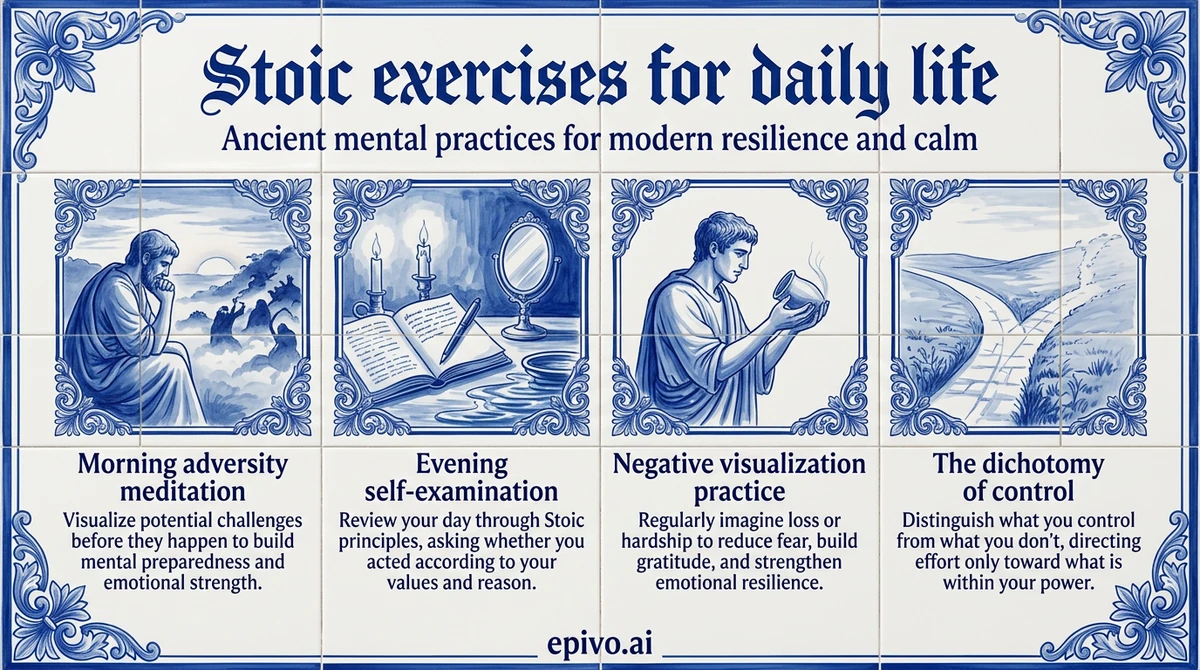
Marcus Aurelius began each day by mentally rehearsing the difficulties he expected to face. In the Meditations, he wrote: 'Begin the morning by saying to thyself, I shall meet with the busy-body, the ungrateful, arrogant, deceitful, envious, unsocial.' By anticipating obstacles in advance, the Stoic practitioner was not surprised or destabilised when they arrived.
This practice is not pessimism. Rather, it is a form of psychological preparation. When you have already considered that a meeting may go badly or that a plan may fail, you can respond calmly instead of reactively. Modern research on mental contrasting — imagining obstacles to a goal before pursuing it — confirms that this approach improves both planning and emotional resilience.
For students and parents alike, five minutes of morning reflection before a demanding day can shift the entire quality of attention. The goal is not to expect the worst, but to remain undisturbed when difficulty arrives.
Evening review and journaling
Two of the most consistent Stoic exercises for daily life are the evening review and journaling. Seneca described his nightly self-examination in Letters to Lucilius (Letter 83), asking three questions at the end of each day: What bad habit did I cure today? What weakness did I resist? What virtue did I increase? These questions make the Stoic exercises concrete and actionable rather than abstract.
Epictetus, in the Enchiridion, similarly teaches the evening review as a method for maintaining alignment between intention and action. Without regular self-examination, the gap between our stated values and our actual behaviour tends to widen unnoticed.
Marcus Aurelius extended these Stoic exercises through daily journaling. The Meditations is itself his private philosophical journal — written in Greek, the language of Stoic philosophy — in which he held himself accountable to Stoic principles day after day. He wrote not for an audience but for himself, as a daily act of self-correction.
Modern practitioners, including the author Ryan Holiday in The Daily Stoic, use journaling in the same way. Because what is Stoicism at its core is a practice, not just a doctrine, writing is one of the most effective tools for embedding it. A brief evening journal entry — noting where you acted well and where you fell short — creates a feedback loop that gradually changes behaviour.

Image: Generated with AI (Epivo)
Did you know?
-
Marcus Aurelius wrote the Meditations in Greek as a private journal during military campaigns. It was never intended for publication but has remained in continuous circulation since the 16th century.
Meditations — Marcus Aurelius (MIT Classics) -
Epictetus taught that before any action or event, you should ask: 'Is this in my control?' If yes, act. If no, accept. This single question is the foundation of the Stoic dichotomy of control.
Enchiridion — Epictetus (MIT Classics) -
Cognitive behavioural therapy (CBT), one of the most evidence-based treatments for anxiety and depression, drew directly from Stoic exercises. Both founders of CBT, Aaron Beck and Albert Ellis, cited Epictetus as a direct influence.
Stanford Encyclopedia of Philosophy — Stoicism
Negative visualization, the dichotomy of control, and the view from above
Several further Stoic exercises for daily life address how to relate to loss, circumstance, and perspective.
Negative visualization and memento mori
Negative visualization involves regularly contemplating the loss of things you value — possessions, relationships, health, or life itself. The goal is not to become anxious but to appreciate what you have and remain undisturbed when losses occur. Epictetus wrote: 'Never say of anything, I have lost it; but, I have returned it.' (Enchiridion 11.) This connects to the Roman practice of memento mori — 'remember you will die' — which encouraged gratitude and focus by keeping mortality in view.
The dichotomy of control
Epictetus' core teaching begins with a simple question: before each action, ask whether the outcome is within your control. If it is, act fully. If it is not, accept the result without distress. This daily habit, described in the opening line of the Enchiridion, changes the emotional response to circumstances over time. It is also one reason what is philosophy remains so practically useful — ancient ideas about the mind continue to shape modern therapy. These Stoic exercises for daily life have been adapted directly into cognitive behavioural therapy.
The view from above
Marcus Aurelius repeatedly describes imagining a cosmic perspective on human affairs. 'How tiny your time in infinity; your atom in the universe,' he wrote in Meditations 5.24. By mentally zooming out to see events from a vast distance, small frustrations lose their grip. This practice reduces anxiety about setbacks and helps maintain proportion.
Obstacle as opportunity
Finally, Marcus Aurelius articulated a reframing principle that modern coaches still use: 'The impediment to action advances action. What stands in the way becomes the way.' (Meditations 5.20.) Each difficulty, when approached as material for growth rather than as an obstacle to avoid, becomes an exercise in itself. Try a personal AI tutor to explore how these principles apply across subjects.

Image: Generated with AI (Epivo)
Frequently asked questions
- What are the main Stoic exercises for daily life?
- The main Stoic exercises for daily life include the morning meditation (premeditatio malorum), evening review, negative visualization, journaling, the dichotomy of control question, and the view from above. Together, these Stoic exercises are designed to strengthen resilience and focus through consistent daily practice.
- How do I start a Stoic morning meditation?
- Begin with five minutes before your day starts. List the difficulties you may encounter — demanding people, unexpected setbacks, or frustrating delays. Marcus Aurelius used this Stoic exercise every morning in the Meditations. The aim is preparation, not pessimism, so that when difficulties arise you respond calmly rather than reactively.
- What is negative visualization in Stoic practice?
- Negative visualization is a Stoic exercise that involves regularly imagining the loss of things you value — health, relationships, possessions — not to cause distress but to deepen appreciation and prepare for loss. Epictetus taught that nothing we have is truly ours to keep; we have only borrowed it temporarily.
- How is the Stoic evening review different from ordinary reflection?
- The Stoic evening review is a structured daily exercise drawn from Seneca: What bad habit did I cure? What weakness did I resist? What virtue did I increase? This three-question format focuses on character development rather than simply replaying events, which makes it more effective for behavioural change.
- Are Stoic exercises connected to modern psychology?
- Yes. Cognitive behavioural therapy (CBT) drew directly from Stoic exercises for daily life, particularly Epictetus' teaching that emotional distress comes not from events but from our judgements about them. Both Aaron Beck and Albert Ellis, the founders of CBT, cited Epictetus when developing their therapeutic approach.
- How long does it take to see benefits from Stoic daily practices?
- Stoic philosophers treated these exercises as a lifelong practice rather than a quick fix. However, consistent daily use of even one Stoic exercise — such as the morning premeditation or the dichotomy of control question — tends to produce measurable changes in emotional responses within a few weeks.