What the dichotomy of control teaches
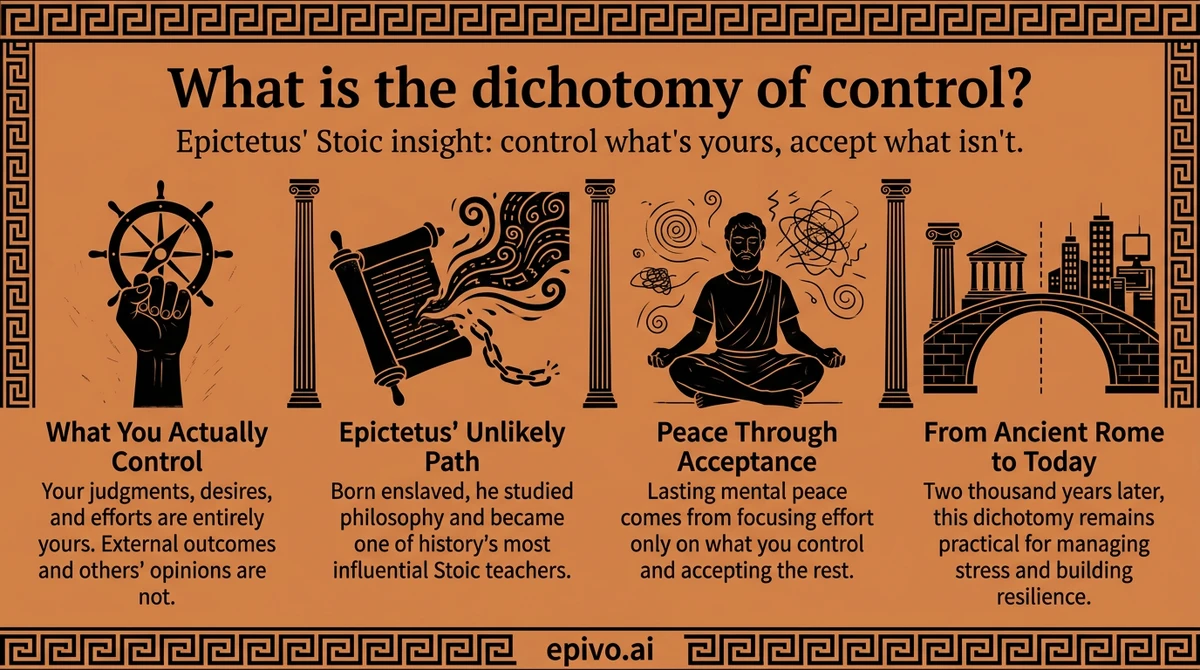
The dichotomy of control appears at the very first line of the Enchiridion, the handbook compiled from Epictetus’ teachings by his student Arrian. Epictetus wrote: “Some things are in our control and others not. Things in our control are opinion, pursuit, desire, aversion, and, in a word, whatever are our own actions. Things not in our control are body, reputation, command, and, in one word, whatever are not our own actions.” (Enchiridion 1)
In plain terms, everything that belongs to your own mind and will is in your control. Everything outside your mind — your health, your social status, the weather, other people’s behaviour — is not. The Stoics used the Greek phrase eph’ hēmin (“in our power”) for the first category and ouk eph’ hēmin (“not in our power”) for the second.
Epictetus drew a sharp conclusion from this division. When we treat things outside our control as if we could control them, we suffer. We become anxious about outcomes we cannot guarantee, and frustrated when the world refuses to cooperate. However, when we focus only on our own judgements and responses, we remain steady regardless of circumstances.
This is not fatalism. Epictetus did not say you should stop acting in the world. He said you should act wholeheartedly while holding the outcome lightly. For example, you can prepare thoroughly for an exam (in your control) without tying your wellbeing to the grade you receive (not in your control). Understanding the dichotomy of control means understanding that effort and outcome belong to different categories entirely.
To understand the broader tradition behind this idea, see our introduction to what is Stoicism.
Who was Epictetus?
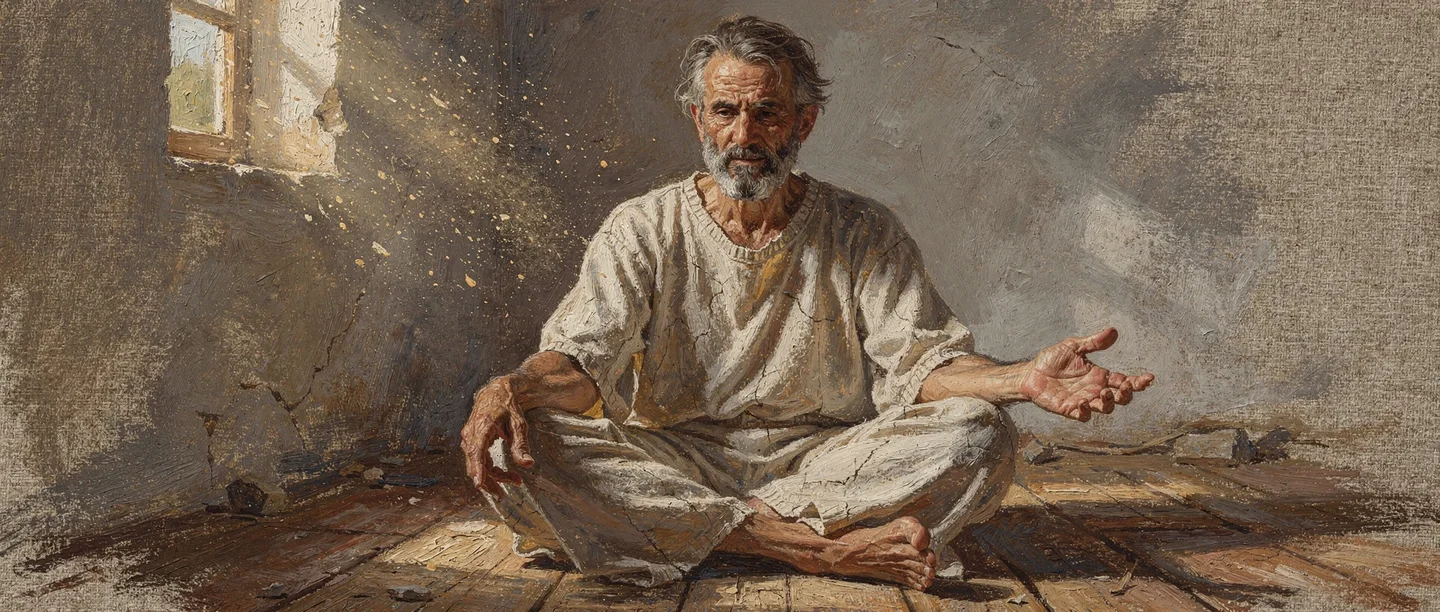
Epictetus (c. 50–135 CE) was born into slavery in Hierapolis, a city in what is now modern Turkey. His name literally means “acquired” in Greek — a stark reminder of his origins. Despite his circumstances, his master allowed him to study philosophy under the Stoic teacher Musonius Rufus in Rome.
After gaining his freedom, Epictetus founded a school of philosophy in Nicopolis, Greece. He attracted students from across the Roman world, including the historian Arrian, who wrote down his lectures. These notes survive as the Discourses and the shorter Enchiridion, the two main sources for the dichotomy of control and his broader philosophy.
Epictetus never wrote anything himself. Everything we know of his teaching comes through Arrian’s records. Nevertheless, his influence was enormous. The Roman emperor Marcus Aurelius read Epictetus closely and applied the dichotomy of control throughout his Meditations. In Meditations 6.52, Marcus wrote: “Everything harmonises with me, which is harmonious to thee, O Universe.” This acceptance of external events while exercising inner discipline is the dichotomy of control in practice.
The Stanford Encyclopedia of Philosophy notes that Epictetus placed the concept of prohairesis — our rational faculty or “will” — at the centre of Stoic ethics. It is this faculty that is fully in our control and therefore the only legitimate source of our wellbeing.

Image: Generated with AI (Epivo)
Did you know?
-
Epictetus was born into slavery around 50 CE. His master allowed him to study philosophy in Rome, and he later gained his freedom and founded his own school in Nicopolis, Greece.
Stanford Encyclopedia of Philosophy — Stoicism -
The Enchiridion opens immediately with the dichotomy of control: “Some things are in our control and others not.” Epictetus placed this distinction at the very foundation of the good life.
Enchiridion — Epictetus (MIT Classics) -
Marcus Aurelius kept a personal journal of Stoic self-examination, later called the Meditations. He applied the dichotomy of control daily to the pressures of ruling the Roman Empire.
Internet Encyclopedia of Philosophy — Marcus Aurelius
How to apply the dichotomy of control in everyday life
The practical power of the dichotomy of control becomes clear when you apply it to situations that actually cause stress. Each example below shows how the principle works in practice.
Exam stress. You cannot control the difficulty of the questions or what your teacher decides to include. However, you can control how much you study, how you organise your revision, and the attitude you bring into the exam room. Focusing your energy there — rather than worrying about outcomes — is the Stoic approach.
Rejection. Whether someone accepts or rejects you — socially, romantically, or professionally — is not in your control. What is in your control is how you interpret that rejection and what you choose to do next. As Epictetus put it: “People are disturbed not by things, but by their opinions about things.” (Enchiridion 5)
Health. You cannot always prevent illness. However, you can control whether you seek treatment, maintain a healthy lifestyle, and face illness with equanimity rather than despair.
Some modern philosophers, including William Irvine in A Guide to the Good Life, have proposed a “trichotomy of control” to refine Epictetus’ original idea. They add a middle category: things partially in our control, such as whether we win a tennis match. We control our effort and preparation, but not the final result. This refinement is especially useful for students navigating competitive situations. In each case, therefore, the dichotomy of control directs attention toward what is genuinely actionable.
The connection to modern psychology is direct. Albert Ellis, who founded Rational Emotive Behavior Therapy (REBT), explicitly cited Epictetus as an inspiration. The core REBT insight — that our distress comes from our beliefs about events, not the events themselves — restates the dichotomy of control in therapeutic language. If you want to explore how what is philosophy connects to wellbeing, the Stoic tradition is an excellent place to start.
Epictetus summarised the practical application simply: “Make the best use of what is in your power, and take the rest as it happens.” (Enchiridion 1) That single instruction, if genuinely practised, transforms the way students, parents, and anyone facing uncertainty relates to the challenges of daily life.

Image: Generated with AI (Epivo)
Frequently asked questions
- What is the dichotomy of control in simple terms?
- The dichotomy of control is the Stoic teaching that some things are up to us — our thoughts, intentions, and responses — and other things are not, such as our health, reputation, and other people’s behaviour. Suffering comes from treating the second category as if it were the first.
- Who first taught the dichotomy of control?
- Epictetus, a Stoic philosopher who lived from around 50 to 135 CE, is the philosopher most closely associated with the dichotomy of control. It opens the Enchiridion, the handbook of his teachings compiled by his student Arrian.
- How is the dichotomy of control different from not caring?
- The dichotomy of control does not mean passive indifference. Epictetus encouraged full engagement with life. The key distinction is that you act with complete effort on what is in your control, while accepting without distress whatever results follow. It is about where you place your emotional investment, not whether you act.
- What is the trichotomy of control?
- The trichotomy of control, developed by philosopher William Irvine, adds a middle category to Epictetus’ original two. It distinguishes things fully in our control (our judgements), things partially in our control (the outcome of a competitive effort), and things entirely outside our control (weather, other people’s decisions). This refinement helps apply the idea to real-world situations.
- How does the dichotomy of control relate to CBT and therapy?
- Albert Ellis founded Rational Emotive Behavior Therapy (REBT) directly citing Epictetus. REBT holds that emotional distress comes from irrational beliefs about events rather than from the events themselves — which mirrors the dichotomy of control exactly. Many cognitive-behavioural techniques, such as challenging unhelpful thoughts, apply Stoic principles in a modern clinical setting.
- Can the dichotomy of control help with anxiety?
- Yes. Anxiety often involves focusing on outcomes we cannot guarantee — whether we will pass an exam, be accepted, or stay healthy. The dichotomy of control redirects attention to what we can actually influence: preparation, effort, and attitude. Research supports the effectiveness of this kind of cognitive reframing in reducing anxiety.