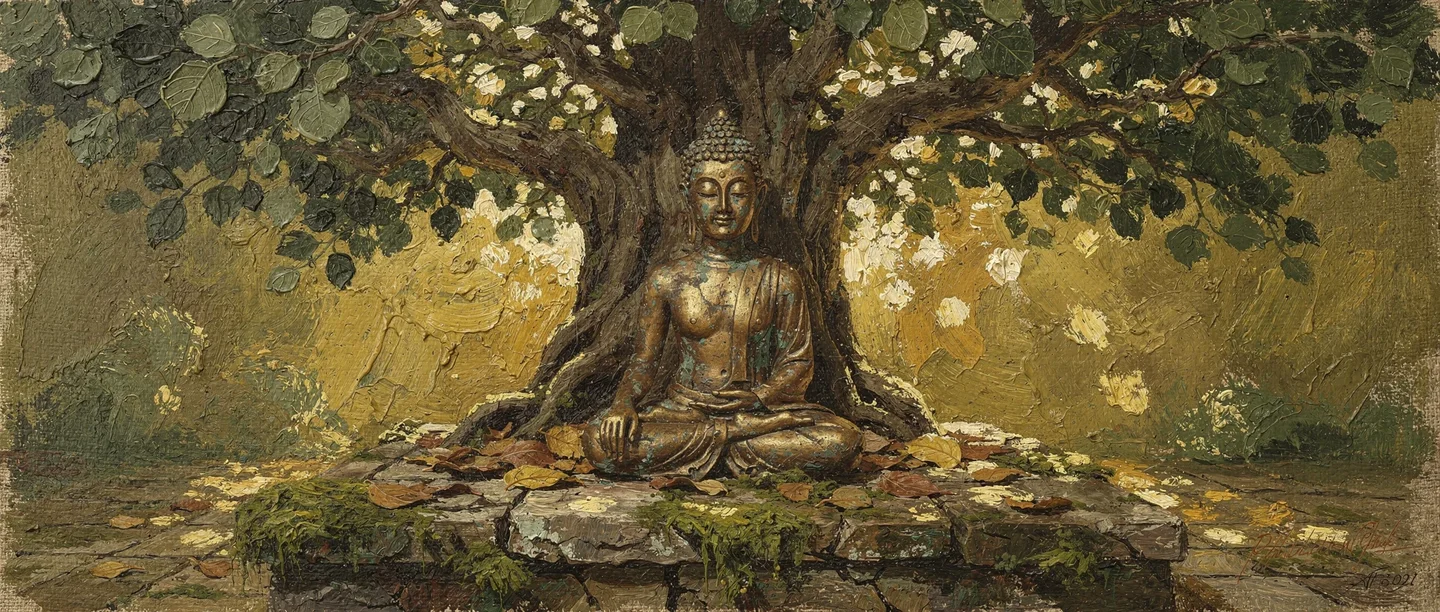
The life of Siddhartha Gautama
Siddhartha Gautama was born around 563 BCE into a royal family in Lumbini, in present-day Nepal. According to tradition, his father shielded him from all suffering. Yet as a young man, Siddhartha encountered old age, sickness, and death for the first time.
These encounters shattered his sheltered worldview. Consequently, at the age of 29 he left his palace, his wife, and his newborn son to seek an answer to human suffering. For six years he studied with various teachers and practised extreme asceticism. However, neither luxury nor self-denial brought him understanding.
Finally, sitting beneath a Bodhi tree in Bodh Gaya, he resolved not to move until he reached enlightenment. After deep meditation, he attained what Buddhists call nirvana — a state of complete liberation from suffering and the cycle of rebirth. From that point he became the Buddha.
The Buddha spent the remaining 45 years of his life teaching across northern India. He established a community of monks and nuns (the Sangha) and attracted followers from all social classes. His teachings, known as the Dharma, were preserved orally and later written down. Importantly, the Buddha did not claim to be a god. He described himself as a teacher who had found a path that others could follow. This distinguishes Buddhism from many other religious traditions. Its roots connect closely to the broader Hindu philosophical tradition, though the Buddha rejected key Hindu ideas like the caste system and the concept of an eternal soul.
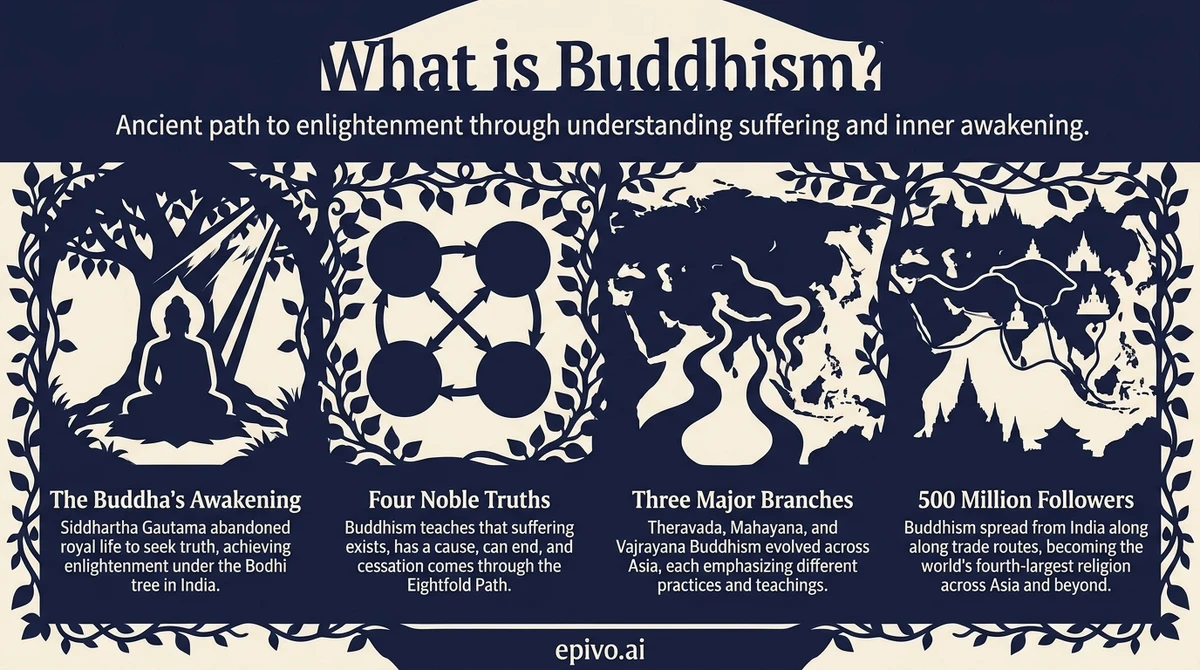
What are the core teachings of Buddhism?
The core teachings of Buddhism centre on understanding suffering and the path to overcoming it. The Buddha's first sermon at Sarnath laid out the framework that all Buddhist traditions share.
The Four Noble Truths
First, dukkha: life involves suffering, dissatisfaction, and impermanence. Second, samudaya: suffering arises from craving, attachment, and ignorance. Third, nirodha: it is possible to end suffering. Fourth, magga: the way to end suffering is the Eightfold Path.
The Noble Eightfold Path
The Eightfold Path provides a practical guide for ethical living, mental discipline, and wisdom. It includes right understanding, right intention, right speech, right action, right livelihood, right effort, right mindfulness, and right concentration. These are not steps to follow in sequence. Instead, they are practised together as an integrated way of life.
The Three Marks of Existence
Buddhism also teaches three fundamental characteristics of all existence. Anicca (impermanence) means nothing lasts forever. Dukkha (suffering) means that clinging to impermanent things causes pain. Anatta (non-self) means there is no permanent, unchanging soul. This last idea is one of the most distinctive features of Buddhist thought. It directly challenges the Hindu concept of Atman, an eternal self. As a result, debates between Buddhist and Hindu philosophers shaped the intellectual history of Asia for centuries.
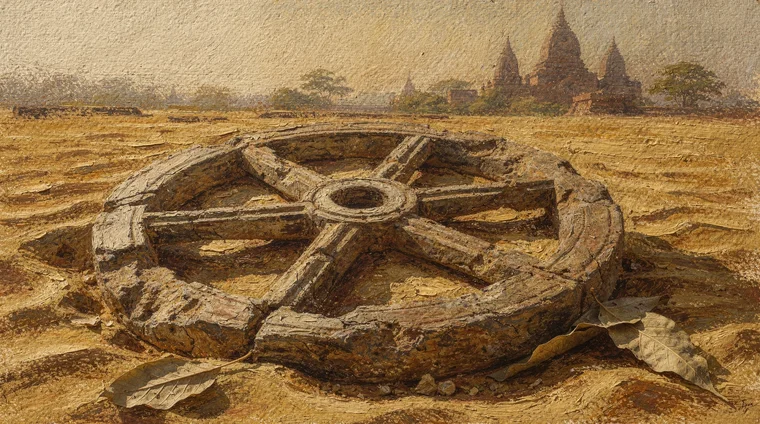
The major branches of Buddhism
Over the centuries, Buddhism evolved into three major branches, each with its own emphasis and geographical reach.
Theravada Buddhism
Theravada, meaning "the Teaching of the Elders," is considered the oldest surviving branch. It emphasises individual liberation through meditation, ethical conduct, and study of the earliest scriptures (the Pali Canon). Theravada is the dominant form of Buddhism in Sri Lanka, Myanmar, Thailand, Laos, and Cambodia.
Mahayana Buddhism
Mahayana, meaning "the Great Vehicle," emerged around the 1st century CE. It introduced the ideal of the bodhisattva — a being who delays their own final liberation in order to help all sentient beings achieve enlightenment. Mahayana spread to China, Korea, Japan, and Vietnam. It includes diverse traditions such as Pure Land Buddhism and Zen Buddhism.
Vajrayana Buddhism
Vajrayana, meaning "the Diamond Vehicle," developed from Mahayana and incorporates tantric practices, rituals, and meditation techniques. It is the dominant form of Buddhism in Tibet, Mongolia, and Bhutan. The Dalai Lama, the spiritual leader of Tibetan Buddhism, is perhaps the most recognised Buddhist figure in the world today.

Buddhism in the world today
Buddhism has shaped civilisations across Asia for over two millennia. Today it continues to grow and adapt in new cultural contexts.
From its origins in India, Buddhism spread along trade routes. Monks carried it to Sri Lanka in the 3rd century BCE, to Central Asia and China by the 1st century CE, and then to Korea, Japan, and Southeast Asia. In each region, Buddhism absorbed local traditions while maintaining its core teachings. Remarkably, Buddhism largely disappeared from India itself by the 13th century, though it has experienced a modern revival.
In the 20th and 21st centuries, Buddhism has also gained a significant following in Europe, North America, and Australia. Meditation practices rooted in Buddhist traditions, particularly mindfulness, have entered mainstream education and healthcare. Furthermore, the ideas of Confucianism and Buddhism interacted deeply in East Asia, producing unique philosophical syntheses.
Today, an estimated 500 million people identify as Buddhists. The tradition's emphasis on compassion, non-violence, and inner transformation continues to attract new practitioners. For students studying world religions and philosophy, Buddhism offers a profound example of how ideas can travel across cultures and centuries while remaining relevant to contemporary life.
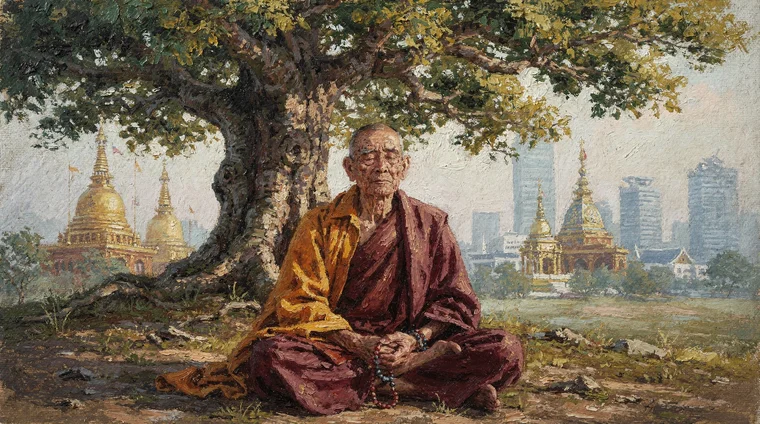
Did you know?
-
Buddhism is the world's fourth-largest religion, with approximately 500 million followers — about 7% of the global population.
Pew Research Center — The Global Religious Landscape -
The Pali Canon, the earliest complete collection of Buddhist scriptures, contains over 10,000 discourses attributed to the Buddha and was first written down in Sri Lanka around 29 BCE.
Encyclopaedia Britannica — Tipitaka -
The Bodhi tree in Bodh Gaya, India — where the Buddha is said to have attained enlightenment — is a UNESCO World Heritage Site and remains a major pilgrimage destination.
UNESCO — Mahabodhi Temple Complex at Bodh Gaya
Frequently asked questions
- Is Buddhism a religion or a philosophy?
- Buddhism is both. It includes religious practices such as meditation, rituals, and monastic communities. At the same time, it offers a systematic philosophy addressing suffering, ethics, and the nature of reality. Some practitioners treat it as a spiritual path; others approach it as a philosophical framework.
- Do Buddhists believe in God?
- Buddhism does not centre on a creator God. The Buddha did not deny or affirm the existence of gods. Instead, he focused on practical methods for ending suffering. Some Buddhist traditions include devotional practices, but the core teaching is about personal liberation through ethical conduct and meditation.
- What is nirvana in Buddhism?
- Nirvana is the ultimate goal of Buddhist practice. It means the cessation of suffering, craving, and the cycle of rebirth. It is not a place but a state of liberation and peace. The Buddha described it as the end of greed, hatred, and delusion.
- What is the difference between Theravada and Mahayana Buddhism?
- Theravada focuses on individual liberation through meditation and following the earliest scriptures. Mahayana emphasises the bodhisattva ideal — helping all beings achieve enlightenment. Theravada is dominant in Southeast Asia; Mahayana is prevalent in East Asia.
- How is Buddhism different from Hinduism?
- Buddhism rejects the Hindu caste system and the concept of an eternal soul (Atman). Both traditions share ideas like karma and rebirth, but Buddhism teaches non-self (anatta) instead. The Buddha also rejected the authority of the Vedas, the foundational Hindu scriptures.