
The 19th-century roots of the movement
Existentialism did not appear suddenly. It grew from ideas developed by 19th-century thinkers who challenged established assumptions about human nature and purpose.
The Danish philosopher Soren Kierkegaard (1813–1855) is often called the father of existentialism. He argued that truth is not something learned from a textbook but something each person must discover through lived experience. Kierkegaard criticised the established Church for turning faith into a comfortable routine. He insisted that genuine religious commitment requires a personal, often agonising 'leap of faith.'
The German philosopher Friedrich Nietzsche (1844–1900) pushed further. He declared that traditional moral systems had lost their authority — a situation he described as 'God is dead.' This was not a statement of atheism but a diagnosis: the foundations on which European civilisation had built its values were crumbling. Nietzsche challenged individuals to create their own values rather than inherit them passively.
Both thinkers shared a conviction that philosophy must begin with the concrete experience of the individual, not with abstract systems. As the Stanford Encyclopedia of Philosophy notes, this emphasis on personal existence, choice, and responsibility laid the groundwork for the existentialist movement that followed.
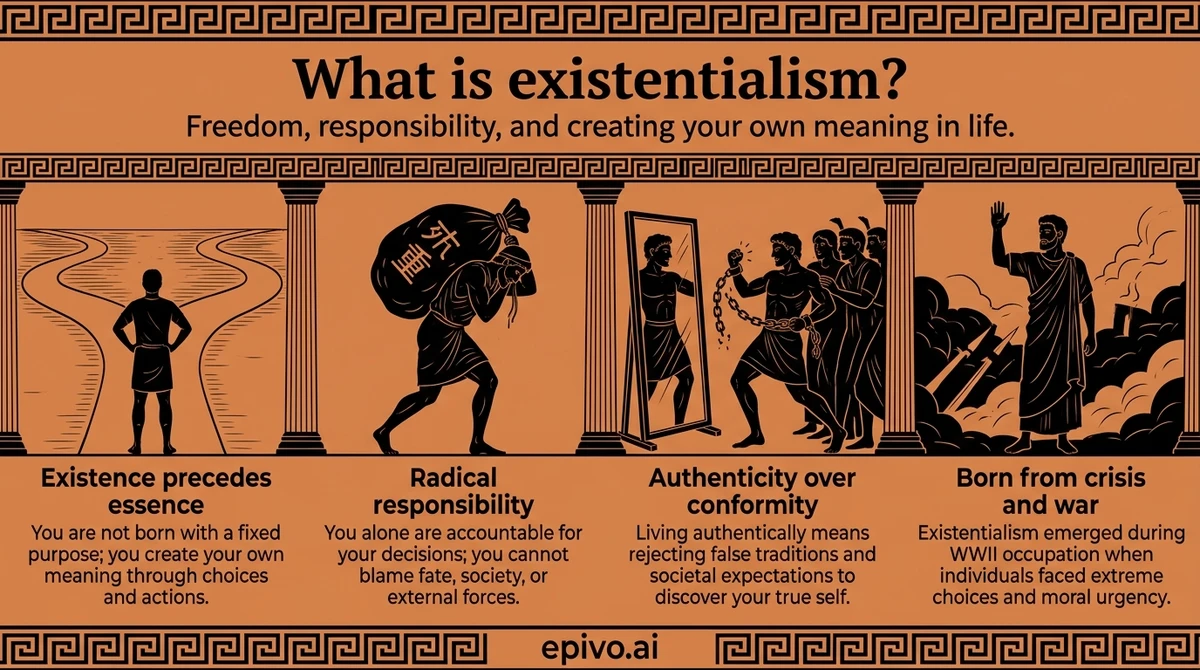
What are the core ideas of existentialism?
Existentialism centres on several interconnected themes. Together, they form a distinctive way of understanding human life.
Existence precedes essence
The French philosopher Jean-Paul Sartre (1905–1980) coined the phrase that became existentialism's motto: 'existence precedes essence.' A hammer is designed with a purpose before it is made — its essence comes before its existence. But human beings, Sartre argued, are the opposite. We exist first and then must decide what we will become. There is no predetermined human nature that dictates how we should live.
Freedom and responsibility
If there is no fixed human nature, then individuals are radically free. However, this freedom brings enormous responsibility. We cannot blame God, society, or upbringing for our choices. Sartre wrote that we are 'condemned to be free' — whether we like it or not, we must choose, and we bear full responsibility for those choices.
Authenticity and bad faith
Existentialists distinguished between authentic and inauthentic living. Authenticity means acknowledging your freedom and making genuine choices. 'Bad faith' — Sartre's term — describes the self-deception of pretending you have no choice. A waiter who loses himself entirely in the role, a student who claims 'I had no option' — both are in bad faith.
Anxiety and absurdity
Confronting radical freedom produces anxiety (Angst). The German philosopher Martin Heidegger (1889–1976) argued that this anxiety reveals the true nature of our existence. Albert Camus (1913–1960) explored a related idea — the absurd — the tension between humanity's desire for meaning and a universe that offers none. Rather than despair, Camus urged defiance: we must imagine, he wrote, that Sisyphus is happy.

Image: Generated with AI (Epivo)
Existentialism, World War 2, and its key figures
Existentialism became a major cultural force during and after World War 2. The experience of occupation, resistance, and mass destruction gave its themes — freedom, choice under extreme pressure, and the absence of guarantees — immediate urgency.
Jean-Paul Sartre and Simone de Beauvoir
Sartre and Simone de Beauvoir (1908–1986) were the public faces of existentialism in post-war Paris. Sartre's Being and Nothingness (1943) provided the philosophical framework. Beauvoir's The Second Sex (1949) applied existentialist ideas to the situation of women, arguing that 'one is not born, but rather becomes, a woman.' Both were active in the French Resistance and saw existentialism as inseparable from political engagement.
Albert Camus
Camus edited the Resistance newspaper Combat during the German occupation of France. His novels The Stranger (1942) and The Plague (1947) explored alienation, mortality, and moral choice. Camus won the Nobel Prize in Literature in 1957.
Martin Heidegger and Karl Jaspers
Heidegger's Being and Time (1927) explored human existence, temporality, and authenticity. His legacy, however, is complicated by his involvement with the Nazi Party. Karl Jaspers (1883–1969) developed ideas about limit situations — extreme experiences such as death, guilt, and suffering — that force individuals to confront the meaning of their existence.
Existentialism's influence extended well beyond philosophy into literature, theatre, art, and psychology. Existential psychotherapy, developed by figures such as Viktor Frankl and Rollo May, applies these ideas to help people find meaning in suffering.

Image: Generated with AI (Epivo)
Why existentialism still matters today
Existentialism is not a relic of post-war Europe. Its core questions — how to live authentically, how to create meaning, and how to take responsibility for your choices — remain deeply relevant.
In psychology, existential therapy helps individuals facing anxiety, loss, and identity crises. Viktor Frankl's Man's Search for Meaning (1946), written after his imprisonment in Nazi concentration camps, argues that finding purpose is essential to human survival. According to the Viktor Frankl Institute, the book has sold over 16 million copies worldwide.
In literature and film, existentialist themes continue to appear. Works exploring alienation, freedom, and the search for meaning owe a clear debt to Sartre, Camus, and Beauvoir. The questions these thinkers raised also connect to other philosophical traditions, including Stoicism, which similarly asks how individuals should respond to circumstances beyond their control.
For students, existentialism offers a framework for thinking about identity, responsibility, and the choices that shape a life. It encourages critical examination of received ideas and the courage to think independently. In an era of information overload and social pressure, the existentialist emphasis on authenticity is more relevant than ever.

Image: Generated with AI (Epivo)
Did you know?
-
Jean-Paul Sartre was awarded the Nobel Prize in Literature in 1964 but refused to accept it, saying he did not wish to be 'transformed into an institution.' He remains the only person to have voluntarily declined the prize.
Nobel Prize — Jean-Paul Sartre -
Simone de Beauvoir's The Second Sex (1949) is considered a founding text of modern feminism. Her existentialist argument — that women are made, not born — challenged biological determinism and reshaped gender studies worldwide.
Stanford Encyclopedia of Philosophy — Simone de Beauvoir -
Viktor Frankl's Man's Search for Meaning, inspired by existentialist ideas about purpose and freedom, has sold over 16 million copies and been translated into more than 50 languages since its publication in 1946.
Viktor Frankl Institute
Frequently asked questions
- What is existentialism in simple terms?
- Existentialism is a philosophy that says people are free to define their own meaning and purpose in life. There is no preset plan. Each person must make choices and take responsibility for them.
- Is existentialism the same as nihilism?
- No. Nihilism holds that life has no meaning at all. Existentialism acknowledges that the universe does not provide meaning — but argues that individuals can and must create it through their choices and actions.
- Who are the most famous existentialist philosophers?
- The most well-known existentialists are Jean-Paul Sartre, Simone de Beauvoir, Albert Camus, Martin Heidegger, and Karl Jaspers. Earlier precursors include Soren Kierkegaard and Friedrich Nietzsche.
- What does 'existence precedes essence' mean?
- It means that human beings are not born with a fixed nature or purpose. We exist first and then create our identity through the choices we make. Sartre considered this the foundational principle of existentialism.
- How is existentialism relevant to students?
- Existentialism encourages critical thinking about identity, responsibility, and values. It challenges students to examine their choices rather than passively accepting expectations from family, peers, or society.