
What human rights are
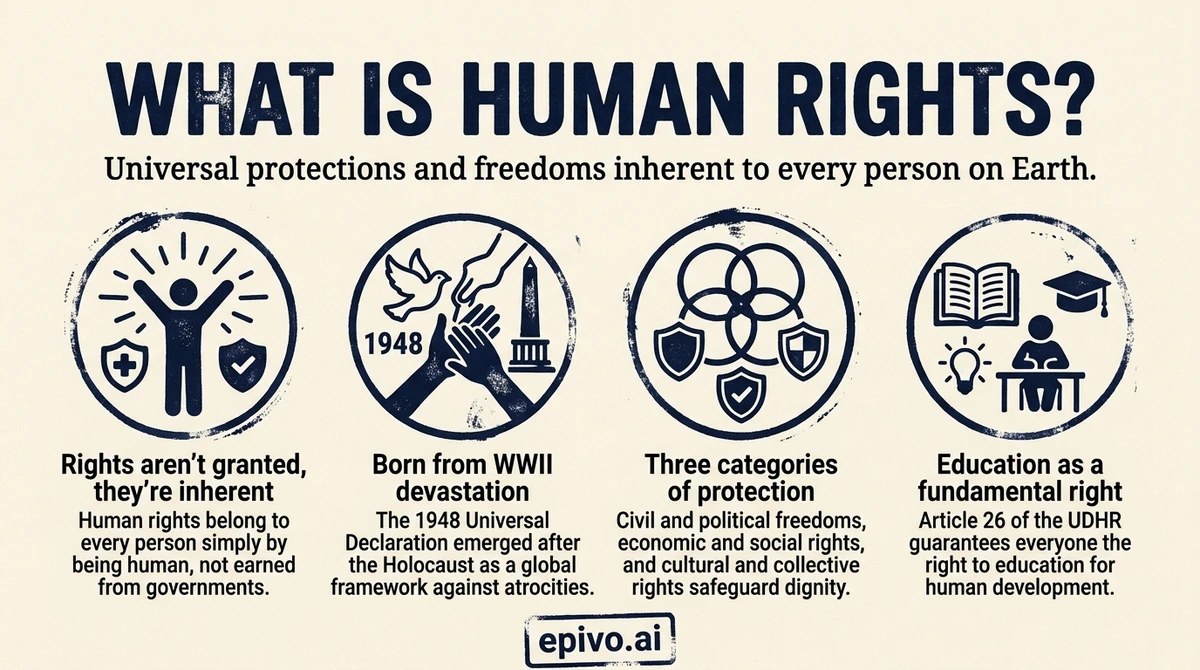
Human rights are the basic protections and freedoms that every person has, regardless of nationality, age, gender, religion, or background. They are not earned or granted by a government — they belong to every human being from birth.
The idea behind human rights is that certain things are so fundamental to human dignity that no government should be allowed to take them away. These include the right to life, protection from torture, freedom of thought and expression, and the right to a fair trial.
Human rights are universal — they apply to everyone, everywhere. They are also indivisible: civil and political freedoms (like the right to vote) cannot be separated from social and economic entitlements (like access to education or healthcare). In practice, one type of protection supports the others. For example, education helps people understand and exercise their civil freedoms.
It is important to note that human rights differ from ordinary laws, which can be changed by governments. Human rights set a minimum standard of treatment — a floor — that all governments are expected to uphold.
The history of human rights: the Universal Declaration
The modern human rights movement grew out of the devastation of World War 2. After witnessing the Holocaust and the scale of wartime atrocities, world leaders agreed that a common framework was needed to protect people from state violence.
On 10 December 1948, the United Nations adopted the Universal Declaration of Human Rights (UDHR). The drafting process was remarkable in itself: representatives from 58 countries debated and revised the text over two years, aiming to create a document that would speak to people across all cultures and political systems. It was drafted by a committee led by Eleanor Roosevelt, the UDHR contains 30 articles covering civil, political, economic, social, and cultural protections. Article 1 begins: "All human beings are born free and equal in dignity and rights."
The UDHR was not a legally binding treaty, but it established a shared standard. Over time, it became the foundation for more than 80 international conventions and treaties, including the Convention on the Rights of the Child (1989), which specifically protects children.
Today, 10 December is celebrated as Human Rights Day worldwide. According to the UN Office of the High Commissioner for Human Rights, the UDHR remains the most translated document in the world.

Types of human rights
Human rights are often grouped into three categories.
Civil and political freedoms
These protect individuals from abuses by governments and guarantee participation in public life. They include freedom from torture, freedom of speech, the right to a fair trial, and the right to vote. Civil and political freedoms were the primary focus of the first international declarations.
Social and economic entitlements
These ensure people can meet their basic needs and participate fully in society. They include access to education, fair employment and pay, healthcare, and cultural participation. Social entitlements recognise that political freedom alone is not enough — people also need material security to live with dignity.
Group and collective protections
A third category covers protections for groups rather than individuals. These include the right of peoples to self-determination and protections for indigenous communities' land and culture. Collective protections are more contested and vary more widely between legal systems.

Did you know?
-
The Universal Declaration of Human Rights, adopted on 10 December 1948, has been translated into over 500 languages — making it the most translated document in the world.
UN Office of the High Commissioner for Human Rights -
The Convention on the Rights of the Child (1989) is the most widely ratified human rights treaty in history, with 196 countries as parties — every country in the world except the United States.
UNICEF — Convention on the Rights of the Child -
Article 26 of the UDHR states that everyone has the right to education, and that education shall be directed towards the full development of the human personality.
UN Office of the High Commissioner for Human Rights
Why human rights matter for students
Human rights matter because they recognise something that all individuals share: fundamental dignity. When these protections are respected, societies tend to be more stable, more equal, and more prosperous. When they are violated — through discrimination, arbitrary detention, or suppression of free speech — the harm extends beyond the individual to the whole community.
Understanding human rights helps students become informed citizens who can recognise injustice and understand how societies should be held accountable. In school, human rights connect directly to topics including democracy, history, and globalisation.
For young people specifically, the Convention on the Rights of the Child guarantees the freedom to learn, the right to play, protection from harm, and a voice in decisions that affect them. These protections apply to every child, everywhere, regardless of nationality or background.
For parents, teaching children about human rights at home builds empathy and critical thinking. Discussing real examples — current news, historical events, stories of activists who changed the world — helps children understand that these freedoms are not automatic but must be actively protected and defended.
Epivo's International Curriculum covers human rights alongside democracy, conflict, and global citizenship for students in grades 6 to 9. Students examine real cases and develop the analytical skills to engage confidently with questions of justice, equality, and international law.
Frequently asked questions
- What is human rights in simple terms?
- Human rights are the basic rights and freedoms every person has, regardless of where they were born or who they are. They include the right to life, freedom from torture, freedom of speech, and the right to education.
- Where do human rights come from?
- The modern framework for human rights comes from the Universal Declaration of Human Rights, adopted by the United Nations in 1948 after World War 2. However, the idea that people have inherent rights predates the UDHR by centuries.
- What is the difference between human rights and laws?
- Laws are rules set by governments and can be changed. Human rights are universal standards that apply to everyone regardless of local laws. When a government passes a law that violates human rights, the law is considered illegitimate under international standards.
- Do children have human rights?
- Yes. The Convention on the Rights of the Child (1989) specifically protects children's rights, including the right to education, protection from harm, and the right to participate in decisions that affect them. It has been ratified by 196 countries.
- Who enforces human rights?
- Human rights are enforced through international bodies like the UN Human Rights Council, regional courts like the European Court of Human Rights, and national courts. Civil society organisations and journalists also play a key role in exposing violations.