What is Kabbalah and where did it come from?
Kabbalah emerged as a distinct intellectual movement in the 12th and 13th centuries in Provence and northern Spain, though its practitioners traced its origins to ancient biblical revelation.
Early mystical roots
Jewish mystical speculation long predates the Kabbalistic movement. The Sefer Yetzirah (Book of Creation), composed between the 3rd and 6th centuries CE, describes God creating the universe through combinations of Hebrew letters and ten primal numbers called sefirot. Early Merkavah (chariot) mysticism focused on ascending through heavenly palaces to encounter the divine.
These traditions laid the groundwork for Kabbalah. But the movement took its distinctive form in medieval Europe, when Jewish thinkers in Provence and Catalonia began producing systematic texts about the hidden structure of divinity.
The Zohar
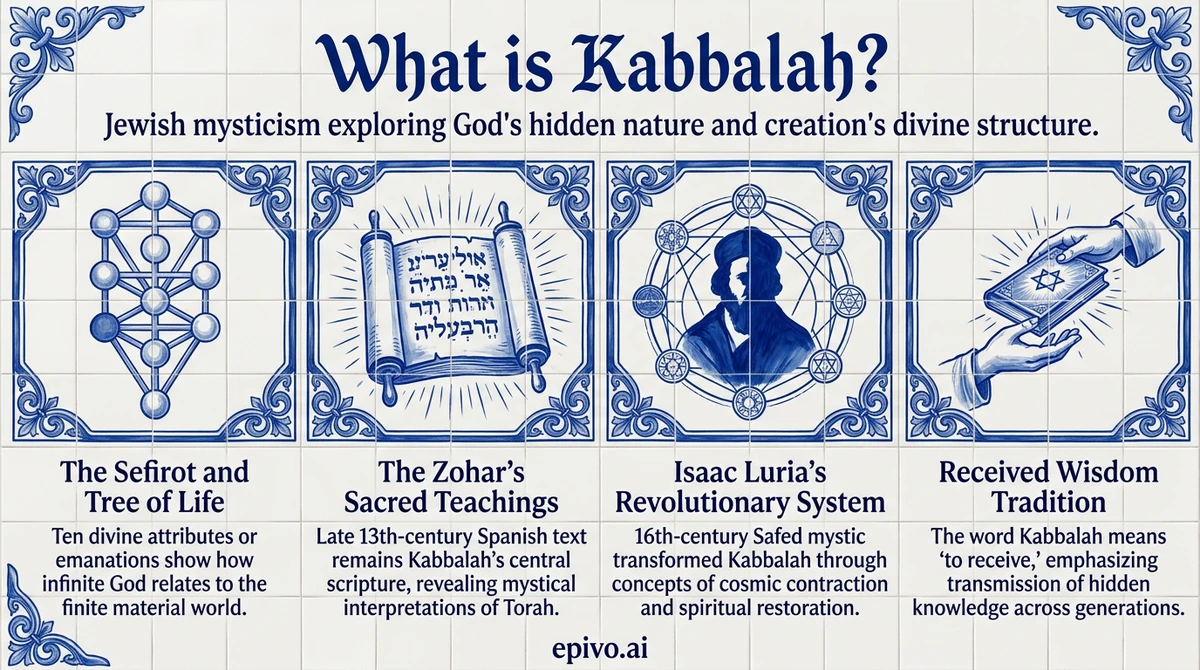
The most important Kabbalistic text is the Zohar (Book of Splendour), which appeared in Spain in the late 13th century. It was published by Moses de Leon, who attributed it to the 2nd-century sage Rabbi Shimon bar Yochai. Modern scholars generally regard Moses de Leon as its primary author. Written in Aramaic, the Zohar presents a mystical commentary on the Torah, interpreting biblical narratives as descriptions of processes within the divine realm. It became the central text of Jewish philosophical mysticism and remains so today.
The Sefirot and the Tree of Life
At the heart of Kabbalistic thought is a model of how the infinite God relates to the finite world. This model centres on the ten Sefirot — divine attributes or emanations through which God creates and sustains reality.
Ein Sof and the problem of creation
Kabbalists begin with Ein Sof — the Infinite, God as utterly beyond human comprehension. Ein Sof has no qualities, no limits, and no form that language can describe. The central question of Kabbalah is: how does an infinite God produce a finite world?
The answer lies in emanation. Rather than creating from nothing in a single act, the divine reality unfolds through stages — each revealing a different aspect of God's nature while remaining connected to the source.
The ten Sefirot
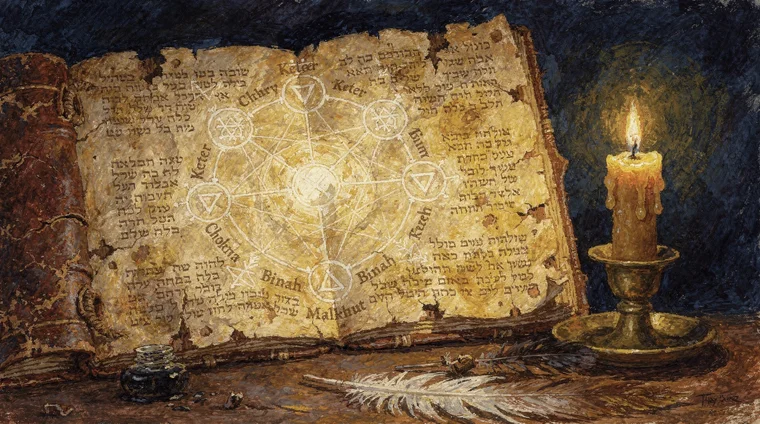
The ten Sefirot form a structured map of these divine emanations, often visualised as the Tree of Life. They are: Keter (Crown), Chokhmah (Wisdom), Binah (Understanding), Chesed (Lovingkindness), Gevurah (Judgement), Tiferet (Beauty), Netzach (Eternity), Hod (Splendour), Yesod (Foundation), and Malkhut (Kingdom).
These are not ten separate gods. They are aspects of a single divine reality — comparable to light passing through a prism producing a spectrum of colours. The Sefirot interact dynamically, and Kabbalists understood human action as capable of influencing the balance among them. Prayer, ethical behaviour, and the performance of commandments were seen as restoring harmony within the divine structure.
How Kabbalah developed across the centuries
Kabbalah was not a static doctrine. It evolved through several major phases, each associated with a specific community and set of ideas.
The Safed school and Isaac Luria
In the 16th century, the town of Safed (Tzfat) in the Galilee became the centre of a remarkable Kabbalistic revival. The most influential figure was Isaac Luria (1534–1572), known as the Ari. Luria introduced three transformative concepts: tzimtzum (divine contraction), shevirat ha-kelim (the breaking of the vessels), and tikkun (repair).
In Lurianic Kabbalah, God contracted to make space for creation, but the vessels meant to contain divine light shattered, scattering sparks of holiness throughout the material world. The purpose of human life is tikkun — gathering these scattered sparks through righteous action. This gave Kabbalah a powerful ethical dimension: every human deed matters cosmically.
Hasidism and popular Kabbalah
In the 18th century, the Hasidic movement founded by the Baal Shem Tov brought Kabbalistic ideas to ordinary Jewish communities in Eastern Europe. Hasidism translated complex mystical theology into accessible practices centred on joy, prayer, and devotion to a rebbe (spiritual leader). Through Hasidism, Kabbalistic concepts entered mainstream Jewish religious life.
Christian Kabbalah and Western esotericism
From the Renaissance onward, Christian scholars including Pico della Mirandola studied Kabbalah, seeing it as confirming Christian theological claims. This 'Christian Kabbalah' influenced Enlightenment-era thought and later Western esoteric movements. While distinct from Jewish Kabbalah, it demonstrates the tradition's intellectual reach beyond its original context.
Did you know?
-
The Zohar, Kabbalah's central text, appeared in late 13th-century Spain. Published by Moses de León, it presents a mystical commentary on the Torah written in Aramaic.
Stanford Encyclopedia of Philosophy — Kabbalah -
The word 'Kabbalah' derives from the Hebrew root Q-B-L, meaning 'to receive.' It refers to a tradition of esoteric knowledge received through a chain of transmission from teacher to student.
Wikipedia — Kabbalah -
Isaac Luria (the Ari) developed his influential Kabbalistic system in 16th-century Safed. His concepts of tzimtzum (divine contraction) and tikkun (cosmic repair) reshaped Jewish mystical theology.
My Jewish Learning — Kabbalah and Mysticism 101
Why Kabbalah matters for understanding philosophy
Kabbalah is not merely a historical curiosity. It represents a sophisticated philosophical system that addresses questions central to philosophy: the nature of reality, the relationship between the infinite and the finite, and the meaning of human action.
A philosophical contribution
The Kabbalistic model of emanation offers a distinctive answer to the problem of how unity produces multiplicity — how one God creates a diverse world. The Sefirot function as a philosophical framework, not unlike Neoplatonic emanation, but rooted in Jewish scriptural interpretation and communal practice.
The Lurianic concept of tikkun olam (repairing the world) has become one of Judaism's most widely recognised ethical ideas, influencing social justice movements well beyond the mystical tradition. According to the Stanford Encyclopedia of Philosophy, Kabbalah constitutes 'one of the most important and intellectually fascinating developments in the history of Jewish thought.'
Academic study today
The modern academic study of Kabbalah, pioneered by Gershom Scholem at the Hebrew University of Jerusalem, established it as a serious field of intellectual history. Scholars including Moshe Idel and Elliot Wolfson have revealed Kabbalah's philosophical depth and its connections to broader currents in European thought.
For students, Kabbalah offers a window into a tradition of inquiry that challenges Western-centric assumptions about where deep thinking happens. Mystical traditions can be intellectually rigorous and philosophically sophisticated.
Frequently asked questions
- What is Kabbalah in simple terms?
- Kabbalah is the mystical tradition of Judaism. It explores hidden meanings in the Torah and offers a philosophical framework for understanding how an infinite God relates to the finite world. Its central concepts include the ten Sefirot (divine attributes) and the Tree of Life.
- Is Kabbalah a religion?
- No, Kabbalah is not a separate religion. It is a tradition within Judaism — a way of interpreting Jewish scripture and practice through a mystical lens. Historically, its study was reserved for learned adults within Jewish communities, though its ideas have spread more widely in modern times.
- What is the difference between Kabbalah and pop Kabbalah?
- Traditional Kabbalah is a scholarly mystical tradition rooted in Jewish textual study, Hebrew language, and centuries of philosophical commentary. Pop Kabbalah, popularised in the late 20th century, extracts individual concepts from their original context and presents them as self-help. Academic scholars and traditional practitioners regard these as very different things.
- What are the Sefirot?
- The Sefirot are ten divine attributes or emanations in Kabbalistic thought. They describe how the infinite God (Ein Sof) manifests in the world through qualities such as Wisdom, Lovingkindness, Judgement, and Beauty. They are often arranged in a diagram called the Tree of Life.
- Can anyone study Kabbalah?
- Traditionally, Kabbalah was studied only by Jewish men over 40 who had mastered the Torah and Talmud. Today, many Jewish communities are more open about Kabbalistic study, and academic courses are available at universities worldwide. The tradition is best understood within its Jewish intellectual context.