Laozi and the Tao Te Ching
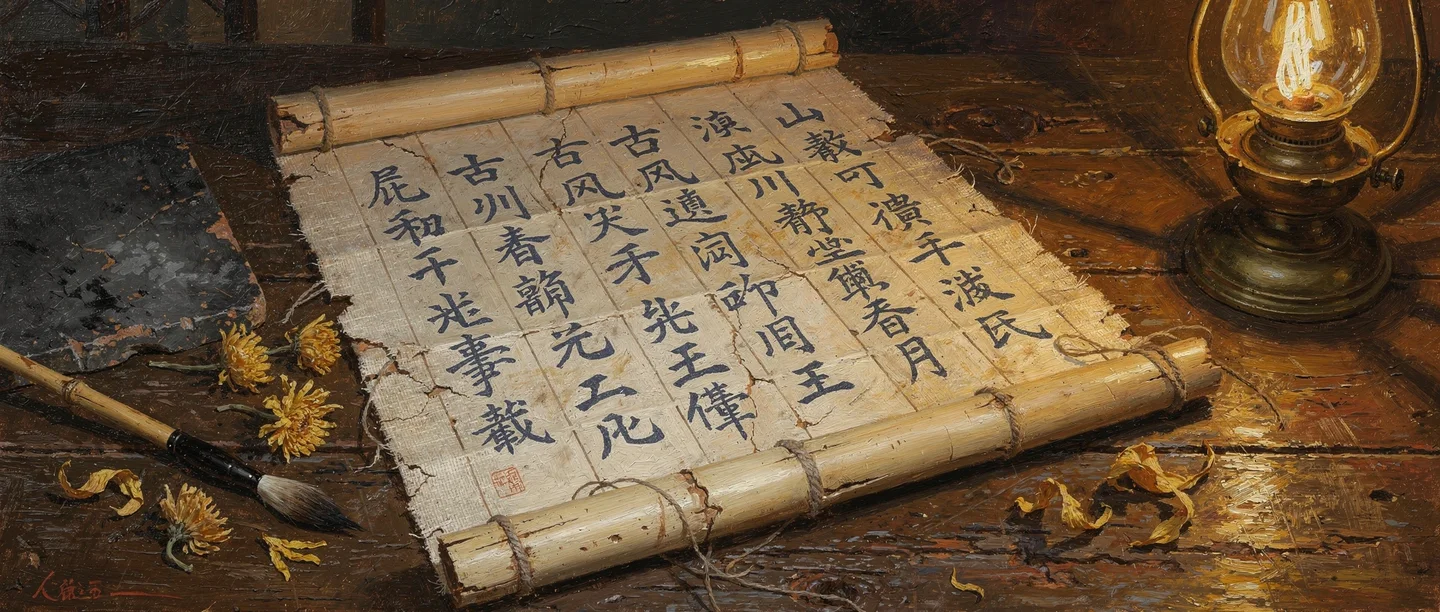
To understand what is Taoism, you must begin with its foundational text. The Tao Te Ching (also written Daodejing) is a short book of about 5,000 Chinese characters, traditionally attributed to a sage called Laozi (Lao Tzu). Scholars debate whether Laozi was a historical figure or a legendary one. According to tradition, he was an older contemporary of Confucius who served as an archivist in the Zhou dynasty court.
The Tao Te Ching is one of the most translated books in history. It consists of 81 brief chapters written in poetic, paradoxical language. Its central idea is the Tao (the Way) — an ultimate reality that cannot be fully described in words. The opening line sets the tone: "The Tao that can be spoken is not the eternal Tao."
Rather than laying down rigid rules, the text uses metaphors drawn from nature. Water is a recurring image: it is soft and yielding, yet it wears away stone. The Tao Te Ching argues that true strength lies in flexibility, not force. Good leaders, it says, govern so lightly that people barely notice their presence.
This approach to wisdom stands in deliberate contrast to Confucianism, which emphasises social roles, rituals, and active governance. Where Confucius focused on building an orderly society through moral education, Laozi questioned whether such striving might itself be the problem.
Core Taoist ideas: Wu wei, yin and yang
At the heart of Taoism are several interconnected concepts that have influenced Chinese thought for millennia.
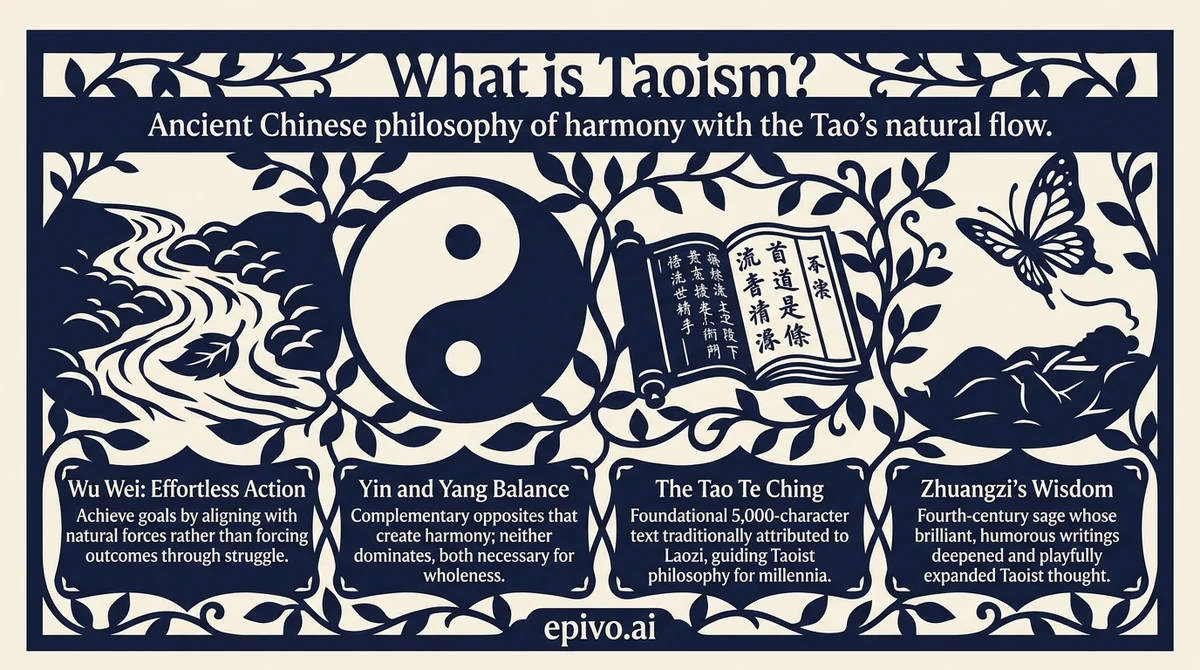
Wu wei: Effortless action
Wu wei is often translated as "non-action," but this is misleading. It does not mean doing nothing. Instead, it means acting in alignment with the natural flow of things — without forcing, straining, or imposing your will. A skilled musician who plays effortlessly, or a swimmer who moves with the current rather than against it, is practising wu wei. The idea is that the best results come when you stop trying to control everything.
Yin and yang
The concept of yin and yang predates Taoism but became central to its worldview. Yin represents qualities like darkness, receptivity, stillness, and coolness. Yang represents light, activity, movement, and warmth. These are not opposites in conflict. They are complementary forces that depend on each other. Day becomes night; rest enables action. The familiar black-and-white symbol shows each side containing a seed of the other.
Ziran: Naturalness
Ziran means "self-so" or "naturalness." It points to the idea that everything has its own nature and should be allowed to express it without interference. A tree grows according to its own pattern; forcing it into an unnatural shape goes against the Tao. Applied to human life, ziran encourages authenticity over conformity.
Zhuangzi and the Development of Taoism
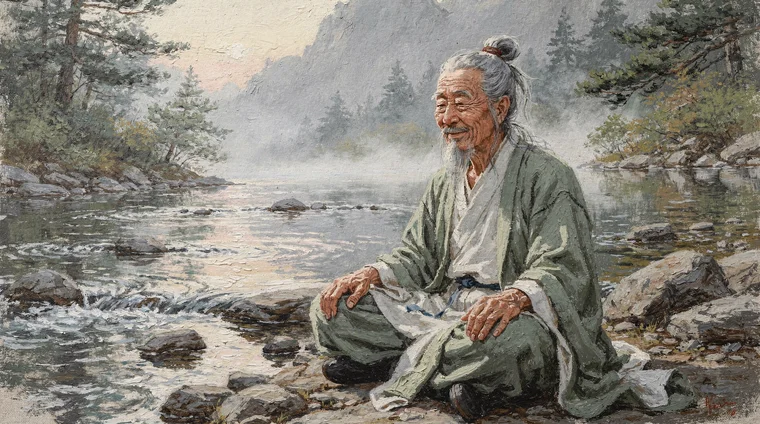
Zhuangzi (also written Chuang Tzu) is the second great figure in Taoist philosophy. He lived in the 4th century BCE and wrote a brilliant, often humorous text known simply as the Zhuangzi. While the Tao Te Ching is concise and poetic, the Zhuangzi is full of stories, dialogues, and vivid imagery.
His most famous passage is the "butterfly dream." Zhuangzi dreams he is a butterfly, fluttering happily. When he wakes, he wonders: was he a man dreaming of being a butterfly, or is he now a butterfly dreaming of being a man? This story challenges fixed ideas about identity and reality — themes that also appear in Western philosophy.
Zhuangzi pushed Taoist ideas further than Laozi. He questioned the value of conventional knowledge, arguing that our categories of right and wrong, beautiful and ugly, are human inventions rather than features of reality. He celebrated spontaneity and skill, telling stories of cooks, swimmers, and craftsmen whose mastery came from forgetting rules and acting from instinct.
Over the centuries, Taoism developed from a philosophy into an organised religion as well. Taoist temples, priests, rituals, and a pantheon of gods emerged during the Han dynasty (206 BCE - 220 CE) and expanded thereafter. Religious Taoism incorporated practices like meditation, breath control, martial arts, and traditional medicine. Tai chi and qigong both have roots in Taoist practice.
Did you know?
-
The Tao Te Ching has been translated into more languages than any other book except the Bible, with over 250 English translations alone.
Encyclopaedia Britannica — Daodejing -
The yin-yang symbol (taijitu) dates back to at least the Song dynasty (960-1279 CE) and represents the interdependence of opposite forces in Taoist cosmology.
Stanford Encyclopedia of Philosophy — Yin and Yang -
Taoism is one of the five officially recognised religions in China today, with an estimated 12 million formal adherents and hundreds of millions influenced by its practices and values.
Encyclopaedia Britannica — Daoism
Why Taoism matters for students today
Understanding what is Taoism gives students access to one of the world's most distinctive ways of thinking about life, nature, and human purpose.
Taoism offers a counterbalance to the pressure and competition that many students experience. Its emphasis on wu wei suggests that not every problem requires more effort — sometimes stepping back, letting go, and trusting the process leads to better outcomes. This resonates with modern research on creativity and wellbeing, which consistently shows that relaxation and play can be more productive than relentless striving.
Taoism also provides essential context for understanding Chinese culture. From landscape painting and poetry to martial arts and traditional medicine, Taoist ideas run through much of China's artistic and intellectual heritage. The concept of harmony with nature has gained new relevance in an era of environmental crisis.
Moreover, Taoism shaped the other great traditions it encountered. When Buddhism arrived in China, it absorbed Taoist vocabulary and concepts, eventually producing Zen Buddhism — a tradition that blends both influences. The interplay between Taoism, Confucianism, and Buddhism created one of the richest intellectual ecosystems in human history.
Epivo's International Curriculum covers Taoism as part of a six-course journey through Chinese, Indian, Islamic, Korean, Japanese, and African philosophy — helping students build a truly global perspective on the questions that matter most.
Frequently asked questions
- Is it Taoism or Daoism?
- Both spellings refer to the same tradition. 'Taoism' uses the older Wade-Giles romanisation system, while 'Daoism' uses the modern Pinyin system. Academics generally prefer Daoism, but Taoism remains more widely recognised in English.
- Is Taoism a religion or a philosophy?
- It is both. Philosophical Taoism focuses on the ideas of Laozi and Zhuangzi about nature, simplicity, and the Tao. Religious Taoism includes temples, priests, rituals, deities, and practices like meditation and qigong. The two strands are closely related and have influenced each other for centuries.
- What is the Tao?
- The Tao (or Dao) means 'the Way.' It refers to the fundamental, indescribable reality underlying all things. The Tao cannot be fully captured in words. It is the natural order of the universe — the source from which everything arises and to which everything returns.
- How is Taoism different from Confucianism?
- Confucianism focuses on social ethics, moral duty, and active participation in society. Taoism emphasises living in harmony with nature, spontaneity, and simplicity. Confucius stressed education and ritual; Laozi questioned whether such efforts might create more problems than they solve.
- Is Taoism still practised today?
- Yes. Taoism is one of five officially recognised religions in China. Taoist temples are active across China, Taiwan, and Southeast Asian communities. Practices rooted in Taoism — including tai chi, qigong, acupuncture, and feng shui — are practised worldwide.