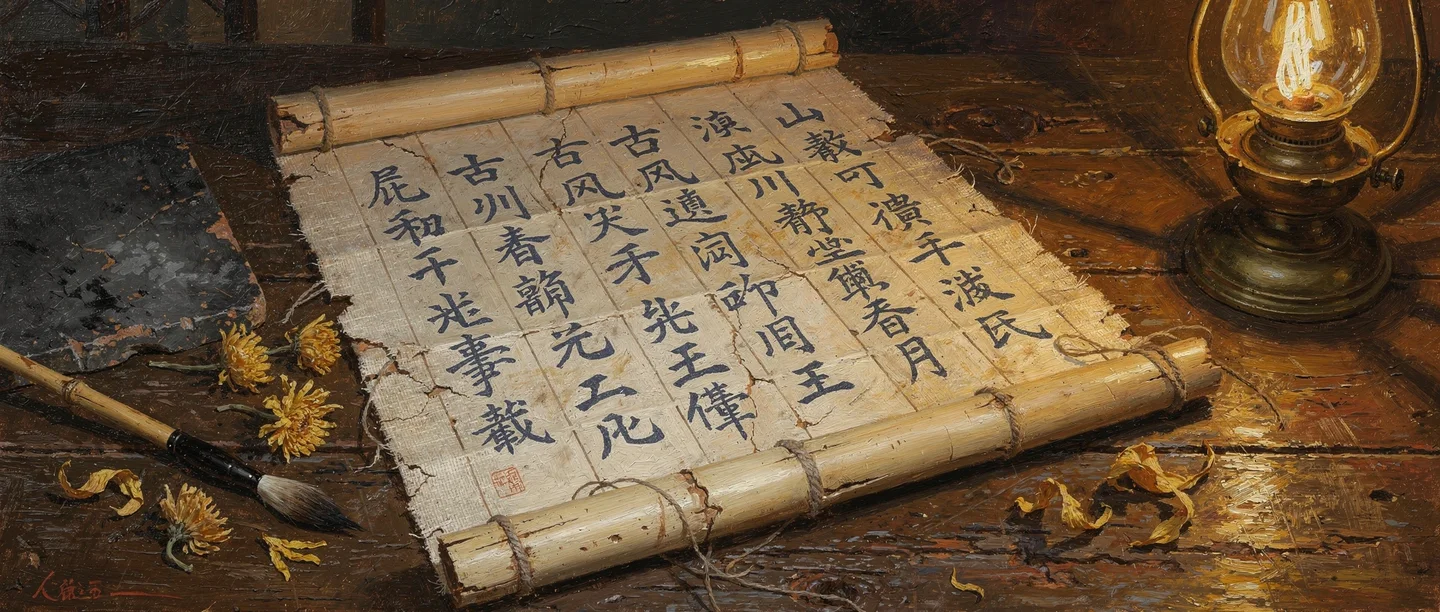
What is the Tao Te Ching about?
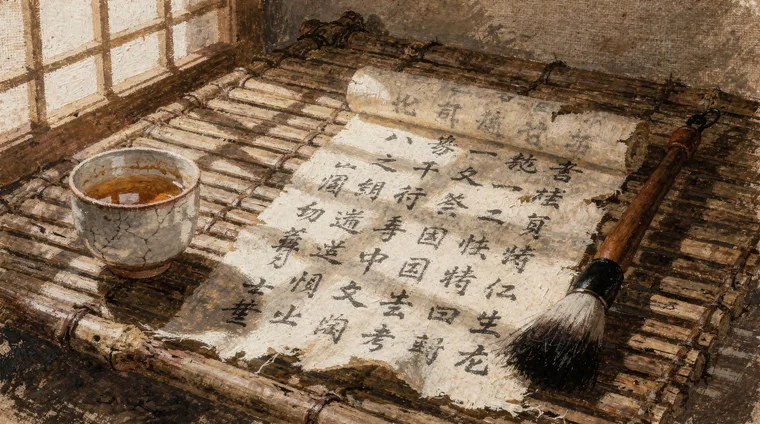
The Tao Te Ching (also spelled Daodejing) is a short but profound text of roughly 5,000 Chinese characters. Its title translates approximately as "The Classic of the Way and Virtue." Despite its brevity, it has shaped Chinese philosophy, governance, art, and spirituality for over two millennia.
The book's central subject is the Tao — meaning "the Way." The Tao is the fundamental, nameless force underlying all of reality. It cannot be fully described in words. The famous opening line makes this clear: "The Tao that can be spoken is not the eternal Tao." Rather than defining the Tao directly, the text uses paradox, metaphor, and imagery drawn from the natural world.
Water is the text's most powerful metaphor. Water is soft and yielding, yet it wears away the hardest stone. It flows downward to the lowest places, yet nothing is more essential to life. Through images like these, the Tao Te Ching argues that true strength comes from flexibility, humility, and patience rather than force.
The text also addresses practical questions about philosophy, leadership, and governance. It argues that the best rulers govern so lightly that their subjects barely notice them. This stands in contrast to the Confucian emphasis on active governance, ritual, and social hierarchy.
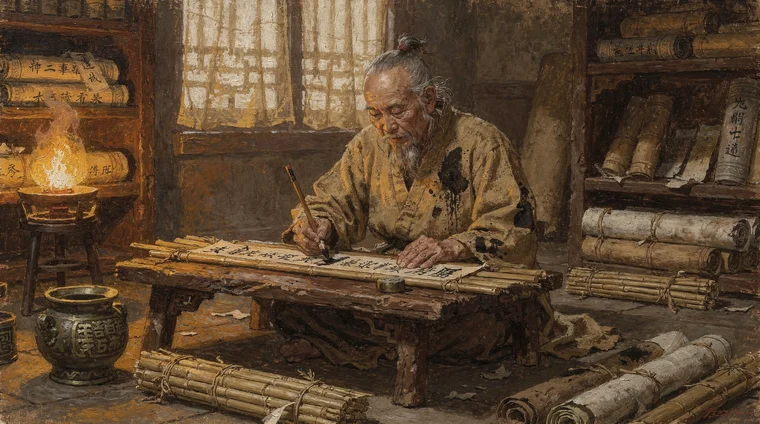
Who was Laozi, the author of this ancient text?
Laozi (also written Lao Tzu) is the legendary sage traditionally credited as the author. According to ancient accounts, he served as an archivist or keeper of records at the Zhou dynasty court. However, modern scholars debate whether Laozi was a single historical figure, a composite of several thinkers, or a purely legendary creation.
The most famous story about Laozi comes from the historian Sima Qian, writing around 100 BCE. According to this account, Laozi grew disillusioned with the corruption of the Zhou court. He decided to leave civilisation and travel westward. At the mountain pass marking the border, a gatekeeper recognised him and asked him to write down his wisdom before departing. Laozi composed the Tao Te Ching, handed it over, and disappeared forever.
Whether or not this story is historical, it captures something essential about the text's spirit. The Tao Te Ching values withdrawal over ambition, simplicity over complexity, and silence over argument. According to the Stanford Encyclopedia of Philosophy, the historical question matters less than the text itself, which has been studied continuously for over two thousand years.
Tradition also holds that Laozi was an older contemporary of Confucius, and that the two met at least once. In the legendary encounter, Laozi reportedly advised Confucius to abandon his pride and ambition. This story, whether factual or symbolic, highlights the fundamental tension between Taoism and Confucianism.
Core teachings of the Tao Te Ching
The Tao Te Ching is built around several interconnected ideas that have influenced Chinese thought for millennia.
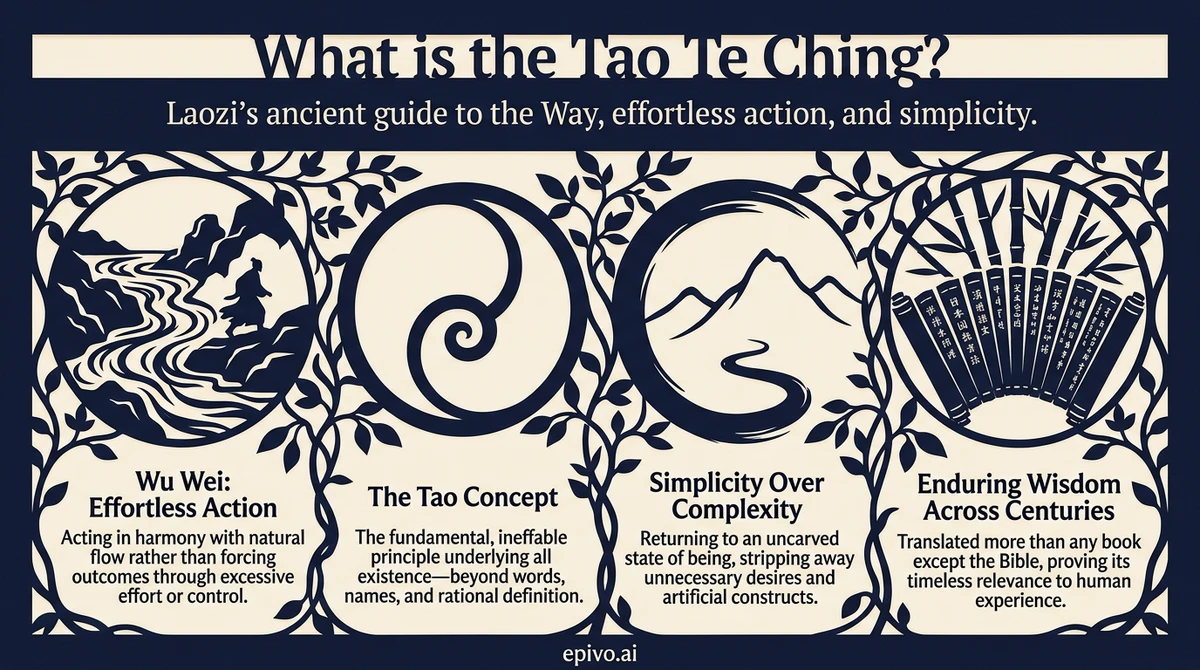
Wu wei: Effortless action
Wu wei is perhaps the text's most distinctive concept. Often translated as "non-action," it does not mean passivity. Instead, it means acting in harmony with the natural flow of things — without forcing, straining, or imposing your will. A river does not push its way downhill; it simply follows the path of least resistance. The Tao Te Ching argues that the wisest actions follow this same principle.
Simplicity and humility
The text repeatedly praises the "uncarved block" (pu) — a metaphor for the state of natural simplicity before human desires and conventions complicate things. It argues that desire, competition, and the pursuit of status create suffering. By returning to simplicity, people can find contentment.
The limits of language
The Tao Te Ching is deeply suspicious of words and categories. It argues that naming and classifying things distorts reality. "The Tao that can be spoken is not the eternal Tao" is not merely a poetic opening — it is a philosophical claim that ultimate reality exceeds what language can capture. This idea influenced later Chinese Buddhist thought and connects to similar insights in Western philosophy about the limits of human knowledge.
Did you know?
-
The Tao Te Ching has been translated into more languages than any other book except the Bible, with over 250 English translations published to date.
Encyclopaedia Britannica — Daodejing -
The oldest known manuscript of the Tao Te Ching was found in 1993 at Guodian, China, written on bamboo strips dating to around 300 BCE.
Stanford Encyclopedia of Philosophy — Laozi -
At roughly 5,000 Chinese characters, the Tao Te Ching is one of the shortest major philosophical texts ever written — yet one of the most widely studied.
Internet Encyclopedia of Philosophy — Taoism
Why the Tao Te Ching still matters for students
Understanding what is the Tao Te Ching gives students access to one of the world's most enduring works of wisdom literature. Its ideas remain strikingly relevant.
For students experiencing pressure and competition, the Tao Te Ching offers a different perspective. Its emphasis on wu wei suggests that not every challenge requires more effort. Sometimes the wisest response is to step back, observe, and let things unfold naturally. Modern research on creativity and wellbeing supports this insight — breakthrough thinking often arrives during moments of relaxation rather than intense striving.
The text also provides essential context for understanding Chinese culture. From landscape painting and calligraphy to martial arts and traditional medicine, the ideas in the Tao Te Ching run through much of China's artistic and intellectual heritage. The concept of living in harmony with nature has gained new urgency in an era of climate change.
Moreover, the Tao Te Ching is the founding text of Taoism, one of the three great traditions — alongside Confucianism and Buddhism — that shaped Chinese civilisation. Reading it opens the door to a richer understanding of how one of the world's oldest and most influential cultures thinks about life, power, and the natural world.
Frequently asked questions
- What does Tao Te Ching mean in English?
- The title translates roughly as 'The Classic of the Way and Virtue.' 'Tao' means the Way, 'Te' means virtue or power, and 'Ching' (or 'Jing') means classic or scripture. Together, it describes a text about living in harmony with the fundamental nature of reality.
- How long is the Tao Te Ching?
- The text consists of 81 short chapters totalling about 5,000 Chinese characters. Most English translations are between 50 and 100 pages. Despite its brevity, it is one of the most widely studied philosophical works in history.
- Is the Tao Te Ching a religious text?
- It is primarily a philosophical text, but it became sacred scripture within religious Taoism. Philosophical readers focus on its ideas about nature, leadership, and simplicity. Religious Taoists also revere it as divinely inspired wisdom. Both readings have coexisted for centuries.
- Why are there so many translations of the Tao Te Ching?
- The original Chinese is highly compressed and ambiguous. Many passages can be read in multiple ways. Additionally, the text's themes — nature, power, simplicity — resonate across cultures. Each translator brings different interpretive choices, producing genuinely different readings of the same source.
- How is the Tao Te Ching different from the Analects of Confucius?
- The Analects record Confucius's teachings on moral duty, social roles, and good governance through direct instruction. The Tao Te Ching uses paradox and poetry to argue for simplicity, non-interference, and harmony with nature. They represent contrasting approaches to wisdom within Chinese thought.