Desert ants count their steps
A desert ant crossing open sand keeps a running tally of every turn and every stride. This form of animal navigation is called path integration. The ant adds up direction and distance as it walks, so it keeps a running estimate of which way home lies.
Desert ants of the genus Cataglyphis can wander more than ten thousand times their own body length from the nest. Then they return to an inconspicuous hole in the ground with great accuracy. They steer by a compass that reads the sky and by a wind compass. They measure distance with an odometer.
But how does an ant measure distance? In 2006, Wittlinger, Wehner and Wolf tested the idea of a step counter in the ant odometer study. They lengthened some ants' legs with stilts and shortened other ants' legs to stumps. As a result, the ants on stilts took longer strides and overestimated how far they had walked home. In contrast, the ants on stumps underestimated it. The ants were counting steps.
Steps are not their only measure, however. Ants carried by nest mates can also judge distance from image motion, called optic flow, which works separately from the step counter.
What happens when the tally runs out
The path integrator combines compass and distance into a running arrow that points home. When that arrow shrinks to zero, the ant should be at the nest. Small errors build up, however, so it rarely lands exactly on the entrance. Instead, it searches systematically around that spot. Finally, remembered snapshots of landmarks near home guide it to the hole.
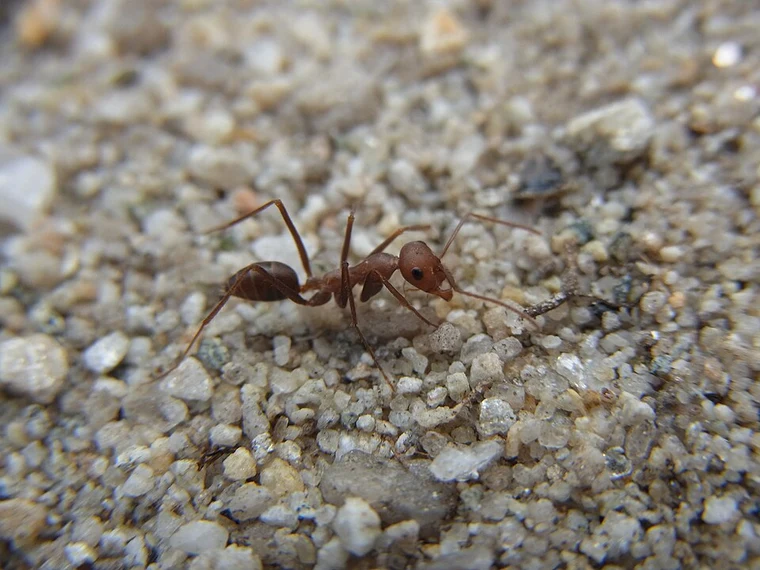
A Cataglyphis nodus ant on sand on the Greek island of Thasos.. Image: Donkey shot, via Wikimedia Commons (CC BY-SA 3.0)
How do homing pigeons find their way home?
Homing pigeons rely on more than one navigation tool to get home. Experiments point to a sun compass, a debated role for smell, and a habit of following roads.
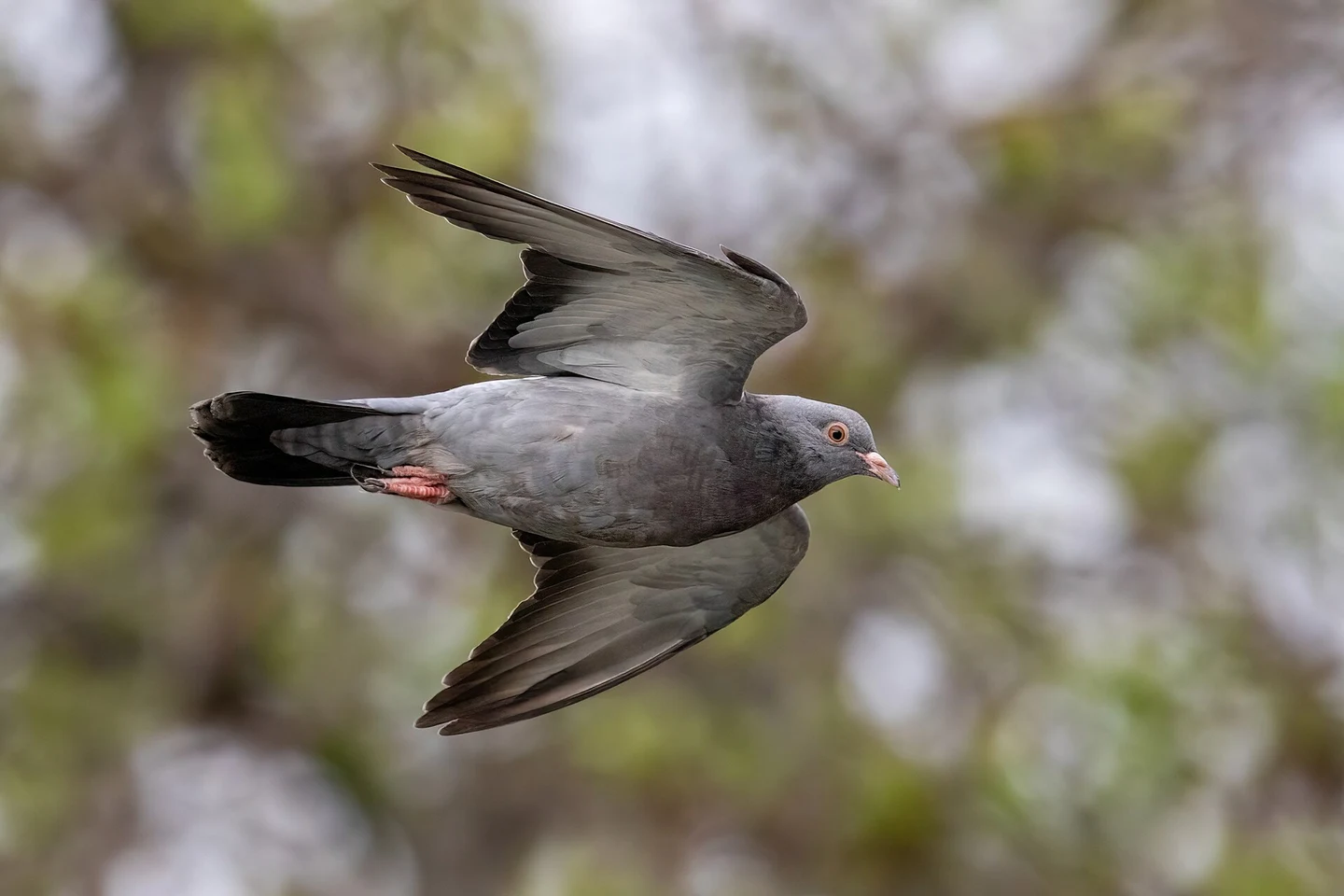
The sun is a moving guide. It crosses the sky during the day, and a bird's internal clock lets it correct for that movement. Clock-shifting experiments show that this time-compensated sun compass is widespread, especially in homing pigeons. In 2013 an Oxford team shifted 24 pigeons' body clocks six hours ahead or six hours behind. The birds then flew home within sight of their own loft. Even so, they veered partly off course, in the direction each shift predicted. Researchers usually blame the partial veering on conflicting landmarks or a magnetic compass.
Can a pigeon smell its way home?
Smell is one of the more surprising cues proposed in animal navigation research. For animal navigation from an unfamiliar place, a compass alone is not enough: a pigeon released far from home also needs to know where it is. Papi and colleagues showed that pigeons unable to smell navigate far worse. Papi proposed that pigeons learn which odours the wind brings from each direction at home. Released far away, they would recognise local odours and work out which way they had been moved.
Rivals argued that odours only switch on a system based on other cues. In 2011, Anna Gagliardo's team tested that idea. Pigeons carried to release sites in filtered air navigated poorly in their first hour, even when given artificial odours. Nevertheless, the debate continues.
Following the motorway
Experienced pigeons are also drawn to routes people built. In 216 GPS-recorded flights around Rome, they were often drawn to highways and a railway running toward home. In fact, many stayed on a highway until a major junction, even when that added a long detour.
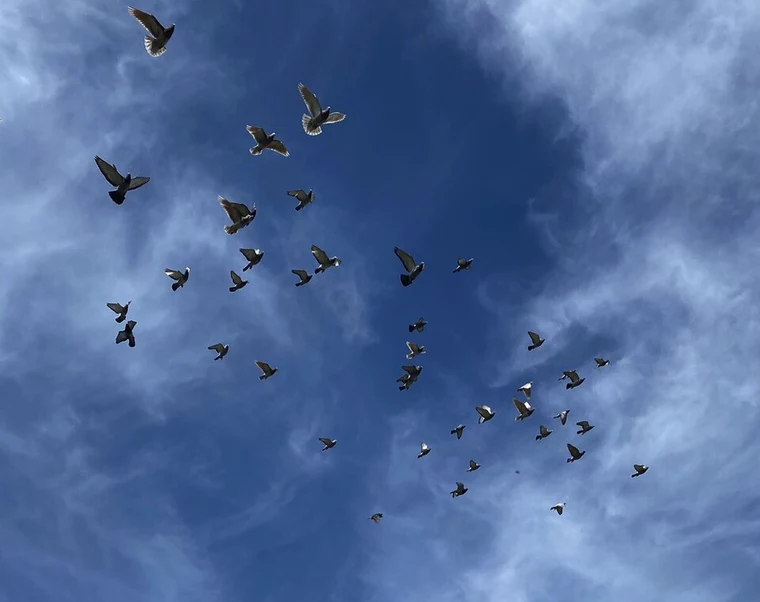
A flock of homing pigeons in flight on a sunny day.. Image: Spanishguitar101, via Wikimedia Commons (CC BY-SA 4.0)
How birds remember thousands of hiding places
Finding a seed hidden months ago is another kind of animal navigation. Food-storing birds use spatial memory, finding many of their hiding places long after they made them.
In the fall, a single Clark's nutcracker can bury tens of thousands of pine seeds. It carries as many as 90 at a time in a pouch behind its tongue. According to the U.S. National Park Service, it finds a large share of its caches in winter, often up to nine months later. Even so, seeds it never recovers help the pines spread.
A bigger memory region in the brain
A study of 52 birds from 35 passerine species or subspecies compared a brain region called the hippocampal complex. Relative to brain and body size, it was significantly larger in species that store food.
Researchers compared many chickadee populations along gradients of winter climate. Birds from harsher places had better spatial memory and a larger hippocampus with more neurons. A 2015 review found this pattern most consistent with natural selection producing local adaptations. It found little support for experience or development as the main cause. Also, wild mountain chickadees that survived to a second winter had done better on a spatial task as yearlings. If the idea of natural selection is new to you, start with what evolution is.
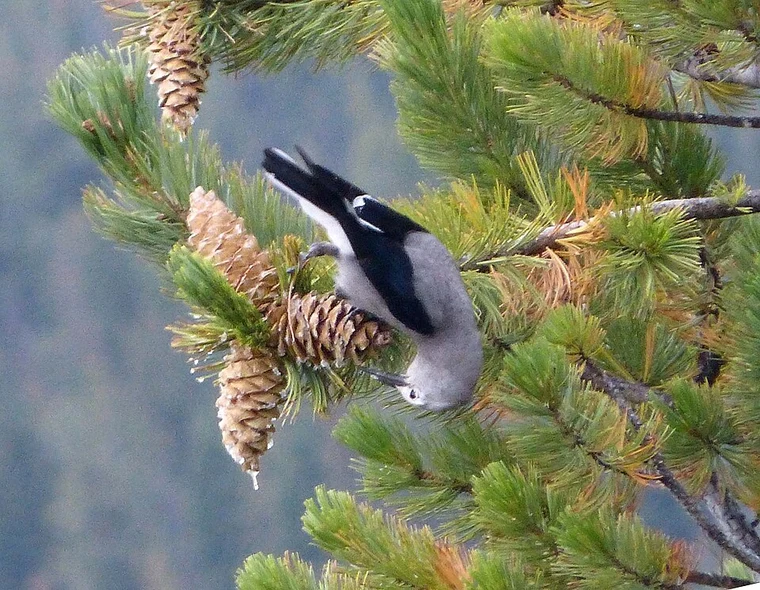
A Clark's nutcracker feeding at pine cones.. Image: gailhampshire, via Wikimedia Commons (CC BY 2.0)
Did you know?
-
Desert ants given stilts overestimated how far they had walked home, and ants with shortened legs underestimated it, showing that they count steps.
The ant odometer: stepping on stilts and stumps (Wittlinger, Wehner and Wolf, Science 2006) -
In 216 GPS-recorded flights around Rome, experienced homing pigeons were often drawn to highways and a railway running toward home.
Pigeon homing along highways and exits (Lipp et al., Current Biology 2004) -
Egyptian fruit bats tracked by GPS were moved 44 kilometres south and flew directly back to a familiar fruit tree or their cave.
Large-scale navigational map in a mammal (Tsoar et al. 2011)
Do animals navigate with a map in their heads?
Can an animal head for a goal it cannot see? Whether animals carry a mental map is still an open question in animal navigation research. A cognitive map would let an animal plan new routes, such as shortcuts it has never taken.
The idea goes back to the psychologist Tolman. In 1946, Tolman, Ritchie and Kalish described the sunburst maze. Rats first learned a winding path to a reward. Then the old route was blocked, and new paths appeared, including a shortcut. A substantial share of rats chose the shortcut, and Tolman read this as evidence of an inner map. He popularised the term cognitive map in 1948.
However, the famous result has not held up well. A 2026 meta-analysis of the sunburst maze examined a dozen repeat studies in rats, squirrel monkeys and humans. Only 17 percent of the experiments in those studies showed shortcutting. The authors judge the maze a poor standalone demonstration of map-based navigation.
For bees and ants the debate is long-standing. In 2011, a computer model of insect memory with no map still solved navigation tasks often said to need one.
Fruit bats and the case for a map
For decades, map-based animal navigation had little field evidence in the wild. In 2020, Toledo and colleagues reported a tracking system that follows dozens of animals at once. They gathered more than 18 million location fixes from 172 foraging Egyptian fruit bats over four years. The bats seldom searched at random. Instead, they flew long, straight flights to their goals, often by shortcuts. The authors' simulations and track analyses ruled out simpler, non-map strategies. The results are therefore consistent with map-like navigation in wild bats.
Senses we do not share
Animals also find their way where we would be lost, partly through senses humans lack. Birds have a magnetic compass sense. Many bats find their way in the dark by echolocation. They send out calls too high for us to hear and read the echoes. The biologist Jakob von Uexküll called each animal's private sensory world its umwelt. You can explore these questions in conversation with a personal AI tutor in the Animal Minds course.
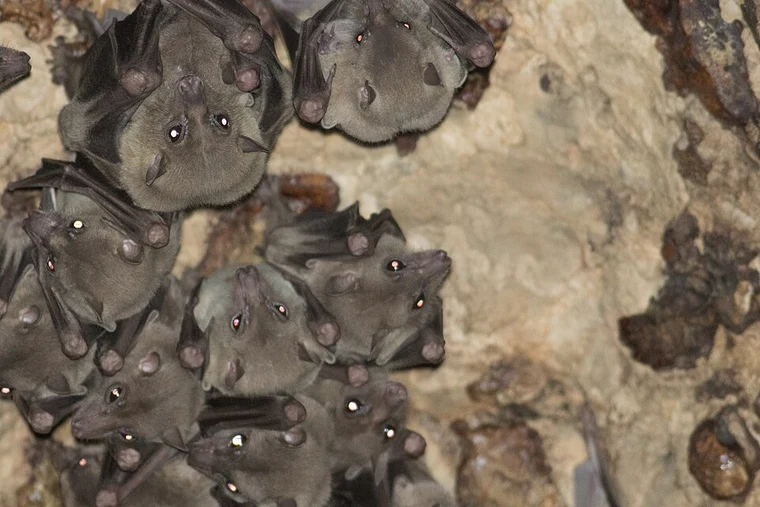
Egyptian fruit bats roosting in Ha-Teomim cave, Israel.. Image: MinoZig, via Wikimedia Commons (CC BY-SA 4.0)
Frequently asked questions
- How do animals navigate over long distances?
- They combine several tools. Desert ants add up steps and sky-compass directions. Homing pigeons use a sun compass, and smell appears to help them, though its exact role is debated. Some birds also have a magnetic compass sense. Fruit bats fly straight shortcuts between known places.
- How do ants find their way back to the nest?
- Desert ants use path integration. They track direction with a sky compass and distance by counting steps, and can also judge distance from optic flow. When the running tally says they are home, they search nearby and use remembered landmark snapshots to find the entrance.
- Do pigeons use the sun to navigate?
- Yes. Clock-shifting experiments show homing pigeons use a time-compensated sun compass. In a 2013 study, pigeons whose body clocks were shifted six hours veered partly off course in the predicted direction, even within sight of their loft.
- How do birds remember where they hid food?
- Food-storing birds rely on spatial memory. A Clark's nutcracker can bury tens of thousands of seeds and find a large share months later. In a study of 35 songbird species and subspecies, food-storers had a significantly larger hippocampal complex relative to brain and body size.
- Do animals have a map in their heads?
- It is an open question. Tolman's sunburst maze, the classic evidence, replicated poorly. A 2020 study of 172 wild fruit bats found straight, goal-directed flights with shortcuts, which the authors judged consistent with map-like navigation. Insect navigation may not need a map.