What is animal cognition?
Most researchers agree that animal cognition involves learning, memory and decision-making, which drive flexible behaviour suited to each animal's life. As a science, animal cognition asks what each mind can do, and how we can tell.
The octopus shows why the question is harder than it looks. A common octopus has around 500 million neurons, about as many as a dog. However, about two thirds of them sit in its arms, not its head. Each arm can taste, touch and move without direction from the brain. Yet the central brain can still take charge. In a 2011 test, octopuses learned to guide one arm through a maze. They could see the food but not smell it. As the Natural History Museum explains, octopuses seem to have both local and central control.
So where is the octopus doing its thinking? One University of Washington team put it this way. Their question is not how intelligent octopuses are, but how they are intelligent with a body so unlike ours. Its brain also arose apart from ours. Our last common ancestor with the octopus was a worm-like animal about 600 million years ago. So the octopus brain was not inherited from anything like ours: evolution built it separately. That is the spirit of the whole field, and of the Animal Minds course, whose first course is Clever Animals.
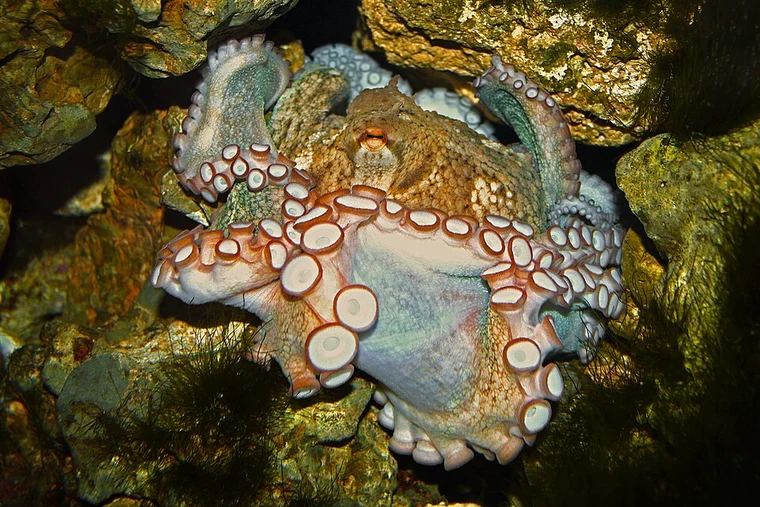
A common octopus in the aquarium of the State Museum of Natural History Karlsruhe, Germany.. Image: H. Zell, via Wikimedia Commons (CC BY-SA 3.0)
Clever Hans and the blind test
The first rule of animal cognition research is to check whether a person is giving the answer away. That rule comes from a horse.
Early in the study of animal minds, a horse called Clever Hans seemed to solve number problems by tapping his hoof. The public, and many scientists, accepted him as a genius. In reality, Hans was watching the people around him. When his taps reached the right answer, they made tiny movements they never noticed. That was his signal to stop. The psychologist Oskar Pfungst cracked the case by keeping the questions the same and changing how they were asked. Hans could not answer when he could not see a human face.
Because of Hans, researchers now build controls into their tests to rule out such cues. A 2024 study of soundboard-trained dogs shows how. Each owner wore a sleep mask and listened to music through noise-cancelling headphones. Sometimes a stranger pressed the buttons instead. The dogs still responded appropriately for words about play and going outside. In other words, they were responding to the words, not to their owners' body language.
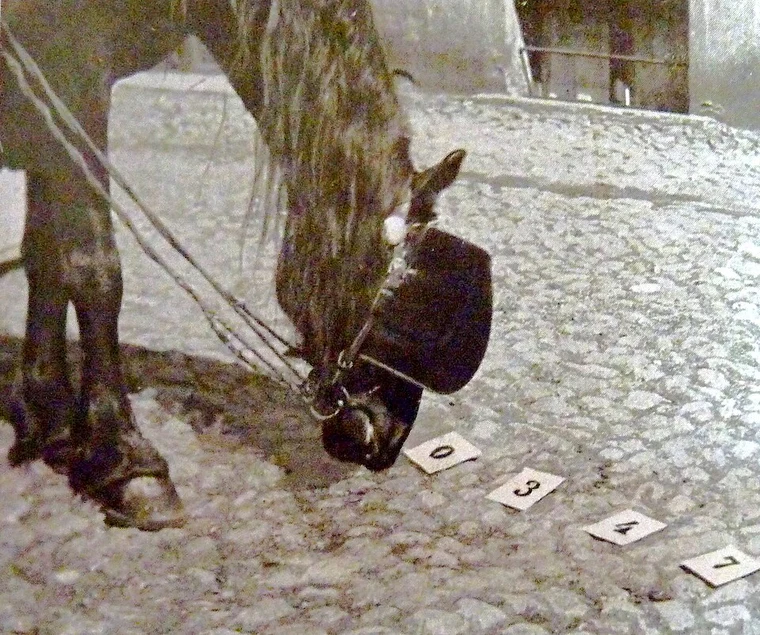
Clever Hans points with his nose to a numbered card, in a photograph from before 1912.. Image: Karl Krall, via Wikimedia Commons (Public domain)
Too generous or too stingy?
Scientists can get animal minds wrong in two directions: by seeing too much, or by seeing too little. Good animal cognition research guards against both errors.
In 1883, George Romanes built a book on anecdotes, including a story that called ants rescuing a trapped nestmate sympathetic help. In response, C. Lloyd Morgan proposed a rule now called Morgan's canon. Never explain an action by a higher mental ability if a lower one can explain it. Today the rule still has support. In a 2021 survey of 210 researchers, over 70 percent agreed it is important, though many added caveats.
On the other hand, caution can become a blind spot. Robert Hinde observed that fear of anthropomorphism had led researchers to reject many interesting phenomena. In 1999, Frans de Waal called this attitude anthropodenial. Clever Hans shows both errors. After his case, the idea that animals could grasp number met a backlash for most of the twentieth century. Interest returned in the early 1980s, with proper controls. Since then, many animals, from salamanders to apes, have proved sensitive to quantity, usually in an approximate way.
Even tiny animals need these controls in animal cognition studies. More dots usually cover more area, so an animal could choose by area alone. In a 2009 study, honeybees matched patterns by number of items after colour, total area and edge length were ruled out. Even so, the authors stopped short of claiming the bees were counting.
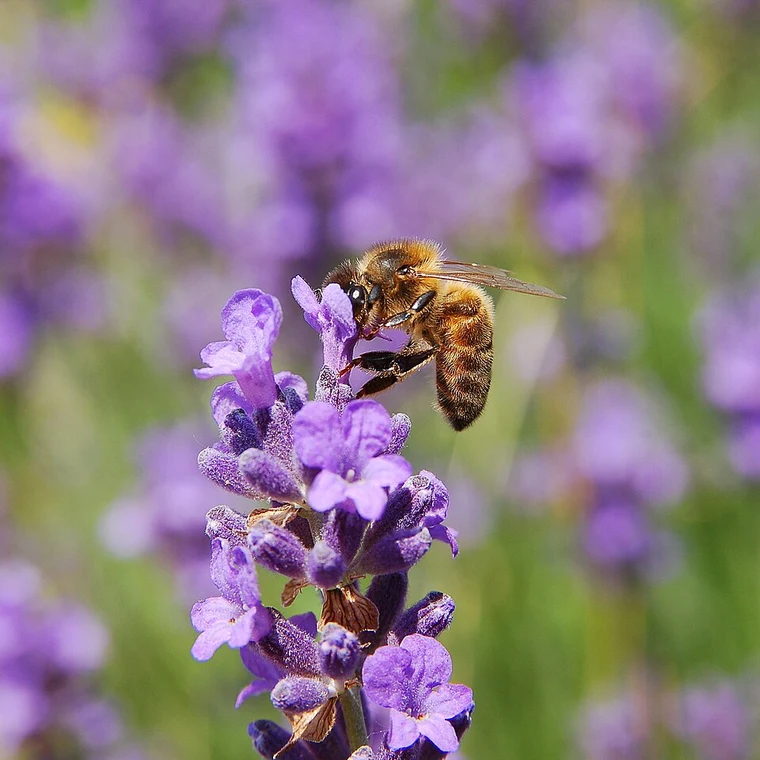
A western honeybee visiting lavender flowers in Belgium.. Image: Luc Viatour, via Wikimedia Commons (CC BY-SA 3.0)
A fair test of animal cognition for a different body
A fair test of animal cognition fits the animal's body and senses. When an animal fails, the test may be the thing that failed.
For example, elephants did poorly on earlier insight tests that asked them to hold a stick. But the trunk is also a nose, and its tip is as sensitive as a fingertip. Researchers at the Smithsonian National Zoo proposed that holding a stick may shut out smell and touch. So they hung fruit overhead instead. A young male, Kandula, moved a large plastic cube beneath it and stood on it, as the study reports. Similarly, dogs once seemed to lack object permanence. Later research found they were following a moving container instead of the hidden reward.
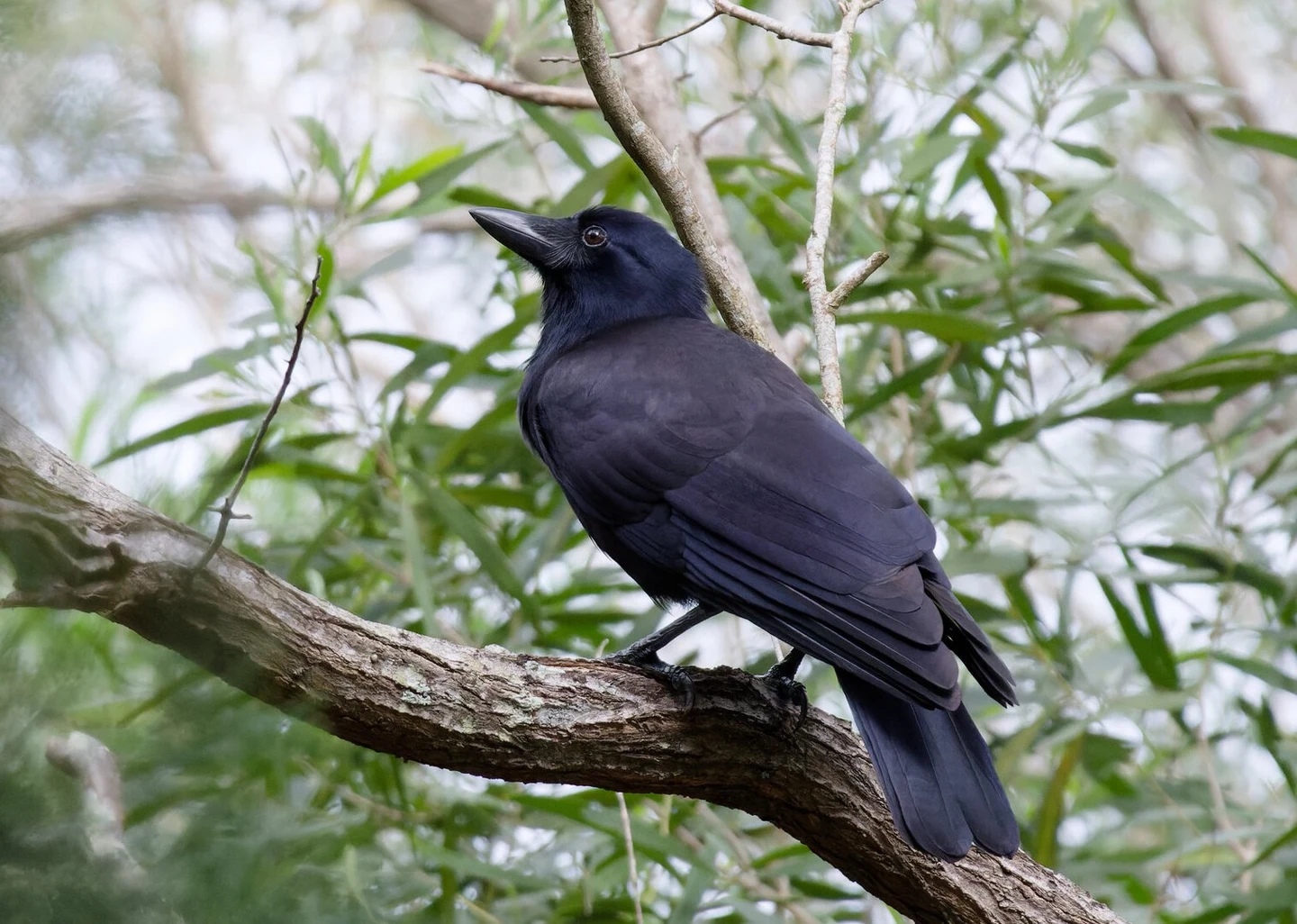
Crows show what a well-designed test can reveal. In Aesop's fable, a thirsty crow drops stones into a pitcher until the water rises. In 2014, researchers turned that story into six tasks for New Caledonian crows. The crows chose sinking objects over floating ones in 88 percent of choices. However, they failed a U-shaped tube with a hidden connection. The team judged their grasp sophisticated but incomplete. That mix of passes and failures tells you more about animal cognition than a single success would.
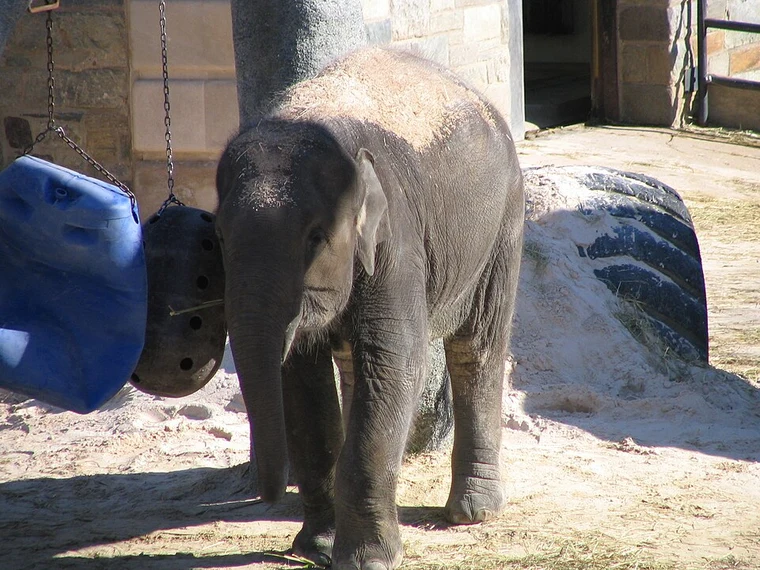
Kandula, an Asian elephant born at the Smithsonian National Zoo, at four years old in 2006.. Image: Rudi Riet, via Wikimedia Commons (CC BY-SA 2.0)
Did you know?
-
The common octopus has over half a billion neurons. Two thirds of them are in its arms, while the rest form a central brain between the eyes.
Brainy creatures — eLife Science Digest -
In 2014 tests, New Caledonian crows dropped sinking objects rather than floating ones into a water tube in 88 percent of choices. On a tube with a hidden connection, they performed at chance.
Using the Aesop's Fable Paradigm to Investigate Causal Understanding of Water Displacement by New Caledonian Crows — PLOS ONE -
In a 2021 survey of animal cognition researchers, nearly all agreed that replication is important, and most disagreed that enough replication studies are done.
The hidden side of animal cognition research — PLOS ONE
Star animals, many animals and no ladder of minds
In animal cognition research, a single famous animal shows what is possible, not what is typical. To learn what a species does, researchers need many animals, repeated tests and comparisons that respect each animal's way of life.
Take Betty, a captive New Caledonian crow. In 2002 she bent a straight wire into a hook to lift a food bucket from a tube. Her case was later cited as remarkable causal reasoning. Yet field research then showed that wild New Caledonian crows routinely bend their tools. Betty may have used a natural habit, or skills learned before capture. Edward Thorndike warned long ago that one remarkable case may not apply to a whole species.
Replication matters for the same reason. In the 2021 survey, researchers expected only about 65 percent of typical studies in their area to succeed if repeated. Fair comparisons are hard too, because most zoos and labs house only a few animals of each species. The ManyPrimates project pools many sites. Its first study tested 176 primates from 12 species at 11 sites on one short-term memory task.
Finally, many people picture animals on a ladder, with humans at the top and fish far below. In 2006, de Waal argued that this ladder idea is wrong. Groupers in the Red Sea, for instance, recruit giant moray eels to hunt with them. A honeybee brain holds fewer than a million neurons, yet bees choose flowers quickly and accurately. On this view, minds are many different solutions, not steps on one staircase.
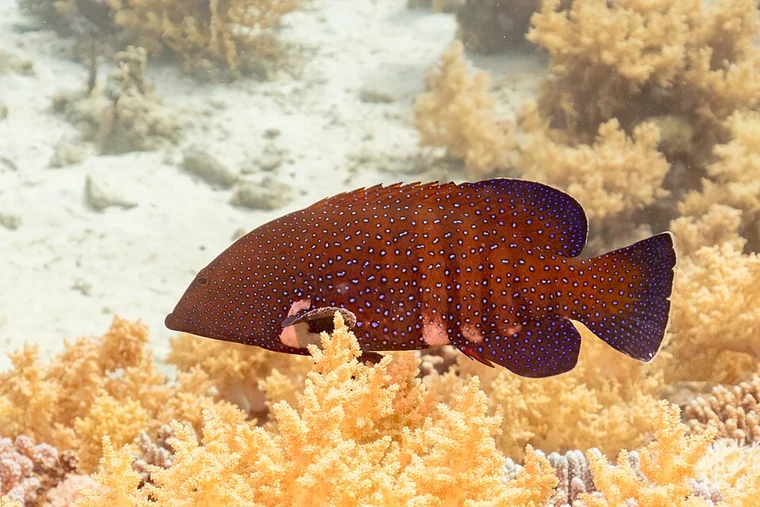
A roving coral grouper over soft corals in Ras Muhammad National Park, Egypt, in the Red Sea.. Image: Diego Delso, via Wikimedia Commons (CC BY-SA 4.0)
Frequently asked questions
- What is animal cognition in simple terms?
- Most researchers agree that animal cognition involves learning, memory and decision-making, which drive flexible behaviour suited to each animal's life. The field studies them in many species, from apes and crows to octopuses and bees.
- What was the Clever Hans effect?
- Clever Hans was a horse that seemed to solve sums by tapping his hoof. In fact, he stopped tapping when people made tiny, unnoticed movements at the right answer. His name now labels an animal reacting to a person's unintended cues.
- What is Morgan's canon?
- Morgan's canon is a rule proposed by C. Lloyd Morgan: never explain an action by a higher mental ability if a lower one can explain it. In a 2021 survey, over 70 percent of animal cognition researchers agreed it is important, often with caveats.
- What does anthropodenial mean?
- Anthropodenial is Frans de Waal's 1999 name for the opposite error to anthropomorphism. It means refusing to see real abilities in animals out of fear of seeing too much of ourselves in them.
- Which animal is the smartest?
- Many researchers think the question itself is the mistake. Frans de Waal argued in 2006 that the ladder from lower to higher animals is wrong. Each species is better judged by the tasks it faces in nature.
- Can bees count?
- In a 2009 study, honeybees matched groups of two and three items by number and told three from four, but failed with four against five. Controls ruled out colour, area and edge length. However, the authors stopped short of claiming the bees were counting.