What would count as language?
Before we can ask "do animals have language?", we need to define language. It is more than passing on information. Researchers treat it as a bundle of abilities, and so far animals show those abilities only in pieces.
Picture grabbing a pan that is too hot. You yelp, and everyone nearby learns that the pan is hot. However, you were not trying to tell them anything. You can choose to warn someone who was out of the room. You can also talk about the pan once it is gone. Many animal signals, such as alarm calls, look more like the yelp. They are fixed responses, given whether or not anyone is there to hear. That is communication, but it is not yet language, as a 2023 study of ape gestures explains.
In fact, human language combines several abilities. Signals refer to things in the world. Words combine by rules, and the meaning of a combination depends on its parts and how they are joined. Structures can sit inside one another. In addition, speakers learn their sounds from others. As a 2018 paper on bird call combinations notes, none of the great apes has a communication system nearly as complex or flexible. Yet studies have found some of these abilities, such as vocal learning and reference, in a range of other animals. So when people ask "do animals have language?", researchers answer one piece at a time.
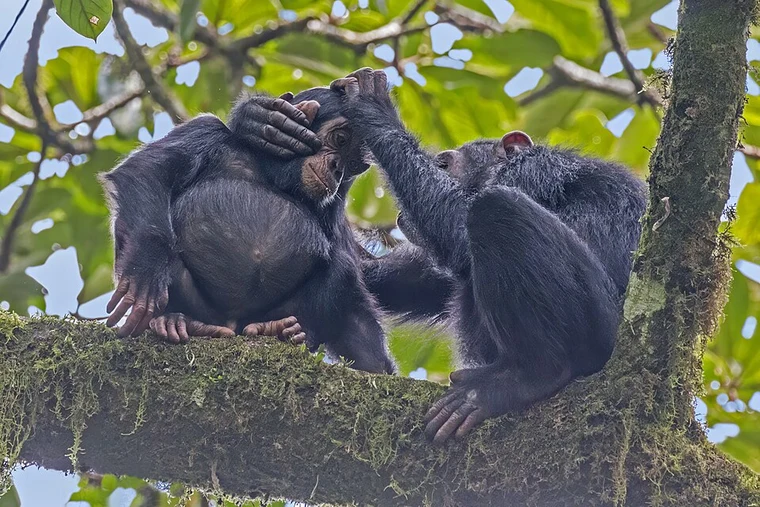
Two eastern chimpanzees grooming in Kibale Forest, Uganda.. Image: Charles J. Sharp, via Wikimedia Commons (CC BY-SA 4.0)
Bees and monkeys: do animals have language for food and danger?
Honeybees and vervet monkeys are classic test cases for the question "do animals have language?" Both have limits.
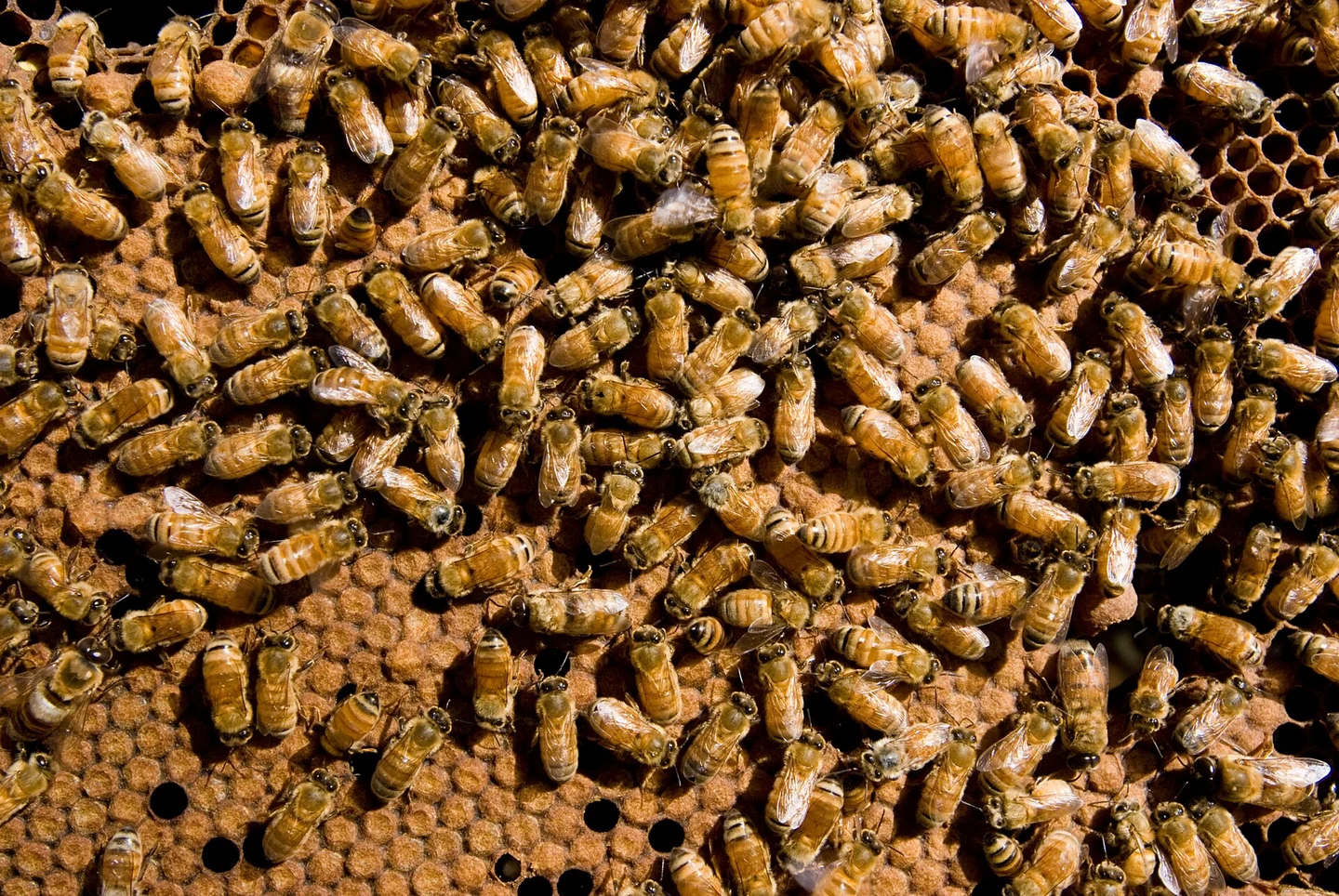
A foraging honeybee that has found food performs a waggle dance on the comb. How long her straight waggling run lasts tells hive mates how far away the food is. Its angle against gravity gives the food's direction relative to the sun. In 2005, researchers moved bees that had just followed a dance to release sites up to 250 metres away. The bees flew in the direction that would have reached the food from the hive.
In addition, a 2008 study found that Asiatic honeybees could decode the dances of European honeybees. The two species dance in different dialects. The waggle dance may be the only known symbolic communication in any animal without a backbone.
Vervet monkeys give different alarm calls for leopards, eagles and snakes. In a 1980 study, researchers played recorded alarms when no predator was present. Leopard alarms sent monkeys running into trees. Eagle alarms made them look up, and snake alarms made them look down. The monkeys responded as though each call stood for a different kind of danger.
Later work made the picture more complicated, however. A 2015 analysis, described in a 2020 review, found that some vervet alarm calls overlap in sound with calls given during fights. Listeners probably combine the call with their reading of the situation. A 2020 review of primate alarm calls noted that no study had yet seen nonhuman primates use their calls symbolically. So whether such calls work like words is still debated.
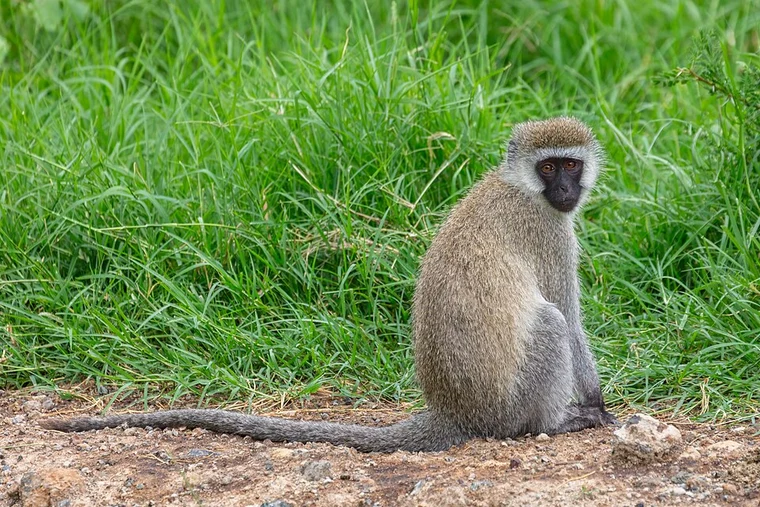
A vervet monkey in Lake Nakuru National Park, Kenya.. Image: Diego Delso, via Wikimedia Commons (CC BY-SA 4.0)
Calls in order: the first hints of grammar?
Some birds and apes combine calls, and the order seems to matter. For anyone asking "do animals have language?", this is where grammar enters the debate.
Japanese tits give an ABC call to warn of danger and a D call to gather others. When mobbing a predator, they join them as ABC-D. In playback experiments published in 2016, birds hearing ABC scanned for danger, and birds hearing D approached. Hearing ABC-D, they approached while scanning. Reversed D-ABC sequences drew weaker responses. The researchers call this the first firm evidence of compositional syntax in a nonhuman animal.
However, not everyone agrees. In a 2018 critique, Bolhuis and colleagues argued that human syntax builds structures nested inside other structures, without limit. In their view, there was still no convincing evidence of syntax-determined meaning in any nonhuman animal.
In a 2011 study, captive bonobos judged whole sequences of food calls, not single calls. Furthermore, in 2025 researchers reported that wild bonobos in the Democratic Republic of Congo combine calls too. These combinations often take meaning from their parts.
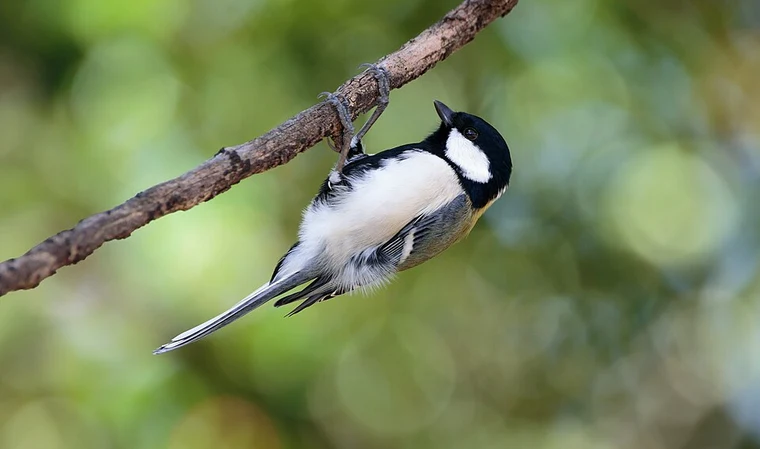
A Japanese tit in Suita, Osaka, Japan.. Image: Laitche, via Wikimedia Commons (CC BY-SA 4.0)
Names and songs: do animals have language-like labels?
Do animals have language for each other's names? Dolphins and elephants may call one another by something like a name. However, researchers have generally avoided calling these signals names, and the evidence varies in strength.
For example, each bottlenose dolphin has a signature whistle. It is learned, not inborn, and the identity sits in its rising and falling pitch, not in the voice. In 2013, researchers played wild dolphins a computer copy of each one's own signature whistle. The dolphins called back, while copies of other dolphins' whistles drew no such reply.
In 2024, Michael Pardo and George Wittemyer used machine learning on 469 wild elephant rumbles recorded in Kenya. Their model picked out which elephant a call was meant for 27.5% of the time, better than chance. Even so, they could not isolate the sound that served as a name.
Whale song shows another piece: learning sounds from others. Only a short list of animals clearly does this, including songbirds, parrots, some whales and dolphins, seals, elephants and bats. Among primates, only humans count without dispute, a striking twist of evolution. In a humpback population, the singing males share one changing song. New songs spread east across the South Pacific in about two years. Most researchers think the whales copy them. In contrast, Eduardo Mercado argued in 2022 that singers may change their songs in similar ways on their own.
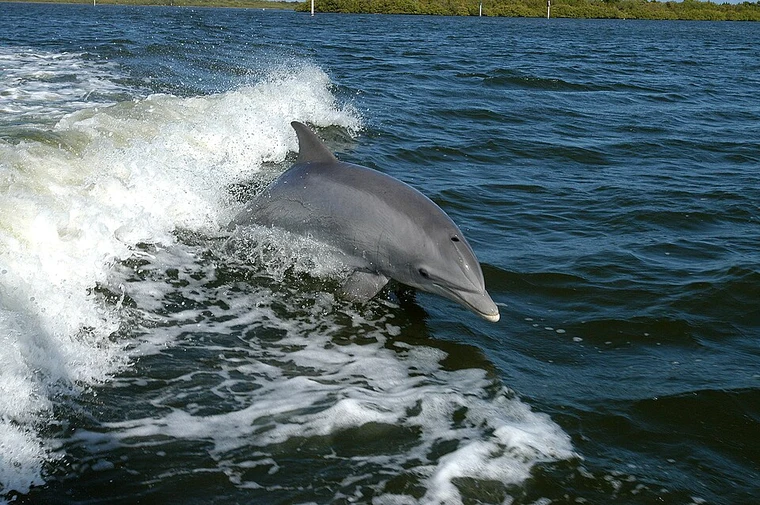
A bottlenose dolphin surfacing in a boat’s wake.. Image: NASA, via Wikimedia Commons (Public domain)
Did you know?
-
In a 2008 study of a mixed colony, Asiatic honeybees decoded the dances of European honeybees and found the food, although the two species dance in different dialects.
East Learns from West: Asiatic Honeybees Can Understand Dance Language of European Honeybees (PLoS ONE, 2008) -
A 2020 review noted that no study had yet seen nonhuman primates use their calls symbolically, as arbitrary signs fixed by convention.
Nonhuman primate alarm calls then and now (Animal Behavior and Cognition, 2020) -
In a 2011 playback study, captive bonobos searched harder at the feeding site that a four-call food sequence pointed to. They judged whole sequences, not single calls.
Bonobos Extract Meaning from Call Sequences (PLoS ONE, 2011)
Talking apes, AI translators and the honest answer
So, do animals have language? Not in the full human sense. On current evidence, several animals show real pieces of language, but none has been shown to combine them all.
Talking apes once seemed to promise more. Herb Terrace recorded every session with his chimpanzee, Nim Chimpsky. He found the trainers were unconsciously prompting the right signs. Nim's most famous string, sixteen signs long, only repeated requests such as give, orange, me and eat. After Terrace published, funding for ape language research was withdrawn, as a 2025 account describes.
The bonobo Kanzi, by contrast, tells a different story. He watched researchers try to teach his adoptive mother. He came to understand spoken English and to communicate with a lexigram board. In a 1993 test, Kanzi understood many spoken requests better than a two-year-old child. One example was "put the mushrooms in the cabinet". Still, that was one bonobo compared with one child.
Can AI translate animals? In 2016, a program could usually tell which Egyptian fruit bat was calling. In 2024, Project CETI described a sperm whale phonetic alphabet of click patterns, but what the variations mean is not yet known. A 2022 theory suggests translation may be feasible if a communication system is complex enough. Yet, as its authors put it, whales do not talk about smartphones.
To explore whether animals have language, Epivo's Animal Minds course includes Animal Talk. You learn in a dialogue with a personal AI tutor where you think out loud.
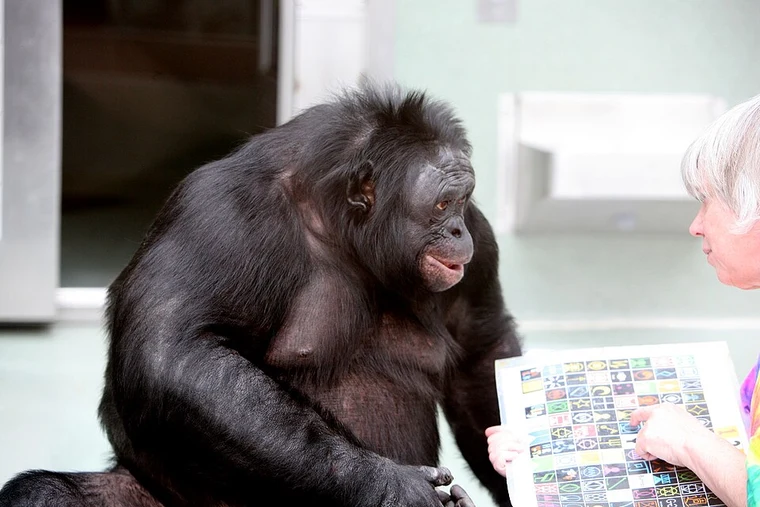
Kanzi converses with Sue Savage-Rumbaugh using a board of lexigram symbols, 2006.. Image: William H. Calvin, via Wikimedia Commons (CC BY-SA 4.0)
Frequently asked questions
- Do any animals have language like humans?
- No animal has been shown to have a full language like ours. Researchers see language as a bundle of abilities: signals that refer, combinations built by rules, nested structure and sounds learned from others. Several animals show possible pieces, such as vervet alarm calls and Japanese tit call combinations, though researchers still debate how word-like or grammar-like these are.
- What is the difference between animal communication and language?
- Communication is any passing on of information, even by accident, like a yelp at a hot pan. Language goes further. A speaker can choose to tell someone, talk about things that are absent, and combine words by rules so that the parts and their order shape the meaning.
- Do dolphins have names?
- Each bottlenose dolphin has a learned signature whistle that identifies it. In 2013, wild dolphins called back when they heard a computer copy of their own whistle. Close companions sometimes copy each other's whistles, perhaps to address one another. Even so, researchers have generally avoided calling these signals names.
- Did any ape ever learn human language?
- No ape has been shown to learn a full human language. Project Nim found that trainers were unconsciously prompting the chimpanzee's signs. The bonobo Kanzi came to understand many spoken English requests and used a lexigram board, but these results come from one bonobo.
- Can AI translate what animals are saying?
- Not yet. Machine learning can identify individual Egyptian fruit bats from their calls and has mapped patterns in sperm whale clicks. What those calls mean remains unknown. A 2022 theory suggests translation may be feasible for a complex enough system, but as its authors note, whales do not talk about smartphones.